Click this link~
The Many Mistresses Of Martin Luther King and the politics of race in America
Thursday, March 29, 2012

Thursday, February 23, 2012
Yea!!! It's Winter - Get Out and Play!!!
I know many of you have been skiing for years, but for others looking for new ways to experience the winter months, let yourself be inspired by the article below. I hope you're enjoying each season and all climates, no matter where you find yourself on our awesome planet!
Have fun,
Kentke
New York Ski Club Adds Black Faces to the Slopes
By LIZ LEYDEN
Published: February 20, 2012
QUEENSBURY, N.Y. — It was nearly time for lessons to begin, but Marcel and Kwesi could not be found. The West Mountain ski school director hurried into the rental shop looking for the missing students. Other members of the Nubian Empire Ski Club filled the benches, snapping stiff buckles into place.
Omoye Cooper, the club’s president, stood among the bent bodies, sorting tickets and fielding questions, including this latest: Where were Marcel and Kwesi?
Ms. Cooper pointed out the window toward the base lodge.
“You’ll see them,” she said, laughing. “They’re probably the only brown boys in there.”
At the small mountain about an hour north of Albany, the faces buried beneath helmets and neck gaiters were mostly white. But scattered among them were the Nubians, whose mission is to coax more African-Americans onto skis.
When Phil Littlejohn moved to the Albany area around 2001, he immediately saw what was missing. Mr. Littlejohn, 74, who first skied in the Poconos when he was 28, had joined black ski clubs wherever he lived.
“In Albany, there was no black ski club, and this is the gateway to ski country,” he said. The problem, he said, was “lack of exposure.”
“So many African-Americans don’t know what a great, great addition to their life skiing becomes,” he said.
In 2001, he and a skiing novice, Peggie Allen, persuaded a dozen people who had never skied to try. They named the group in honor of the black people of southern Egypt, and so began what Mr. Littlejohn described as a “labor of love.”
The Nubian Empire Ski Club, which is based in Albany, has since grown to more than 40 members: experts and beginners, first graders and retirees, professors and accountants. They have skied most mountains in New York and as far away as Chamonix-Mont-Blanc in the French Alps.
This season, despite a lack of snow, the club’s youth program has drawn nine participants. On a recent Sunday they gathered on the bunny trail at West Mountain for their second lesson of the season. Brown grass edged the trails, but no one seemed to mind, soon caught up in the silly language of learning: Pizza stop. Duck walk. Sit low to slow.
Do you remember when we couldn’t even turn?” one little girl shouted to the boy beside her. “When we used to fall and fall?”
Nisha Thomas, a 31-year-old employee in the state comptroller’s office, was one of three adults in the group of beginners. That Ms. Thomas ignored an oncoming cold to do so was as surprising to her as was the fact that she let Ms. Cooper, her mother-in-law, talk her into skiing at all.
“I’m from the Caribbean,” said Ms. Thomas, who lives in Albany. “I didn’t grow up dreaming about snow. I think this club helps because it’s a sort of mentorship.”
The Nubian Web site brims with instructions that people accustomed to winter sports take for granted, like layering on synthetic clothes and sunscreen, as well as the reason for buying water-resistant snow pants: “Your first day will acquaint your butt with the snow. Keep it warm and dry!”
Off-season, club members appear wherever they might find new recruits, visiting Kwanzaa and Juneteenth celebrations and setting up information booths in Walmarts.
When skeptics tell them “black people don’t ski,” Ms. Cooper notes that the National Brotherhood of Skiers, a black organization that formed in 1973, has 3,000 members. It has 59 member clubs, including three in New York City.
Kimberly Barksdale, executive secretary of the group, said that for people who did not grow up with snow sports, the clubs provided critical support.
“Our people in the clubs love to ski, and they also love to help others learn to,” Ms. Barksdale said. “They walk them through everything and really make sure they have a good time. And that sense of camaraderie makes it so much more likely that people stay with the sport.”
Of 67,000 skiers who responded to a question in a survey conducted by the National Ski Areas Association at the end of the 2010-11 season, 2 percent identified themselves as African-American.
Audrey Bennett, a communications professor at Rensselaer Polytechnic Institute in Troy, said she heard about the Nubians through word of mouth two years ago. Though her son Marcel was sure he would hate skiing, Ms. Bennett, 40, pushed him to try it. Now, Marcel, 14, races giant slalom and is applying to ski academies.
“I loved it after the first run,” he said. “I felt like I was free, like I was flying down the mountain. All my stresses disappeared.”
By noon, most everyone on the beginner slope at West Mountain had turned toward the lodge for lunch — everyone but three small children who scooted back for one more run.
“Look, they snuck back up,” Ms. Cooper said, smiling. She watched the three, remembering her own beginnings on skis.
“I wanted to conquer that hill, not let it conquer me,” she said. “And then I was going to quit.”
But it was too late. “It was too addictive,” she said.
The children snaked down the hill. Wide smiles filled their faces as they reached the bottom without falling. Before they could jump back in line, Ms. Cooper glided toward them.
“Do not go back up,” she said. “We are going in for lunch. Exit stage left. Don’t worry. We’ll be back out.”
Click this link to view the 10 photo slide show:
Published: February 20, 2012
QUEENSBURY, N.Y. — It was nearly time for lessons to begin, but Marcel and Kwesi could not be found. The West Mountain ski school director hurried into the rental shop looking for the missing students. Other members of the Nubian Empire Ski Club filled the benches, snapping stiff buckles into place.
Omoye Cooper, the club’s president, stood among the bent bodies, sorting tickets and fielding questions, including this latest: Where were Marcel and Kwesi?
Ms. Cooper pointed out the window toward the base lodge.
“You’ll see them,” she said, laughing. “They’re probably the only brown boys in there.”
At the small mountain about an hour north of Albany, the faces buried beneath helmets and neck gaiters were mostly white. But scattered among them were the Nubians, whose mission is to coax more African-Americans onto skis.
When Phil Littlejohn moved to the Albany area around 2001, he immediately saw what was missing. Mr. Littlejohn, 74, who first skied in the Poconos when he was 28, had joined black ski clubs wherever he lived.
“In Albany, there was no black ski club, and this is the gateway to ski country,” he said. The problem, he said, was “lack of exposure.”
“So many African-Americans don’t know what a great, great addition to their life skiing becomes,” he said.
In 2001, he and a skiing novice, Peggie Allen, persuaded a dozen people who had never skied to try. They named the group in honor of the black people of southern Egypt, and so began what Mr. Littlejohn described as a “labor of love.”
The Nubian Empire Ski Club, which is based in Albany, has since grown to more than 40 members: experts and beginners, first graders and retirees, professors and accountants. They have skied most mountains in New York and as far away as Chamonix-Mont-Blanc in the French Alps.
This season, despite a lack of snow, the club’s youth program has drawn nine participants. On a recent Sunday they gathered on the bunny trail at West Mountain for their second lesson of the season. Brown grass edged the trails, but no one seemed to mind, soon caught up in the silly language of learning: Pizza stop. Duck walk. Sit low to slow.
Do you remember when we couldn’t even turn?” one little girl shouted to the boy beside her. “When we used to fall and fall?”
Nisha Thomas, a 31-year-old employee in the state comptroller’s office, was one of three adults in the group of beginners. That Ms. Thomas ignored an oncoming cold to do so was as surprising to her as was the fact that she let Ms. Cooper, her mother-in-law, talk her into skiing at all.
“I’m from the Caribbean,” said Ms. Thomas, who lives in Albany. “I didn’t grow up dreaming about snow. I think this club helps because it’s a sort of mentorship.”
The Nubian Web site brims with instructions that people accustomed to winter sports take for granted, like layering on synthetic clothes and sunscreen, as well as the reason for buying water-resistant snow pants: “Your first day will acquaint your butt with the snow. Keep it warm and dry!”
Off-season, club members appear wherever they might find new recruits, visiting Kwanzaa and Juneteenth celebrations and setting up information booths in Walmarts.
When skeptics tell them “black people don’t ski,” Ms. Cooper notes that the National Brotherhood of Skiers, a black organization that formed in 1973, has 3,000 members. It has 59 member clubs, including three in New York City.
Kimberly Barksdale, executive secretary of the group, said that for people who did not grow up with snow sports, the clubs provided critical support.
“Our people in the clubs love to ski, and they also love to help others learn to,” Ms. Barksdale said. “They walk them through everything and really make sure they have a good time. And that sense of camaraderie makes it so much more likely that people stay with the sport.”
Of 67,000 skiers who responded to a question in a survey conducted by the National Ski Areas Association at the end of the 2010-11 season, 2 percent identified themselves as African-American.
Audrey Bennett, a communications professor at Rensselaer Polytechnic Institute in Troy, said she heard about the Nubians through word of mouth two years ago. Though her son Marcel was sure he would hate skiing, Ms. Bennett, 40, pushed him to try it. Now, Marcel, 14, races giant slalom and is applying to ski academies.
“I loved it after the first run,” he said. “I felt like I was free, like I was flying down the mountain. All my stresses disappeared.”
By noon, most everyone on the beginner slope at West Mountain had turned toward the lodge for lunch — everyone but three small children who scooted back for one more run.
“Look, they snuck back up,” Ms. Cooper said, smiling. She watched the three, remembering her own beginnings on skis.
“I wanted to conquer that hill, not let it conquer me,” she said. “And then I was going to quit.”
But it was too late. “It was too addictive,” she said.
The children snaked down the hill. Wide smiles filled their faces as they reached the bottom without falling. Before they could jump back in line, Ms. Cooper glided toward them.
“Do not go back up,” she said. “We are going in for lunch. Exit stage left. Don’t worry. We’ll be back out.”
Click this link to view the 10 photo slide show:
Websites:
Nubian Empire Ski Club - http://www.nubianempireski.org/
National Brotherhood of Skiers - http://www.nbs.org/
National Brotherhood of Skiers - http://www.nbs.org/
Thursday, February 16, 2012
Oakland Museum of California's Question Bridge Panel Delves Deep into Black Manhood (Review/Reflection)
 Arnold Perkins and Joshua Merchant ruminate during the Question Bridge panel discussion.
Published on Tuesday, February 14, 2012
Oakland Local Online
By Eric K. Arnold
One of the deeper discussions on black male identity in recent memory took place this past Saturday at the Oakland Museum of California. The event - a roundtable panel discussion between several generations of black me, age 17-70 – was part of OMCA’s programming around Question Bridge: Black Males, an exhibit currently showing simultaneously at the Brooklyn Museum, Salt Lake City Arts Center and Atlanta’s Castain Arts gallery (earlier this year, it also was shown at the Sundance Film Festival).
One of the deeper discussions on black male identity in recent memory took place this past Saturday at the Oakland Museum of California. The event - a roundtable panel discussion between several generations of black me, age 17-70 – was part of OMCA’s programming around Question Bridge: Black Males, an exhibit currently showing simultaneously at the Brooklyn Museum, Salt Lake City Arts Center and Atlanta’s Castain Arts gallery (earlier this year, it also was shown at the Sundance Film Festival).
Question Bridge is somewhat of an onomatopoeia of a video installation: It’s exactly what it sounds like – a Q&A exchange, which bridges the generation gap among African-American men from the hip-hop and Civil Rights generations. The installation, which runs through July 8 at OMCA, consists of 1,500 video exchanges between 150 black men recruited from 11 cities, including Oakland and San Francisco, along with Chicago, New York, New Orleans, Birmingham, Atlanta and Philadelphia, and collected by Chris Johnson, Hank Willis Thomas, Kamal Sinclair and Oakland’s own Bayete Ross-Smith.
Why is this a big deal? Well, for one, it shatters many commonly-held stereotypes about black men - that they are angry, unemotional, non-communicative, inarticulate and blame racism for everything that has happened to them. Watching the exhibit, one is forced to reexamine one’s perceptions about African-American males. It’s a big rethink.
The afternoon began with a performance by Motif Performance Project with choreographer Rashad Pridgen, developed especially for Question Bridge, followed by a roundtable forum, which recreated much of the format of the exhibit, but in 3-D (rather than the two-dimensional back and forth of the video screens) with real, live, actual black men.
The panel included moderator Chris Chatmon, the Oakland Unified School District's executive officer of African-American Male Achievement, and a stellar group of panelists, including actor Delroy Lindo; spoken word artists Ise Lyfe and Joshua “Adonis” Merchant; photographer Pendarvis Harshaw; educators Greg Hodge; youth worker Abbas Khalid; social justice activist Abel Habtegeorgis; retired public health official Arnold Perkins; and student Sean Johnson.
If anything, the panel discussion - whose starting point was the question, "Why didn’t you leave us with the blueprint,” posed by a hip-hop generationer to a Civil Rights-era veteran - went even deeper into the African-American male psyche than the exhibit. Instead of a singular or small group learning experience, as might be expected of a museum viewing, the presence of an audience made for a more public experience and a stronger connection to community. Additionally, follow-up questions were asked and answered in real time.
Before the panel began, Question Bridge co-director Chris Johnson explained how speaking about the topic “really articulated truths” about the generational divide between black men, while addressing the lack of a “direct connection” between the hip-hop and Civil Rights eras.
If the purpose of Question Bridge was to address that disconnect and repair the hurt caused by it, it succeeded. First, the younger generation asked questions of the elders; then the elders asked questions from younger people. But who qualified as what wasn’t immediately apparent. Habtegeorgis noted that he was included in the group of community elders, yet was only 27.
Hodge cleared that up, however, by noting that “everybody here is somebody’s elder.”
During the panel, several revealing exchanges between the participants occurred, such as when Harshaw queried, “When do you learn how to tie a tie?”
“That is so profound,” Lindo replied, before recounting an anecdote about being on the way to rapper Heavy D’s funeral and being asked by a young black man he was riding with to tie his tie. Lyfe followed with his own anecdote, about being 22 years old, being invited to a black-tie event to accept an award and realizing he didn’t know how to tie a tie.
“I was so embarrassed,” he recalled. Later, he went to the library and checked out an etiquette book.
Johnson, the youngest panelist, discussed when he considered dropping out of high school. When asked why, he mentioned poor math grades and noted that Skyline has almost 500 juniors and just one counselor for them. Other panelists chimed in with supportive words.
“Frederick Douglass cajoled his education out of white people. Get the help,” Hodge said.
The difference, Lyfe said, between being 17 and 27 was having perspective on life.
“You can’t condemn yourself to a moment,” he added.
The panel resulted in many other quotable soundbites. Here are a few of the most notable and profound quips:
“Who are we considering young [people]?” (Lindo)
“If I’m 20 and a brother’s 80, asking me what to do … You had a 60-year-head start. That’s terrifying.” (Lyfe)
“Do my skinny jeans and non-prescription glasses make me safer walking around my neighborhood?” (Merchant)
“When will sagging go out of style?” (Hodge)
[As black men,] “We’re all going to be judged, all the time.” (Lindo)
“Why is it so hard for us to call ourselves African?” (Perkins)
“I am of African descent, but I am from Oakland” (Harshaw)
“It’s so normalized, not having your father in your life.” (Lyfe)
“Seventy-five percent of people I know, their father hasn’t been in their lives.” (Khalid)
“Since I was in the sixth grade, my dad has been in and out of jail.” (Khalid)
“We have to break the cycle.” (Khalid)
“Even [white people’s] resistance … is full of valor and vigor and privilege: ‘We occupying this.’” (Lyfe)
“Why are so many black people dying in Chicago when Barack Obama’s in office?” (Harshaw)
“For me, the blueprint is education because it created tremendous power in daily life.” (Perkins)
“Our charge is to be that continuum.” (Harshaw)
“What I need from elders and community leaders is the play.” (Lyfe)
“The fact of the matter is the goal posts shift all the time.” (Lindo)
 An audience member asks a question as Chris Chatmon and Delroy Lindo look on.
Overall, the panel discussion offered two solid hours of deep reflection, brutal honesty, brave vulnerability – and a glimpse behind the cool pose and beyond the mean mug. It transcended both the saggy-pants conundrum and the Cosby-syndrome of misunderstanding. It created, as intended, the blueprint for discourse, giving hope that the elder generation and the youth will one day be able to see eye to eye.
Perhaps the most remarkable aspect of this landmark intergenerational dialogue? Not once was the word “racism” mentioned.
Click here to visit the article, for a slideshow of images from the video installation.
Kentke
http://oaklandlocal.com/article/omca’s-question-bridge-panel-delves-deep-black-manhood-reviewreflection
About Eric K Arnold
Eric K. Arnold has been writing about urban music culture since the mid-1990s, when he was the Managing Editor of now-defunct 4080 Magazine. Since then, he’s been a columnist for such publications as The Source, XXL, Murder Dog, Africana.com, and the East Bay Express; his work has also appeared in the San Francisco Chronicle, Vibe, Wax Poetics, SF Weekly, XLR8R, the Village Voice and Jamrock, as well as the academic anthologies Total Chaos and The Vinyl Ain’t Final. Eric began his journalistic career while DJing on college radio station KZSC, and remembers well the early days of hip-hop radio, before consolidation, and commercialization set in. He currently lives in Oakland, California.
Thursday, February 2, 2012
I am the first to declare South Africa has found it's own Condeleezza Rice

Lindiwe Mazibuko
Delusions ... and Illusions...
or ...When a Tool Doesn't Know that it's Being Mis-Used...
Uhmm......What to name this post!?!??!!!!
Since Nelson Mandela left the office of President of South Africa, I don't believe that the voices, needs and dreams of the masses of the nation, --- those Africans whose potential was most denied and retarded by the system of apartheid and the white supremist thinking of the regime --- have yet to be handed their proper place in the nation's priororities.
I visited South Africa in 1967. At the time in order for me (and 14 other young Black women) to walk the streets of Capetown and Durban without being arrested for having none of the documents that would allow Blacks to freely walk the streets of these cities, the Parliament had to pass a special law for our two week visit. Eversince my law-changing visit, I've followed the history and politics of the nation.The article below is therefore quite interesting to me. But it should also be of interest to all that stood up to free that nation from apartheid.
As my opening paragraph mentioned, I don't think the work is finished there. So I hope we'll all pay attention, and watch the "new" tactics afoot....or maybe not so knew.
The article will introduce you to a young woman that being the prescient mystic that I am, I can see assuming a role in South African politics similar to the one played by Condeleezza Rice for the Republican party on the American political stage. We had "Condi", and they are about to get their dose of "Lindi" who now leads the Democratic Alliance, the party in opposition to the African National Congress in South Africa's Parliament.
There are similarities in the backgrounds of the two women. Both come from middle class households, with traditional values. It also seems that their alliegence to their political parties began because they were impressed by a kindness which either they or their family experienced at the hands of the party they now support. Both women also share a strong love of music, and began their college studies pursuing music degrees.
Also each enjoyed the opportunity of close and personal involvment with the theoreticians of their parties. This fostering later resulted in their quick rise to positions of importance and leadership. For as both parties carry the banner of the white the political establishment in their countries, they understand that they must at least attempt to reach out to Blacks and people of color, and also demonstrate that women are important in their vision. With women such as Condi and Lindi, on their teams, they get a real bargain. Especially with their apparent preference for the status quo. There are many articles on Lindiwe Mazibuko, so google her and get your own feel for this new face on the scene.

Oh, and both women, have nice smiles.
Kentke
A South African Party’s New Face, and Lightning Rod
January 27, 2012
CAPE TOWN
CAPE TOWN
SHE has unmistakably African roots, from her birthplace (the kingdom of Swaziland) to one of her native tongues (isiZulu) to her mocha skin.
But for many people, Lindiwe Mazibuko is just not black enough.
During a parliamentary session this year, a government minister here called her a coconut (white on the inside, brown on the outside). One political opponent described Ms. Mazibuko as the tea girl, or servant, for the leader of the country’s chief opposition party. Twitter users have flung racial slurs at her, called her a token and said she was naïve.
Even a member of her own party was quoted as saying that when you closed your eyes and listened to Ms. Mazibuko, “you would say a white person is talking to you.”
There is a profound ambivalence surrounding Ms. Mazibuko, 31 — and it represents the stiff challenge facing her party, the Democratic Alliance, in its effort to wrestle power from the dominant governing party, the African National Congress.
Ms. Mazibuko became the first black leader of the alliance’s parliamentary caucus after an internal party vote in October. She is now the face of an effort to diversify the party’s leadership, shed its stereotype as the party of South Africa's white elite and give it any hope of catching up to the A.N.C., which captured more than 65 percent of the vote to the alliance’s 16 percent during the last national election in 2009.
Yet Ms. Mazibuko remains dogged by critics who say her private school education and refined British accent are signs that she is out of touch with most black South Africans. Critics have said that her party pushed Ms. Mazibuko into the second most powerful position, despite her inexperience, simply because she was black and might help broaden the alliance’s appeal.
“She can only attract a particular type of black, young person, not the whole spectrum of black, young people,” said Baleka Mbete, the chairwoman of the A.N.C. “I don’t think the people she would attract are the majority.”
BUT what opponents view as Ms. Mazibuko’s weakness, her party, supported by about 5 percent of black South Africans, sees as potential.
There is an untapped population of young black voters raised in middle-class environments like Ms. Mazibuko’s, voters who talk like her, were born after apartheid and will be able to vote for president for the first time in 2014. The Democratic Alliance’s hope is that those voters do not feel the same emotional attachment as their elders to the A.N.C., which liberated blacks from apartheid. Instead, the alliance hopes that young blacks will look to leaders like Ms. Mazibuko as someone who represents their interests.
The D.A. has to grapple with the perception that it is a white party and it is interested in preserving white privilege,” said Sejamothopo Motau, a member of Parliament for the alliance. “Its leadership has to reflect that the party has gone beyond that — that the party is a party of all South Africans. So having Lindiwe as one of the two leaders of the party at the national level is quite significant.”
Yet one of Ms. Mazibuko’s loudest critics was a member of her own party, Masizole Mnqasela, a member of Parliament, who wrote a letter months ago to the party’s leader, Helen Zille, saying that Ms. Mazibuko “does not have a strong resonance with the black constituencies, and it will defeat our objective of trying to attract black votes.”
Mr. Mnqasela, facing disciplinary charges from his party because of those and other comments, was more supportive in an interview, saying, “It is an opportunity to have a black leader, and especially a black woman — it is an opportunity in itself for the organization.”
Ms. Zille, one of Ms. Mazibuko’s biggest supporters, said it was ridiculous to suggest that Ms. Mazibuko was elected only because she was black.
“Can’t people be judged for who they are?” Ms. Zille asked. “She’s highly intelligent, she’s very capable, she’s extremely articulate, she’s a very good politician and she’s black.”
Ms. Mazibuko has maintained a tough exterior amid the questions about her blackness, saying she has heard them since her childhood. Suggesting that all black people must be a certain way was an apartheid way of thinking, she said. During some of her radio appearances, she said, people called in demanding to hear her speak isiZulu.
“I refuse to do that,” she said. “I don’t believe being black is a prize people can award to you.”
Ms. Mazibuko was born in the tiny kingdom of Swaziland, tucked between South Africa and Mozambique. Her father was a banker and small-business owner, and her mother was a nurse.
When she was 6, her parents moved the family to apartheid-torn South Africa, believing that, despite the racism, the country would provide them with new opportunities.
For six years, Ms. Mazibuko lived in Umlazi, a black township, but her family maintained her middle-class lifestyle. She attended a Jewish school because her parents could not get her into the Catholic school. Every June 16, on the anniversary of the Soweto uprising, a protest in 1976 against the education system under apartheid, her parents sneaked her past street demonstrations to get her to school, even going so far as hiding her in the trunk of their car, she said.
After her father died, her mother moved the family to an affluent neighborhood in north Durban in 1992. Ms. Mazibuko went off to an Anglican boarding school.
POLITICS were never big in her household.
She said she voted for the A.N.C. in her younger days because “that’s what I thought black people did.”
Her inner politician began surfacing after she moved to England to study classical singing.
The Sept. 11 terrorist attacks happened, and she was disturbed by the way Muslims were negatively portrayed. It smacked of the racism that had defined South African politics, she said, and had the feel of the crusades.
“It made me pause, and it made me think about things I could do in the future, I suppose, to shed a bit of light on that,” Ms. Mazibuko said.
At the same time, she was looking at South Africa from afar and began to change her view of the role government should play in people’s lives. Whereas township life had led her to believe that government needed to pull people up, she said, she began to adopt the view that government empowers people to help themselves.
She left her music studies to pursue political journalism. While working on a research paper on Ms. Zille for an honors degree, Ms. Mazibuko said, she found common ground with the party’s leader and its politics. Ms. Mazibuko parlayed the assignment into a job as a researcher for the Democratic Alliance. In 2009, she was appointed the party’s national spokeswoman and selected by it to serve in Parliament.
When she speaks about her value to the party, Ms. Mazibuko mentions her age before her race, saying it gives her the ability to communicate in a different way from that of party veterans.
When she ran for parliamentary leader, she hired a media strategist and ran a public campaign, the first time that had been done for one of the alliance’s internal elections.
When she ran for parliamentary leader, she hired a media strategist and ran a public campaign, the first time that had been done for one of the alliance’s internal elections.
“Because of that, a number of members of Parliament were pressurized by their own constituencies to support her,” said Ian Ollis, an alliance member in Parliament who supported Ms. Mazibuko. “For the first time, we saw constituencies telephoning their member of Parliament and saying, ‘I want you to vote for Lindiwe Mazibuko.’ ”
But in her Twitter messages, politics take a back seat to intimate life details, like what she is cooking for dinner or how she styles her hair.
When one user asked whether she should wear a hair weave or braids, Ms. Mazibuko responded, “Braids, so you can hit the beach this summer,” under the hash tag “blackgirlsolutions.”
Sunday, January 29, 2012
Lone Wolf's Trek Makes History ~ All in Search of A Mate
 Officials say this image from a trail camera in south Oregon is probably of OR7
Hey! The month for celebrating Love, Unions and Harmonious Companionship is Just Around the Corner... and nothing is more precious to all mammals than to feel the presence of acceptance, warmth and affection~
A year or so ago, I showed you the winning photo in an international wildlife photo competition that depicted a wolf jumping a fence in darkness. As you can see here, it was a stunning image, but alas, it turned out to be staged, and the photographer was stripped of his prize.

Spanish Wolf
Well here's a story a lot closer to reality, and also, one that's being told in 'real time', as this grey wolves movements are being tracked by GPS systems.
You know that I'm part canine at heart thanks to my gift of time as Anubis' mother. And the wikipedia says that the origin of the domestic dog~ Canis lupus familiaris ~began with the domestication of the gray wolf~ Canis lupus ~ several tens of thousands of years ago. I love the Canidae Family. Wonderful animals, lifemates and wonderful teachers.....

Montana Wolf
lovu,
Kentke
SAN FRANCISCO — On the Chinese calendar, this week ushers in the year of the dragon. But here, it feels a lot more like the year of the wolf.
On Dec. 28, a 2 1/2 -year-old gray wolf crossed the state line from Oregon, becoming the first of his species to run wild here in 88 years.
On Dec. 28, a 2 1/2 -year-old gray wolf crossed the state line from Oregon, becoming the first of his species to run wild here in 88 years.
His arrival has prompted news articles, attracted feverish fans and sent wildlife officials scrambling to prepare for a new and unfamiliar predator.
“California has more people with more opinions than other states,” said Mark Stopher, senior policy adviser for the California Department of Fish and Game. “We have people calling, saying we should find him a girlfriend as soon as possible and let them settle down. Some people say we should clear humans out of parts of the state and make a wolf sanctuary.”
The wolf, known to biologists as OR7, owes his fame to the GPS collar around his neck, which has allowed scientists and fans alike to use maps to follow his 1,000-mile, lovelorn trek south from his birthplace in northeastern Oregon.
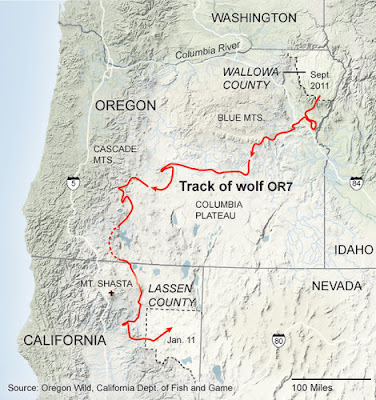
Along the way, OR7 has accrued an almost cultlike status.
“People are going to get wolf tattoos, wolf sweaters, wolf key chains, wolf hats,” said Patrick Valentino, a board member with the California Wolf Center, a nonprofit advocacy and education organization.
In Oregon, students participated in art contests to draw OR7’s likeness and a competition to rename him (the winner: “Journey”). This month, people across the country attended full-moon, candlelight wolf vigils organized by groups with names like Howl Across America and Wolf Warriors.

John Stephenson, a biologist, measured the stride of the gray wolf known as OR7 in Crater Lake National Forest, Ore., in December.
As with seemingly all wayward and famous animals these days, the wolf has a lively virtual existence on social networking sites like Twitter, where at least two Twitter accounts have been posting from the wolf’s perspective.
“Left family to find wife & new home. eHarmony just wasn’t working for me,” read one Twitter profile. Another account, which describes the wolf’s hobbies as “wandering, ungulates,” recently had in a post: “Why is everyone so worried about my love life?”
The wolf’s presence has also set off more practical responses from state wildlife officials, who are hustling to prepare for what they now see as the inevitability of wild gray wolves here.
In mid-January, the California Department of Fish and Game put up a gray wolf Web site that includes a map of OR7’s trek and a 36-page explainer on the species. The department has already begun a series of public meetings with local governments in the state’s northern counties, where wolves are most likely to take up residence first.
Biologists say that OR7 is unlikely to survive long hunting alone without a pack and that it could be as many as 10 years before wild wolf packs roam northern California. Still, state and federal wildlife officials met Friday to discuss a strategy for wolves.
Next month, state biologists will get training by the Agriculture Department to identify livestock killed by wolves.
Once widespread across much of the country, gray wolves were nearly extinct in the contiguous United States by the early 20th century, killed by government trappers, ranchers and hunters. In 1974, the gray wolf was listed as endangered under the newly established Endangered Species Act. Then in 1995 and 1996 wildlife officials released 66 Canadian wolves into Yellowstone National Park and central Idaho, an area that is now home to nearly 1,700 wolves.
Wolves have been remarkably successful in reinhabiting their old terrain. In recent years regulators removed wolves from the endangered list for much of the northern Rocky Mountains and Great Lakes regions. In Idaho and Montana, they can be legally hunted.
In California, gray wolves remain protected under federal law, and the recent appearance of one has flared up large predator agita among ranchers.
“I’m afraid somebody will step up and take this wolf’s life in their own hands,” said Darrell Wood, a cattle rancher. “There are huge state and federal penalties for killing a wolf.”
Mr. Wood’s family has been raising cattle in Lassen County — where OR7 is now and where the state’s last wolf was shot in 1924 — for six generations. “I just hope it wasn’t a relative of mine who shot him,” said Mr. Wood, 56.
Other area residents seemed more interested in the wolf’s place in the mythological pantheon. “What’s next, sparkly vampires?” asked a commenter on a Lassen County Times article about the wolf, an apparent reference to “Twilight,” the vampire and werewolf series.
Ardent wolf fandom and ire do not surprise Ed Bangs, the federal Fish and Wildlife Service’s recently retired wolf recovery coordinator. “When wolves come back, one side says it’s the end of civilization, our children will be dragged down at the bus stop,” he said. “The other side thinks nature is finally back in balance and can we all have a group hug now.”
California will see the same divisions, said Mr. Bangs, who in his 30 years in gray wolf management attended hundreds of contentious meetings with residents, ranchers and environmentalists.
“I like to say wolves are boring,” he said, “but people are fascinating.”
Photographes:
Richard Cockle/The Oregonian, via Associated Press
Allen Daniels/The Medford Mail Tribune
Allen Daniels/The Medford Mail Tribune
Wednesday, January 25, 2012
Disgust ~ Survival’s Ick Factor

I share this article because for a long time, I've felt we live with a deeply repressed disgust for many of the values, concepts and ideals imposed upon us by the dominant culture. I find that disgust is healthy, as it's a subtle indication that we're dealing with something that doesn't sit right with us.
Often times we can't even identify where these feelings of disdain, discomfort and desire for distance originate, but conscious people more enlightened than I suggest that it is our own 'in-dweller' or our highest Self, our inate knowing of what's appropriate, letting us know that what we're thinking, or are doing is out of synch with Cosmic Wholeness. Yet we continue with the behaviour or attitude, and ignore the inner truth we hear or feel, because that's what we've been programmed to do.
I hope reading this and the article below will stimulate you to think deeply and free your repressed disgust. Express what you don't care for, want or believe in, so that your true Self's ideals, values and preferences may take their rightful place in your Dear Life, and 'way of Being in the world'. It takes some time and requires we keep our attention on what we think, say and our actions, before we do them. But we can release old thinking, and this allows our True Self to come back into activity, directing and guiding us from within.
I mean if you're a teen, and you know looking at someones' rusty butt crack , or dirty funky shorts hanging out of their jeans is disgusting... why would you want to Be that image? A little off the track, but it seems we have allowed ourselves to become a culture that embraces our weakest moments and hold them up as badges of pride. With Academy Award performances, we play the negative, demeaning, needy and small roles that those that don't care for us, know or understand us, hold and use to give the world their version of who we are.
So today, we are a major part of our own dis-service. We are choosing things, ideals, solutions and habits that we don't really like. And we're making this our Life, and who we are.
Rather, let's get back on the track of Who and What we really are, and develop an authentic identity. This means that we stop taking our cues from outside of ourselves. We quit allowing the media, psychological marketing and mass culture with it's mindless trends and fads, to use us for their profits, scapegoats and amusement. Instead let's develop a sense of self that is inwardly defined and determined by how much more we can be of the Realized potential, which lives within each of us from birth.
Read that sentence again. It's saying that you've achieved some of your potential, and you're continuing to move forward to transform into an even more expanded expression of those great possibilities that we always knew were contained within you. There's always more that we can Be...no matter how old we are, our circumstances or conditions. Something new, something profound, something great, which all Life, our people and the human community are needing, that can only come forth through each of our lives. So we must keep transforming, into our Best version of our True Self in these times.
Lastly Beloveds, don't think for a minute that I'm talking about a lot of hard difficult work. I've written about this in earlier blogs. My experience is that when you get in the flow of what's right for you ~ not for the economy, the nation, or the comfort of other people ~ things start to fall into place. You find the right help, at the right time, and because you're in touch with Being your highest Self, there's mystical protection where the Power of the invisable realm of Life joins in. Your new found joy and happiness are true, and your smile radiates from your Heart. Your attention on what the media is saying fades, because you have connected with a source of Goodness, that no matter what they say is going on, All is well in your world!
This is what I want for you Beloveds. Your confidence, peace, joy, prosperity and wholeness intact, and undisturable. Being aware of what disgusts you, is a step into that realm.
lovu,
Kentke
Rather, let's get back on the track of Who and What we really are, and develop an authentic identity. This means that we stop taking our cues from outside of ourselves. We quit allowing the media, psychological marketing and mass culture with it's mindless trends and fads, to use us for their profits, scapegoats and amusement. Instead let's develop a sense of self that is inwardly defined and determined by how much more we can be of the Realized potential, which lives within each of us from birth.
Read that sentence again. It's saying that you've achieved some of your potential, and you're continuing to move forward to transform into an even more expanded expression of those great possibilities that we always knew were contained within you. There's always more that we can Be...no matter how old we are, our circumstances or conditions. Something new, something profound, something great, which all Life, our people and the human community are needing, that can only come forth through each of our lives. So we must keep transforming, into our Best version of our True Self in these times.
Lastly Beloveds, don't think for a minute that I'm talking about a lot of hard difficult work. I've written about this in earlier blogs. My experience is that when you get in the flow of what's right for you ~ not for the economy, the nation, or the comfort of other people ~ things start to fall into place. You find the right help, at the right time, and because you're in touch with Being your highest Self, there's mystical protection where the Power of the invisable realm of Life joins in. Your new found joy and happiness are true, and your smile radiates from your Heart. Your attention on what the media is saying fades, because you have connected with a source of Goodness, that no matter what they say is going on, All is well in your world!
This is what I want for you Beloveds. Your confidence, peace, joy, prosperity and wholeness intact, and undisturable. Being aware of what disgusts you, is a step into that realm.
lovu,
Kentke
January 23, 2012
By JAMES GORMAN
By JAMES GORMAN
Disgust is the Cinderella of emotions. While fear, sadness and anger, its nasty, flashy sisters, have drawn the rapt attention of psychologist, poor disgust has been hidden away in a corner, left to muck around in the ashes.
No longer. Disgust is having its moment in the light as researchers find that it does more than cause that sick feeling in the stomach. It protects human beings from disease and parasites, and affects almost every aspect of human relations, from romance to politics.
In several new books and a steady stream of research papers, scientists are exploring the evolution of disgust and its role in attitudes toward food, sexuality and other people.
Paul Rozin, a psychologist who is an emeritus professor at the University of Pennsylvania and a pioneer of modern disgust research, began researching it with a few collaborators in the 1980s, when disgust was far from the mainstream.
“It was always the other emotion,” he said. “Now it’s hot.”
It still won’t wear glass slippers, which may be just as well, given the stuff it has to walk through. Nonetheless, its reach takes disgust beyond the realms of rot and excrement.
Speaking last week from a conference on disgust in Germany, Valerie Curtis, a self-described “disgustologist” from the London School of Hygiene and Tropical Medicine, described her favorite emotion as “incredibly important.”
She continued: “It’s in our everyday life. It determines our hygiene behaviors. It determines how close we get to people. It determines who we’re going to kiss, who we’re going to mate with, who we’re going to sit next to. It determines the people that we shun, and that is something that we do a lot of.”
It begins early, she said: “Kids in the playground accuse other kids of having cooties. And it works, and people feel shame when disgust is turned on them.”
Some studies have suggested that political conservatives are more prone to disgust than liberals are. And it is clear that what people find disgusting they often find immoral, too.
It adds to the popularity of disgust as a subject of basic research that it is easier to elicit in an ethical manner than anger or fear. You don’t have to insult someone or make anyone afraid for his or her life — a bad smell will do the trick. And disgust has been relatively easy to locate in the brain, where it frequents the insula, the amygdala and other regions.
“It is becoming a model emotion,” said Jonathan Haidt of the University of Virginia, a disgust pioneer with Dr. Rozin.
And the research may have practical benefits, including clues to obsessive compulsive disorder, some aspects of which — like excessive hand washing — look like disgust gone wild.
Conversely, some researchers are trying to inspire more disgust at dirt and germs to promote hand washing and improve public health. Dr. Curtis is involved in efforts in Africa, India and England to explore what she calls “the power of trying to gross people out.” One slogan that appeared to be effective in England in getting people to wash their hands before leaving a bathroom was “Don’t bring the toilet with you.”
Disgust was not completely ignored in the past. Charles Darwin tackled the subject in “The Expression of the Emotions in Man and Animals.” He described the face of disgust, documented by Guillaume-Benjamin Duchenne in his classic study of facial expressions in 1862, as if one were expelling some horrible-tasting substance from the mouth.
“I never saw disgust more plainly expressed,” Darwin wrote, “than on the face of one of my infants at five months, when, for the first time, some cold water, and again a month afterwards, when a piece of ripe cherry was put into his mouth.”
His book did not contain an image of the infant, but fortunately YouTube has numerous videos of babies tasting lemons.
Human beings are complex, of course, as evidenced by the behavior of parents who give their babies lemons and record their distress on video, and the lemon face is not exactly that of adult disgust.
It is, however, generally accepted that disgust evolved partly to avoid putting bad things in the mouth, an idea already put forth when Dr. Rozin tackled disgust. He and his colleagues developed the idea that disgust was then elaborated by cultural evolution to include other forms, one of them based in a dislike for reminders of the animal nature of humans. Sex, death, feces and bad food all smacked of animality.
There are many variations in how scientists now view disgust, but one new approach by evolutionary psychologists was captured in a December special issue of The Philosophical Transactions of the Royal Society B, “Disease Avoidance: From Animals to Culture,” and in a conference on “The Evolution of Disgust” this month in Bielefeld, Germany, where many of the same scientists appeared.
Dr. Curtis contributed to the issue and the conference, and emphasized above all disgust as an adaptation to avoid disease-causing microbes and parasites that involves not only taste and smell but also sight and touch.
“To me the story is quite simple,” she said. The animal origins of disgust involve all sorts of ways that diseases are spread, includin fleas, so there are a variety of signs of disease and types of disgust.
“It’s not all oral,” Dr. Curtis said.
Under that evolutionary umbrella, however, there is still the question of what kinds of disgust there are. Dr. Haidt, Dr. Rozin and Clark McCauley of Bryn Mawr College claim nine different domains of disgust for North Americans. Dr. Curtis proposes seven categories. Joshua Tybur of VU University in Amsterdam proposed three domains of disgust, three separate psychological programs, for disease avoidance, mate choice and moral judgment.
“People who are sensitive to one type of disgust are not necessarily sensitive to another,” he said. For example, he said, earlier claims that political conservatives (self-identified) were more sensitive than liberals to disgust were overly general. Research that he and his colleagues did suggested that conservatives were more disgusted by sexual topics, but were similar to liberals in the domains of disease avoidance and moral judgment.
Still, it’s not always easy to say in which domain a form of disgust fits, and there is no reason that more than one can’t operate at the same time, given the right stimulus. Jeffrey Dahmer killed and ate people he had had sex with — a disgust trifecta if there ever was one.
Researchers have also been trying to pin down details about the mechanisms and evolutionary value of disgust. Daniel Fessler, an anthropologist at the Center for Behavior, Evolution and Culture at the University of California, Los Angeles, investigated with his colleagues why pregnant women were more sensitive to disgust. What they found was that as progesterone levels went up, so did sensitivity to disgust. That was true in the first trimester of pregnancy, when derailing fetal development would have the most dire effects. In very recent work, Dr. Fessler said, the researchers found that even in women who weren’t pregnant and were not suffering nausea, disgust increased with the levels of progesterone.
An important function of progesterone, Dr. Fessler said, is that it dials down an early-warning part of the immune system, inflammation, which might prevent the embryo, or conceptus, from implanting itself in the placenta. The eight-cell embryo “actually destroys tissue as it burrows in,” Dr. Fessler said. “Left to its own, the maternal immune system would destroy the conceptus.” So, he and his colleagues reason, while the body turns down the dial on one kind of protection, it turns it up on disgust, another kind of defense.
Whatever the fine points of disgust, its power to affect behavior is unquestioned, and that power ought to be put to good use, Dr. Curtis said. So, in one of her projects, she has worked with an Indian public relations agency to come up with a disgust-based campaign to encourage hand washing among mothers in small villages, which could save countless children’s lives lost to diarrhea and other diseases.

REVOLTING
In India, the power of disgust to improve villagers' hygiene is being tested. Center of Gravity, a Bangalore agency working with Valerie Curtis, a disgust researcher, created skits including this role, Laddu Lingam; he makes treats of mud and worms and never washes his hands. Another character, Supermom, shows the proper behavior.
The result, now being tested, is a skit involving two characters, one a supermom and the other a disgusting, dirty man. The man makes sweets using mud and worms, stops in the middle of the performance to rush off because he has diarrhea, never washes his hands and does everything possible to be revolting. Supermom is scrupulously clean. Her children don’t get sick, the skit makes clear. In fact, her baby grows up to be a doctor. She washes her hands all the time.
The prominence of diarrhea in the skit is no accident. One thing about studying disgust, Dr. Curtis said, is that it makes you realize how important it is to talk about the very things that disgust us, because they often present dangers to public health.
Exhibit 1 is excrement. “We need to talk about” excrement, she said, using a punchier single-syllable word for maximum effect — a word she is unapologetic about using, as befits a disgustologist.
“Which is worse?” Dr. Curtis asked. To talk about it, “or to make kids die?”
This article has been revised to reflect the following correction:
Correction: January 23, 2012
An earlier version of this article misstated the name of the institution where Valerie Curtis works. It’s the London School of Hygiene and Tropical Medicine.
Tuesday, January 17, 2012
Come On In the Room
Don't know how your day is going, but I just lucked up on this. Well not actually...
Accessing free music from youtube, I brought sound into the room after a long and very fulfilling awakening session spent inwardly focused by first listening to Gary Bartz' Song of Loving-Kindness.
Accessing free music from youtube, I brought sound into the room after a long and very fulfilling awakening session spent inwardly focused by first listening to Gary Bartz' Song of Loving-Kindness.
I then moved to find one of my favorites, Maybe God is trying to Tell you Something, from the film soundtrack of The Color Purple. (please pardon the 5 sec. ad)
You may not need this reminder from the Come on in the Room video today, but save it for a 'rainy day'......And ofcourse to suit my personal consciousness, I expand the lyrics abit...."The Divine Cosmic Mind writes out my prescriptions, and gives me all my medicines..."
http://www.youtube.com/watch?v=DnXMSAa1qW4&feature=related
After listening you might understand how it helped me realize that one reason why I've been able to stay in these small spaces of the last few years. They are like a closet....and definately closely contain all the energy I pray, chant and meditate up really well. That's why this way of life is mandatory for me....I feel so well armoured, prepared, fortified, joyfull and fulfilled, when I go out the door to deal with the world. It's also why I'm late often, and sometimes just choose to stay in. Lots of good stuff going on in here.
Life....is so good, when we can take the time to relax into it, and receive it's grace.
So follow my journey by clicking the links and enjoy Beloveds.....
You may not need this reminder from the Come on in the Room video today, but save it for a 'rainy day'......And ofcourse to suit my personal consciousness, I expand the lyrics abit...."The Divine Cosmic Mind writes out my prescriptions, and gives me all my medicines..."
http://www.youtube.com/watch?v=DnXMSAa1qW4&feature=related
After listening you might understand how it helped me realize that one reason why I've been able to stay in these small spaces of the last few years. They are like a closet....and definately closely contain all the energy I pray, chant and meditate up really well. That's why this way of life is mandatory for me....I feel so well armoured, prepared, fortified, joyfull and fulfilled, when I go out the door to deal with the world. It's also why I'm late often, and sometimes just choose to stay in. Lots of good stuff going on in here.
Life....is so good, when we can take the time to relax into it, and receive it's grace.
So follow my journey by clicking the links and enjoy Beloveds.....
lovu,
Kentke
Song of Loving Kindness - Gary Bartz
God is Trying to Tell you Something - soundtrack from The Color Purple, Tata Vega vocalist
Come On In The Room - The Georgia Mass Choir
Thursday, January 12, 2012
George Lucas says Hollywood Won't Support Black Films
 George Lucas has invested $93m (£60m) of his own money into the movie
 12 January 2012 Last updated at 08:50 ET
Director George Lucas says it took 20 years to get his latest film made, "because it's an all-black movie".
Speaking on The Daily Show, Lucas said he had to self-fund Red Tails, the true story of a group of African-American pilots who fought in World War II ( The Tuskegee Airmen http://www.tuskegeeairmen.org/ ).
He claimed major film studios would not back the movie because "there's no major white roles in it at all".
"I showed it to all of them and they said, 'No. We don't know how to market a movie like this,'" he said.
"They don't believe there's any foreign market for it, and that's 60% of their profit," he added.
Lucas co-wrote and produced Red Tails, which which was directed by Anthony Hemingway.
It features several well-known names - including Oscar-winner Cuba Gooding Jr, Terence Howard and R&B star Ne-Yo - and shows how the pilots were segregated and kept on the ground for most of the war, until they were called up to fight for their country.
The real-life airmen featured in the drama were given a Congressional Gold Medal by then-President George Bush in 2007.
'Invisible' Audience
Lucas put $58 million (37.8 million) of his own money into the movie. It will be released by his company Lucasfilm, and distributed by Twentieth Century Fox.
He is putting a further $35 million (£22.8 million) towards the distribution costs, said trade paper The Hollywood Reporter.
"It's a reasonably expensive movie," Lucas told Jon Stewart on The Daily Show. "Normally black movies, say Tyler Perry movies or something, they're very low budget.
"Even then, the [Hollywood studios] won't really release his movies, it goes to one of the lower, not major distributors.
"This [film] costs more than what those movies make," Lucas added.
Director and actor Perry, whose movies include Why Did I Get Married and the Madea series, is one of the most profitable film-makers in the US.
However, he retains the rights to all his work - which plays almost exclusively to black audiences - and has previously stated that his fans are "invisible" to the Hollywood mainstream.
Lucas's comments echo those of Spike Lee, who criticised the lack of black faces in Hollywood war movies in 2008.
Speaking about Clint Eastwood's movies Flags Of Our Fathers and Letters From Iwo Jima, Lee said: "He did two films about Iwo Jima back to back and there was not one black soldier in both of those films".
"I know it was pointed out to him and that he could have changed it. It's not like he didn't know."
Eastwood later justified his choice of actors on Flags Of Our Fathers, saying that the African-American troops who did take part in the battle of Iwo Jima were not involved in the key incident in the film - where US marines raised the American flag on Mount Suribachi.
The veteran actor argued that if he had deliberately "put an African-American actor in there, people would go: 'This guy's lost his mind'".
Lucas insisted that Red Tails was nothing like preceding war films, including 1989's Glory which, although it starred Denzel Washington, featured "a lot of white officers running these guys into cannon fire".
If his film does well at the box office, Lucas said he had a prequel and sequel planned.
After reading this, I hope you all will support this film by going to see it in a theater. Take all your family and especially your friends that are not of African descent so they can experience one chapter from our long history of contributing to the good of America. My uncle, (James) Peter Thompson, who passed in Sept. was a member of the Tuskegee Airmen, and was one of those honored by the nation in 2007 with a Congressional Medal of Honor.
Kentke
Friday, December 23, 2011
Low Country Boil from the West Coast Gullah
 West Coast Gullah's Low Country Boil full of fresh prawns, oysters, clams, black bass,
 sweet potates, carrots, okra, and cabbage.
In early November, I went to St. Helena Island, and the city of Beaufort in South Carolina, to connect with my roots on my Dad's side. Yep! We Geechee, or Gullah, whichever you prefer. I journeyed to the 29th Annual Gullah Heritage Festival, held at the Penn Center, which is the site of one of the country's first schools for freed Africn slaves. The link is below to learn more about this fascinating place.
Seafood, which was always a big part of our diet in my Los Angeles home, is a staple of the African people that cultivated rice and indigo in the Sea Islands off the coast of the Carolinas and Georgia. So the dish I had at the Gullah Heritage Festival was basically shrimp, potatoes, spicy sausage, and corn. I also discovered that oysters are also a huge part of the Gullah diet. Our family had fried fish almost every Friday for dinner. Fried oysters were always accompanied by sand dabs, catfish, and Louisiana Buffalo, but we'd always save a few of the oysters to eat raw.
Seafood, which was always a big part of our diet in my Los Angeles home, is a staple of the African people that cultivated rice and indigo in the Sea Islands off the coast of the Carolinas and Georgia. So the dish I had at the Gullah Heritage Festival was basically shrimp, potatoes, spicy sausage, and corn. I also discovered that oysters are also a huge part of the Gullah diet. Our family had fried fish almost every Friday for dinner. Fried oysters were always accompanied by sand dabs, catfish, and Louisiana Buffalo, but we'd always save a few of the oysters to eat raw.
As I grew older and developed into a full fledged lover of raw oysters and clams, I attributed this craving to my Dad, who'd grown up in Newark, New Jersey. I just thought it was the influence of the Italian culture that'd planted this love of raw oysters and clams in him, which he'd passed on to me. Well this recent visit revealed that his love of oysters came from his own heritage, for harvesting and eating oysters is definitely a part of Gullah culture.
Now because the other side of me, my Mother's people, are also exquisite cooks, who get alot of their seasonings and spices from our Native American heritage, as I'm whirling about in the kitchen I also have to surrender to their urgings. My grandmother's mother was 1/2 Indian, and her husband, my grandfather's father was a full blood Comanche.
So I add sage, bay leaf and thyme to my Low Country Boil. Can't forget the gumbo file, which is sassafras, an herb my sister used to love as a tea when she was a child. I bring my own love of veggies to it, by adding carrots, almost a full head of cabbage, and to deepen the African soul of the dish, I add okra. And ofcourse, all this is built upon a bulb of sauted garlic following the holy trinity (onions, bell peppers and celery) which gets the fragrances and flavors going.
As far as seafood, besides fresh shrimp, I add oysters and clams. Last batch I even added crab. To honor my Uncle Wendell, who taught me how to fish, ring a chicken's neck and love the outdoors, I place a nice piece of black bass on top almost at the end so that it doesn't fall apart. Bass was one of his favorite fish, and my middle name is derived from his name.
The dish is lighter than gumbo because it is not started with roux. A roux, made from flour and water is a thickener, and I like that my Gullah ancestors liked to 'keep it light', because the dish is really very low in calories and as I make it, totally healthy.
So I add sage, bay leaf and thyme to my Low Country Boil. Can't forget the gumbo file, which is sassafras, an herb my sister used to love as a tea when she was a child. I bring my own love of veggies to it, by adding carrots, almost a full head of cabbage, and to deepen the African soul of the dish, I add okra. And ofcourse, all this is built upon a bulb of sauted garlic following the holy trinity (onions, bell peppers and celery) which gets the fragrances and flavors going.
As far as seafood, besides fresh shrimp, I add oysters and clams. Last batch I even added crab. To honor my Uncle Wendell, who taught me how to fish, ring a chicken's neck and love the outdoors, I place a nice piece of black bass on top almost at the end so that it doesn't fall apart. Bass was one of his favorite fish, and my middle name is derived from his name.
The dish is lighter than gumbo because it is not started with roux. A roux, made from flour and water is a thickener, and I like that my Gullah ancestors liked to 'keep it light', because the dish is really very low in calories and as I make it, totally healthy.
I use all organic veggies, and the freshest fish from Chinese fish markets. I find Chinese markets always a better source for fish than Whole Foods, or any other markets. Daily fresh catches, often wild caught, and all for dollars less per pound than traditional supermarkets. A slightly hot smoked sausage made of beef and chicken (my favorite choice is James' BBQ sausage) just contrasts the fish with a kick that's satisfying in itself.
A couple of last notes....I use Rooibus, the African red tea that is higher in anti-oxidants than green tea as my liquid base. To prepare it I boil at least 2 tsps in a quart pan and start my Boil with that. Later I add more water to the Boil making sure everything is covered. The Boil is actually a seafood, sausage and vegetable soup, so enough water is critical, as the broth is just as delectable as the ingredients.
And yes, sea salt....never that iodized salt. I remember that at the Penn Center, this dish was HOT! So I make sure mine is also by using what the Jamaican Ital chefs call a Scotch Bonnet pepper. And I also added about 1/8 of a tsp of cayenne pepper (30,000 scoville units).
Lawd Have Mercy....Deeelicious~
Kentke
I just ruined all that good eating by snacking out on Trader Joe's Cocoa Drizzled Kettle Corn!!! OMG that stuff is good! And they even had the nerve to price it cheap~ only $1.99.
Now if you really want a taste organism, add sweet raisins and dry roasted salted p-nuts. Dr. Carver would approve. It makes a great party mix, or movie/video snack.
Bon Appetite Darlings~
Saturday, December 17, 2011
WAKE UP PEOPLE - American Workers Could Lose the Right to Organize Jan 1, 2012
It is said that soon after his enlightenment the Buddha passed a man on the road who was struck by the Buddha's extraordinary radiance and peaceful presence. The man stopped and asked,
"My friend, what are you?Are you a celestial being or a god?"
"No", said the Buddha.
"Well, then, are you some kind of magician or wizard?"
again the Buddha answered.
"No."
"Are you a man?"
"No."
"Well, my friend, then what are you?"
The Buddha replied,
"No", said the Buddha.
"Well, then, are you some kind of magician or wizard?"
again the Buddha answered.
"No."
"Are you a man?"
"No."
"Well, my friend, then what are you?"
The Buddha replied,
"I am awake."
Sorry friends for the introduction, but when I read the article below describing the crucial moment which American workers face, and decided I wanted to share it with you, this story I learned almost 40 years ago came to mind.
Just think, wouldn't it be nice if American companies no longer had to send their businesses and factories overseas to get the cheapest labor possible? Yea, I mean, if they could only pay the same wages as they do overseas, and loose all the restrictions and benefits they have to shell out...corporate America and multinationals could keep their business right here in America and use American workers!
When are the people here in America going to wake up? Where's the Occupy Movement when you need it?!? Efforts to diminish the importance of the Occupy Movement always bring up the fact that the Movement doesn't focus on a particular issue. Well here's one ready for them to confront that could also bring more American workers into action.
By the way, the most beautiful sights in Oakland at Frank Ogawa City Hall Plaza, on the day of the Nov. 2nd Occupy Oakland General Strike were the groups feeding the people. This was led by the SEIU Local 1021 workers providing free food (hamburgers and hotdogs), and distributing water to the thousands gathered to march that day. Their particpation, leadership and acts of generosity were stunning and inspiring demonstrations of true solidarity.
Next to their tables, lines formed to receive free plates of delicious chicken and rice and Afghani naan from Kamdesh, a downtown Middle Eastern restaurant.
This is how we must move forward. With everyone contributing from their gifts, freely sharing our abilities and talent, we become an unbeatable force.
A luta Continua~
The Struggle Continues
Kentke
Crippling the Right to Organize
By WILLIAM B. GOULD IV
Stanford, Calif.
UNLESS something changes in Washington, American workers will, on New Year’s Day, effectively lose their right to be represented by a union. Two of the five seats on the National Labor Relations Board, which protects collective bargaining, are vacant, and on Dec. 31, the term of Craig Becker, a labor lawyer whom President Obama named to the board last year through a recess appointment, will expire. Without a quorum, the Supreme Court ruled last year, the board cannot decide cases.
What would this mean?
Workers illegally fired for union organizing won’t be reinstated with back pay. Employers will be able to get away with interfering with union elections. Perhaps most important, employers won’t have to recognize unions despite a majority vote by workers. Without the board to enforce labor law, most companies will not voluntarily deal with unions.
If this nightmare comes to pass, it will represent the culmination of three decades of Republican resistance to the board — an unwillingness to recognize the fundamental right of workers to band together, if they wish, to seek better pay and working conditions. But Mr. Obama is also partly to blame; in trying to install partisan stalwarts on the board, as his predecessors did, he is all but guaranteeing that the impasse will continue. On Wednesday, he announced his intention to nominate two pro-union lawyers to the board, though there is no realistic chance that either can gain Senate confirmation anytime soon.
For decades after its creation in 1935, the board was a relatively fair arbiter between labor and capital. It has protected workers’ right to organize by, among other things, overseeing elections that decide on union representation. Employers may not engage in unfair labor practices, like intimidating organizers and discriminating against union members. Unions are prohibited, too, from doing things like improperly pressuring workers to join.
The system began to run into trouble in the 1970s. Employers found loopholes that enabled them to delay the board’s administrative proceedings, sometimes for years. Reforms intended to speed up the board’s resolution of disputes have repeatedly foundered in Congress.
The precipitous decline of organized labor — principally a result of economic forces, not legal ones — cemented unions’ dependence on the board, despite its imperfections. Meanwhile, business interests, represented by an increasingly conservative Republican Party, became more assertive in fighting unions.
The board became dysfunctional. Traditionally, members were career civil servants or distinguished lawyers and academics from across the country. But starting in the Reagan era, the board’s composition began to tilt toward Washington insiders like former Congressional staff members and former lobbyists.
Starting with a compromise that allowed my confirmation in 1994, the board’s members and general counsel have been nominated in groups. In contrast to the old system, the new “batching” meant that nominees were named as a package acceptable to both parties. As a result, the board came to be filled with rigid ideologues. Some didn’t even have a background in labor law.
Under President George W. Bush, the board all but stopped using its discretion to obtain court orders against employers before the board’s own, convoluted, administrative process was completed — a power that, used fairly, is a crucial protection for workers. In 2007, in what has been called the September Massacre, the board issued rulings that made it easier for employers to block union organizing and harder for illegally fired employees to collect back pay. Democratic senators then blocked Mr. Bush from making recess appointments to the board, as President Bill Clinton had done. For 27 months, until March 2010, the board operated with only two members; in June 2010, the Supreme Court ruled that it needed at least three to issue decisions.
Under Mr. Obama, the board has begun to take enforcement more seriously, by pursuing the court orders that the board under Mr. Bush had abandoned. Sadly, though, the board has also been plagued by unnecessary controversy. In April, the acting general counsel issued a complaint over Boeing’s decision to build airplanes at a nonunion plant in South Carolina, following a dispute with Boeing machinists in Washington State. Although the complaint was dropped last week after the machinists reached a new contract agreement with Boeing, the controversy reignited Republican threats to cut financing for the board.
In my view, the complaint against Boeing was legally flawed, but the threats to cut the board’s budget represent unacceptable political interference. The shenanigans continue: last month, before the board tentatively approved new proposals that would expedite unionization elections, the sole Republican member threatened to resign, which would have again deprived the board of a quorum.
Mr. Obama needs to make this an election-year issue; if the board goes dark in January, he should draw attention to Congressional obstructionism during the campaign and defend the board’s role in protecting employees and employers. A new vision for labor-management cooperation must include not only a more powerful board, but also a less partisan one, with members who are independent and neutral experts. Otherwise, the partisan morass will continue, and American workers will suffer.
William B. Gould IV, a law professor at Stanford, was chairman of the National Labor Relations Board from 1994 to 1998.
You can also click this link to read my Sept. 10, 2010 blog post, which gives some background on today's labor movement.
http://knewzfrommeroewest.blogspot.com/2010/09/after-life-in-labor-union-leader.html
Union support bolsters Occupy Oakland strike
http://www.whec.com/news/stories/s2354738.shtml
Saturday, December 3, 2011
al-Qaida in Mali ---- Can Africa Get a Break ????
Or in the vernacular...."Can a brotha, and a sistah get a break????"

(AP Photo/ Martin Vogl, File)

Between evil despots, mentally sick political demigods and military factions, Chinese and eternal Western neo-colonial greed for raw resources, now al-Qaida has established a foothold on the continent. And like a cancerous invader, it is intent on imposing it's ideology, religion and Arab culture.
May our brothers and sisters see through these and all acts of calculated 'kindness' and remain true to their own ways. May the guidance of the highest understanding inspire and lead them safely into the fullest expression of their autonomous realized potential...as individuals, communities and nations.
May Africa again lead humanity. Lead us now into new ways of being that start with the harmonious existence, health, prosperity and governance of the people of the continent. May enlightened living flow like the rivers, nurturing and restoring animals, plants, the land and all life, by the grace of right relationship.
Ashe!
Kentke

(AP Photo/ Martin Vogl, File)
In this May 17, 2010 file photo, a boy in Sokolo, Mali rides a donkey cart. A majority of Sokolo’s population make their living either in the fields of rice to its south or in the forest to its north, where they take their herds to graze. It’s in this same forest that an offshoot of al-Qaida has taken root.
Candy, cash _ al-Qaida implants itself in Africa
Dec 3, 10:39 AM (ET)By MARTIN VOGL and RUKMINI CALLIMACHI
(AP Photo/Alfred de Montesquiou, File)
In this May 17, 2010 file photo, a nomad from the Tuareg tribe of the Sahara Desert brings his herd for vaccination to a team of U.S. Special Forces in the Sahara Desert handing out aid near the town of Gao in northeastern Mali. With almost no resistance, al-Qaida in the Islamic Maghreb, or AQIM, is implanting itself in Africa's soft tissue, choosing as its host Mali, one of the poorest nations on earth. Although AQIM's leaders are Algerian, it recruits people from Mali, including 60 to 80 Tuareg fighters, the olive-skinned nomads who live in the Sahara desert, according to a security expert who spoke anonymously because of the sensitivity of the matter.
SOKOLO, Mali (AP) -
The first time the members of al-Qaida emerged from the forest, they politely said hello. Then the men carrying automatic weapons asked the frightened villagers if they could please take water from the well.
Before leaving, they rolled down the windows of their pickup truck and called over the children to give them chocolate.
That was 18 months ago, and since then, the bearded men in tunics like those worn by Osama bin Laden have returned for water every week. Each time they go to lengths to exchange greetings, ask for permission and act neighborly, according to locals, in the first intimate look at how al-Qaida tries to win over a village.
Besides candy, the men hand out cash. If a child is born, they bring baby clothes. If someone is ill, they prescribe medicine. When a boy was hospitalized, they dropped off plates of food and picked up the tab.
With almost no resistance, al-Qaida has implanted itself in Africa's soft tissue, choosing as its host one of the poorest nations on earth. The terrorist group has create a refuge in this remote land through a strategy of winning hearts and minds, described in rare detail by seven locals in regular contact with the cell. The villagers agreed to speak for the first time to an Associated Press team in the "red zone," deemed by most embassies to be too dangerous for foreigners to visit.
While al-Qaida's central command is in disarray and its leaders on the run following bin Laden's death six months ago, security experts say, the group's 5-year-old branch in Africa is flourishing. From bases like the one in the forest just north of here, al-Qaida in the Islamic Maghreb, or AQIM, is infiltrating local communities, recruiting fighters, running training camps and planning suicide attacks, according to diplomats and government officials.
Even as the mother franchise struggles financially, its African offshoot has raised an estimated $130 million in under a decade by kidnapping at least 50 Westerners in neighboring countries and holding them in camps in Mali for ransom. It has tripled in size from 100 combatants in 2006 to at least 300 today, say security experts. And its growing footprint, once limited to Algeria, now stretches from one end of the Sahara desert to the other, from Mauritania in the west to Mali in the east.
The group's stated aim is to become a player in global jihad, and suspected collaborators have been arrested throughout Europe, including in the Netherlands, Spain, Italy, England and France. In September, the general responsible for U.S. military operations in Africa, Army Gen. Carter Ham, said AQIM now also poses a "significant threat" to the United States.
The answer to why the group has thrived can be found in this speck of a town, where homes are made of mud mixed with straw and families eke out a living either in the fields of rice to the south or in the immense forest of short, stout trees to its north.
It's here, under a canopy stretching over an area three times larger than the city of New York, that Sokolo's herders take their cattle. They avoid overgrazing by organizing themselves into eight units linked to each of the eight wells, labeled N1 through N8, along the 50-mile-long perimeter of the Wagadou forest. They pay $5 per year per head of cattle, and $3 per head of sheep, for the right to water their animals.
When the al-Qaida fighters showed up about 1 1/2 years ago with four to five jerrycans and asked for water, they signaled that they did not intend to plunder resources. They stood out in their tunics stopping a little below the knees, small turbans and beards, a foreign style of dress associated with the Gulf states and bin Laden.
"From the moment you lay eyes on them, you know that they're not Malian," said 45-year-old herder Amadou Maiga.
They started to come every four or five days in Land Cruisers, with Kalashnikovs slung over their shoulders. At first they stayed for no more than 15 to 20 minutes, said the villagers, including herders, a hunter and employees of the Malian Ministry of Husbandry who travel to the area to vaccinate animals and repair broken pumps. If on Monday they took water from one well, on Wednesday they would go to another, always varying their path.
Fousseyni Diakite, 51, a pump technician who travels twice a month to the forest to check the generators used to run the wells, first ran into the cell in May 2010, when he saw four men in Arab dress inside a Toyota Hilux truck, all with AK-47s at their feet.
He said the men come with medical supplies and try to find out if anyone is sick.
"There is one who is tall with a big chest - he's Arab, possibly Algerian. He's known for having an ambulatory pharmacy. He goes from place to place giving treatment for free," Diakite said.
They venture into the camps where the herders sleep at dusk and hand out cash to villagers who join them for prayers, he said - bills of 10,000 West African francs (about $20), equal to nearly half the average monthly salary in Mali.
Most of the herders sleep in lean-to's in camps at the forest's edge. Because these are temporary settlements, they do not have mosques, unlike most villages in this nation twice the size of France that is 90 percent Muslim.
In Boulker, a hamlet near the forest, the fighters left 100,000 francs (around $200), instructing locals to buy supplies and build an adobe mosque, Diakite said.
"They said that for every population center with at least 10 people, there should be a mosque," he said.
Along with its poverty, Mali has an enormous geography and a weak central government - not unlike Afghanistan, where bin Laden first used the charm offensive to secure the loyalty of the local people, said Noman Benotman, a former jihadist with links to al-Qaida, now an analyst at the London-based Quilliam Foundation.
"We used to teach our people about this. It's part of the military plan - how to treat locals. This is the environment that keeps them alive," said Benotman, who first met bin Laden in Sudan and who spent years fighting alongside al-Qaida in Afghanistan. He said bin Laden gave his fighters specific instructions on how to conduct themselves: Don't argue about the price, just make the locals happy. Become "like oxygen" to them.
AQIM is taking the lesson to heart. Soon after they began taking water, one of the bearded fighters approached a shepherd at the pump to buy a ram. The fighters were looking to slaughter it to feed themselves. The shepherd offered it to him for free - too afraid to ask for money, said Maiga, the man's friend.
But the stranger refused to take the ram without payment, and immediately handed over a generous sum.
"They seem to know all the prices ahead of time. They point to a ram and say, 'I'll buy that one for 30,000 cfa ($60),'" said Maiga, quoting the highest sum a herder could expect to get for a ram in these parts. "They never bargain."
AQIM grew out of the groups fighting the Algerian government in the 1990s, after the military canceled elections to stave off victory for an Islamist party. Over the next decade, they left a trail of destruction in Algeria. Around 2003, they sent an emissary to Iraq to meet an al-Qaida intermediary, according to Benotman. Three years later, the insurgents joined the terror family, in what second-in-command Ayman al-Zawahiri called "a blessed union."
Since then, their attacks have taken on the hallmarks of al-Qaida. A pair of explosions this August killed 18 people as they tore through the mess hall of Algeria's military academy, with the second bomb timed to hit emergency responders.
Al-Qaida in turn appears to be learning from its affiliates, which have used kidnappings for ransom in Algeria, Yemen, Pakistan, Iraq and Afghanistan. After bin Laden's death in May, investigators found files on his hard drive showing plans to turn to kidnapping to compensate for a decline in donations.
AQIM in particular has perfected what analysts call a "kidnap economy," drawing on its refuge in Mali, according to diplomats, hostage negotiators and government officials. In 2003, the group kidnapped and transported 32 mostly German tourists from southern Algeria to Mali, where, according to a member of Mali's parliament, they struck a deal with local authorities that is still in effect today.
"The agreement was, 'You don't hurt us, we won't hurt you,'" said the parliament member, formerly involved in hostage negotiations, who asked not to be identified because of the danger involved.
The government of Mali denies these accusations, but officials cited in diplomatic cables published by WikiLeaks make the same assertion. The president of neighboring Mauritania, Mohamed Ould Abdel Aziz, told his American counterparts in 2009 that Mali is "at peace with AQIM to avoid attacks on its territory." Whereas the al-Qaida cell has captured more than 50 foreigners in Algeria, Niger and Mauritania, hardly any of the violence has touched Mali.
The cell has also managed to recruit local fighters, including 60 to 80 Tuaregs, the olive-skinned nomads who live in the Sahara desert, according to a security expert. And villagers say they have seen black-skinned sub-Saharan Africans in the pickups speaking the languages of Mali, Guinea and Nigeria.
"The situation in Mali is they have become locals - they are not foreigners," said Benotman. "This is really, really very, very difficult to do, and it makes it very hard to get rid of them."
One thing still stands in al-Qaida's way: Its hardcore ideology does not gel with the moderate Islam practiced by Mali's nomads. Most of them said they were afraid, caught between need for the money al-Qaida offers and wariness of its extremist beliefs.
When bin Laden died, the members of the local cell went from well to well to ask people to pray for his soul, according to Amaye ag Ali Cisse, an employee of the Ministry of Husbandry who travels twice a month to the wells to oversee the vaccination of animals.
"Everyone is uncomfortable," he said. "This is a religion that doesn't belong to us."
The herders say the fighters have not tried to impose their ideology by force. Instead, they say that the AQIM members wait until they have seen a herder at least a few times before broaching the subject.
"It was the third time that I saw them that they started preaching to me," said Maiga. "They said that everything they do is in order to seek out God."
Herder Baba Ould Momo, 29, said he tries to come up with an excuse to leave when the pickup trucks arrive at the well, because he's afraid the terror cell will pull him in. He said they backed off when they noticed he wasn't interested.
"The first thing they try to do is invite people to join them in the forest. If they see that the person is wavering, it's then that they start preaching - saying everything is transitory," said Momo, who like most of the herders wears plastic flip-flops, with a robe of wrinkled cloth. "But if the person is categorical in saying 'No,' they leave them alone."
In June, Mauritania and Mali led a rare joint attack on the al-Qaida cell in the Wagadou Forest. However, herders say that a week earlier, the al-Qaida fighters told them that an attack was imminent and that they had laid down land mines in the forest. Mauritania blames Malian officials for tipping off AQIM.
The herders said that for around two weeks, they didn't see the bearded fighters. Then they returned with a new fleet of Hilux pickup trucks, and with more men. Since then, the fighters' tracks have been all over the forest floor, in a map of constant movement, said 60-year-old hunter Cheickana Cisse. They no longer sleep in the same place.
Just as Cisse was taking a drink of water at the N7 pump on a recent evening, two pickup trucks mounted with anti-aircraft cannons and loaded with combatants drove up. The men had chains of ammunition strapped across their chests, and belts loaded with cartridges.
They laid their AK-47s in a circle on the ground to create a space to pray, like a symbolic mosque. One of them asked Cisse if he had heard of bin Laden.
"He said, 'We're like this with bin Laden,'" Cisse explained, intertwining his right and left index fingers like a link in a chain. "He said, 'We're al-Qaida.'"
The elderly hunter tried to slip away just as one of the fighters made the call to prayer.
"And they said, 'You? Aren't you going to pray?' They told me to come into the circle. I could feel them watching me," he said.
The men kneeled inside the circle of weapons. Four others guarded them, including one who climbed on the roof of the truck. Cisse tiptoed inside and began going through the prayer. "I kept stealing glances to see if they were doing the same moves as me," he said. "I know the words, but I was scared."
When the group had finished, the four who had kept vigil took their turn inside the circle. Cisse quietly walked away.
They didn't try to stop him.
Subscribe to:
Posts (Atom)