Friday, January 12, 2018

This is How Ignorant you have to Be to call Haiti a ‘Shithole’

From The Washington Post 
 

Italics, green and red font are my emphasis.
Kendke

A Quick and Concise History of America's Role in Haiti's History


The president had no respect for Haiti. He could see as well as anyone following the news that the country was a basket case — racked by political unrest, filthy, incapable of handling its own affairs. There was no doubt his opinion of the black republic was informed by his blatant racism, which included praising members of the Ku Klux Klan. He had criticized his predecessors’ foreign wars while running for office. But in the White House, he realized he was willing to flex the country’s muscles abroad, as long as the mission fit his motto: “America first.”

Taking Haiti was a U.S. priority, he decided. The United States would invade.


That president was Woodrow Wilson. The year was 1915. And if that was the beginning of a story you’ve never heard before, you aren’t alone.


Since news broke that Wilson’s unwitting heir, President Trump, called Haiti — along with El Salvador and seemingly all 54 nations in Africa — “shithole countries,” the president’s defenders made it clear not only that they do not know Haiti’s history but also that they’re unaware of their own. As soon as they heard his comments, Trump’s partisans went defensive, claiming that while Trump might have been rude, he was right.

Fox News regular Tomi Lahren tweeted: “If they aren’t shithole countries, why don’t their citizens stay there?”

“Trump should ‘vehemently condemn’ the Haitian government for running a shithole country,” wrote Will Chamberlain, one of the organizers of last year’s inaugural “DeploraBall.”

Some on the right particularly applauded a segment on CNN in which National Review editor Rich Lowry asked political commentator Joan Walsh whether she would “rather live in Norway or Haiti.” It was a reference to Trump’s reported wish that the United States ring in more Nordic immigrants instead of those from Latin America or Africa. Walsh refused to answer, noting she’d never visited either country. Tucker Carlson accused her of dishonesty. “Those places are dangerous, they’re dirty, they’re corrupt and they’re poor,” the Fox News host said, with an indignation Wilson would have admired. “Why can’t you say that?”

Trump’s supporters on cable news appear to believe that they, and he, are brave tellers of unvarnished truths others are too timid or politically correct to say out loud. (Never mind that Trump is a notorious, if not pathological, liar — or that, hours later, he tried weakly to walk back the “shithole” remark after his favorite TV show told him to.)

But in reality, they don’t know many truths at all. To rail against poverty in countries such as Haiti and argue that it’s some naturally occurring, objective reality ignores why that poverty exists and what the United States’s role has been in creating it. And ignoring that means not only making bad and hateful decisions today but risks repeating the errors of the past.

***

Haiti was founded Jan. 1, 1804, by people of African descent who were tired of being slaves. They fought and won a revolution against France, ultimately defeating an expeditionary force of Napoleon Bonaparte’s army, then the most powerful in the world.


France fought so hard to keep the colony because it was basically the Saudi Arabia of coffee and sugar at the time, providing the majority of both commodities consumed in Europe. The money it generated fueled the entire French empire. But it was made with blood. The slave regime necessary to produce those crops was so deadly that 1 in 10  enslaved Africans kidnapped and brought to the island died each year. As historian Laurent Dubois has noted, the French decided that it was cheaper to bring in new slaves than to keep the ones they had alive.


As soon as Haiti was free, the world’s most powerful empires did everything they could to undermine it. France refused to acknowledge the new nation existed. In the United States — then the only other independent country in the Americas — President Thomas Jefferson, a slaveholder, was uninterested in seeing a free black nation succeed nearby. The slaveholding powers refused to set up official trade with Haiti, forcing the country into predatory relationships. Haiti’s independence remained a cautionary tale U.S. slavers used to counter abolitionists until the Civil War.

France finally offered much-needed diplomatic recognition in 1825, at gunpoint. King Charles X demanded the Haitian government pay restitution of 150 million gold francs — billions of dollars in today’s money — to French landowners still angry about the loss of their land and the Haitians’ own bodies in the war. If they didn’t pay, he would invade.

Haiti’s leaders agreed. They spent the next decades raiding their own coffers and redirecting customs revenue to paying France for the independence they had already won, ravaging the economy. By the 1880s, Haiti had paid what France had wanted. But now it owed huge sums to foreign banks, from which it had borrowed heavily to make ends meet. In the early 20th century, much of that debt belonged to banks in the United States. Americans had also established extensive business interests in Haiti, exporting sugar and other commodities.

The United States, meanwhile, was looking to expand. Starting in 1898, we began using our military to secure new territory and markets overseas. By 1914, we had annexed the Philippines, Hawaii, Guam and other islands in the Pacific. In the Caribbean, we had Puerto Rico and a permanent base in Cuba at Guantanamo Bay. The Marine Corps had also helped carve out a new Central American country, Panama, in exchange for rights to dig a canal providing a trade route to Asia — and the United States invaded Nicaragua, Honduras, Mexico and elsewhere.

Haiti was next. Haiti’s politics, roiled by the economic turmoil caused by the debt, were in a tailspin. Presidents were repeatedly assassinated and governments overthrown. The banks demanded payment; U.S. businessmen wanted more security and control. Newspapers had been paving the way for U.S. public opinion — a New York Times dispatch in 1912 declared, “Haitians acknowledge the failure of a ‘Black Republic’ and look forward to coming into the Union.”

In late 1914, U.S. Marines came ashore in Port-au-Prince, marched into the national reserve and carried out all the gold. It was hauled back to the National City Bank in New York — known as Citibank today. Months later, declaring his concern that European powers, especially Germany, might gain a foothold in the Caribbean (even though they were all busy with World War I), Wilson ordered an invasion, then a full occupation.

The U.S. flag was run up Haiti’s government buildings. The Haitian government and armed forces were dissolved. For the next 19 years, the United States ruled Haiti. U.S. Marines fought a bloody counterinsurgency campaign to stamp out resistance. The Haitian government, constitution and army were disbanded and replaced with new U.S.-friendly ones. Intending to embark on a major public works program, the Marines instituted a system, drawn from Haitian law, called the corvée, in which peasants were essentially re-enslaved. Many of the occupation’s leaders were explicit white supremacists who used lessons they had learned instituting Jim Crow at home to create new, American forms of discrimination in Haiti. One major organizer was Col. Littleton W.T. Waller, a child of antebellum Virginia who assured his friend Col. John A. Lejeune — the future commandant of the Marine Corps: “I know the n—– and how to handle him.”

Not all Americans were fans of the colonial regime in Haiti. Anti-imperialist lawmakers, journalists and organizations including the NAACP protested, held hearings and wrote screeds against the occupation. But most Americans, then as now, were essentially unaware. As reports of massacres and other abuses mounted, though, embarrassment grew. Franklin D. Roosevelt, who had served in the occupation of Haiti as assistant secretary of the Navy, came to office promising to end U.S. imperial policies in this hemisphere. The occupation ended in 1934. Haiti had some new roads and buildings, a legacy of scars and abuse and a new U.S.-made economic and political system that would keep wreaking havoc over the decades to follow.

In 1957, a U.S.-trained physician, François Duvalier, came to power. Known as Papa Doc, he was a black nationalist who positioned himself in part as an heir to the Haitian Revolution and an opponent of U.S. imperialism, but he also knew how to manage a nearby superpower. U.S. presidents gave him, and his son who succeeded him, support at key moments (when they weren’t trying to sponsor coups against him), until the dictatorship ended in 1986.

***

So in light of all that history, to be convinced that Haiti just happens to be a failed “shithole” where no one would want to live, you’d have to know nothing about how Haitians view their country and themselves. You’d have to know nothing about the destructive U.S. trade policies that continued past the end of the dictatorship, destroying trade protections and, with them, local industries and agriculture. You’d have to not know about the CIA’s role in the 1991 coup that overthrew President Jean-Bertrand Aristide, or the U.S. invasions in 1994 and 2004. You’d have to know nothing about why the United States sponsored and took the leading role in paying for a U.N. “stabilization mission” that did little but keep a few, often unpopular, presidents in power and kill at least 10,000 people by introducing cholera to Haiti for the first time. And you’d have to not understand the U.S. role in the shambolic response to the Jan. 12, 2010, earthquake — which was a mess, but possibly not in the way that you think.

Haiti is indeed a difficult place to live for many of the people who live there. Poverty is rampant. There is no good sanitation system, in part because the same international system that introduced cholera in 2010 steadfastly refuses to meet its promises to pay to clean it up. (Before the outbreak, the United States withheld funds to pay for water and sanitation infrastructure for more than 10 years for purely political reasons.) After centuries of exploitation and abuse, the best hope for many Haitians is to move away — and suddenly encountering infrastructure and opportunities, they thrive. For many migrants, the ultimate goal is to earn enough money to retire, build a home in Haiti and go back.

In trying to walk back his slur Friday, Trump insisted that he “has a wonderful relationship with Haitians.” There is no evidence of that. As he decided to move forward with forcing the deportation of tens of thousands of Haitians allowed to take refuge after the 2010 earthquake, Haiti’s leading newspaper pronounced him the country’s “worst nightmare.” Last summer, he reportedly said all Haitians have AIDS — a slur that cuts deep in the Haitian American psyche. And now this.

I lived in Haiti for 3½ years, by choice. I saw many people struggling, many beautiful and terrible sights, and lived through some of the hardest days of my life. I learned a lot about the complicated relationship between that country and ours — the ways in which our power can be used for good, and to do incredible harm. Many people pointed out this week that Haitians have been through far worse than a racist president calling their country a “shithole.” The question is whether, knowing the truth, we all want to go through it again.

Jonathon M. Katz
Director of the Media and Journalism Initiative at Duke University's John Hope Franklin Humanities Institute.


Shit for Brains

Personally, every time I see Donald Trump speaking before a crowd, all I can think of is how much his mouth looks exactly like the hole that served as the mouth on one of those old fashioned life size plastic sex dolls~


Image result for life size sex doll with hole for mouth for sucking dickImage result for donald trumps ugly mouth


Well after 45's comments about refusing immigration to people from "shithole countries", Star Trek actor and activist George Takei had my favorite declaration:


George Takei

George Takei ✔ @GeorgeTakei
Trump apparently wants more Norwegians and fewer people from ”shithole” countries in Africa. You know what’s a real shithole? Trump’s goddamned mouth.
Look at that mouth...Can you see what I see?
 
Takei also posted this front page featuring 45:

Wednesday, January 10, 2018

Humanity! Know the Source of HisStory! Melanated People, Claim YOUR LEGACY

 The African Enlightenment

The highest ideals of Locke, Hume and Kant were first proposed more than a century earlier by an Ethiopian in a cave

Image result for Near Lalibela, in northern Ethiopia, the location of Zera Yacob’s cave
Near Lalibela, in northern Ethiopia, the location of Zera Yacob’s cave

Beloveds~
Below I share another wonderful gem from my homepage website, Art & Letters Daily.  If you like news from all over the globe, and if you like thought provoking articles, reviews of books, and essays, then you must visit this website Arts & Letters Daily.

I love them because they always have some very interesting pieces that deepen my understanding of the many great contributions from people of African descent to humanity. Too often the Euro-centric perspective of academia and contemporary media, act as if philosophy and creative excellence began and was developed in Europe. Even today, the perspective of these two elements, like to volley 'greatness' between Europe and America as to what is established as noteworthy when discussing excellence, power and art.


I've shared great articles, essays and reviews of books on our authors, scientists, political and cultural leaders with my email family. What's unique about this site is that it draws phenomenal material from a wealth of different literary sources. It's not overly technical or academic, but it is for the person that enjoys using their grey matter, and for those that love to read as a path to discovery and acquiring revelations about Life. And there's a great list of international newspapers, and media outlets so you've got a wide range of sources, to help you define what is 'fake news' that Fox or CNN or NBC might be shoving down our throats. Do check it out.

As the US offers time to reflect on Black History Month (laughable) in February, let this offering deepen love of Self, and fortify the bonds of the excellent gifts of the past, that your Life embody in this moment. Your unique qualities are called to respond to the moment. The clarity, open-mindedness, and creative imagination that focuses on great(er) expectations because we KNOW what absolute wholeness feels like, and we sense what it might look like from OUR perspective. And OUR PERSPECTIVE is VALID and worthy of our honoring what our Hearts KNOW. 

So we focus not on the antics of clowns, buffoons and ignorant fakers, but on Being the place where the dreams of our imagination, and delightful new possibilities coagulate. Focusing inwardly, we keep our minds on ONE SPOT, OUR IDEAL, and work and watch as IT takes form as new expressions of our living in the flow of unlimited Good in 2018.
And So It IS~


As always, I deeply appreciate any Comments, Feedback or Additions to the topic.
lovu,
Kendke

https://aeon.co/essays/yacob-and-amo-africas-precursors-to-locke-hume-and-kant
This article is written by~

Dag Herbjørnsrud
is a historian of ideas and founder of SGOKI (the Center for Global and Comparative History of Ideas) in Oslo. His latest book is Global Knowledge: Renaissance for a New Enlightenment, forthcoming (2016 original in Norwegian).


The ideals of the Enlightenment are the basis of our democracies and universities in the 21st century: belief in reason, science, skepticism, secularism, and equality. In fact, no other era compares with the Age of Enlightenment. Classical Antiquity is inspiring, but a world away from our modern societies. The Middle Ages was more reasonable than its reputation, but still medieval. The Renaissance was glorious, but largely because of its result: the Enlightenment. The Romantic era was a reaction to the Age of Reason – but the ideals of today’s modern states are seldom expressed in terms of romanticism and emotion. Immanuel Kant’s argument in the essay ‘Perpetual Peace’ (1795) that ‘the human race’ should work for ‘a cosmopolitan constitution’ can be seen as a precursor for the United Nations.


As the story usually goes, the Enlightenment began with René Descartes’s Discourse on the Method (1637), continuing on through John Locke, Isaac Newton, David Hume, Voltaire and Kant for around one and a half centuries, and ending with the French Revolution of 1789, or perhaps with the Reign of Terror in 1793. By the time that Thomas Paine published The Age of Reason in 1794, that era had reached its twilight. Napoleon was on the rise.


But what if this story is wrong? What if the Enlightenment can be found in places and thinkers that we often overlook? Such questions have haunted me since I stumbled upon the work of the 17th-century Ethiopian philosopher Zera Yacob (1599-1692), also spelled Zära Yaqob.


Yacob was born on 28 August 1599 into a rather poor family on a farm outside Axum, the legendary former capital in northern Ethiopia. At school he impressed his teachers, and was sent to a new school to learn rhetoric (siwasiw in Geéz, the local language), poetry and critical thinking (qiné) for four years. Then he went to another school to study the Bible for 10 years, learning the teachings of the Catholics and the Copts, as well as the country’s mainstream Orthodox tradition. (Ethiopia has been Christian since the early 4th century, rivalling Armenia as the world’s oldest Christian nation.)


In the 1620s, a Portuguese Jesuit convinced King Susenyos to convert to Catholicism, which soon became Ethiopia’s official religion. Persecution of free thinkers followed suit, intensifying from 1630. Yacob, who was teaching in the Axum region, had declared that no religion was more right than any other, and his enemies brought charges against him to the king.


Yacob fled at night, taking with him only some gold and the Psalms of David. He headed south to the region of Shewa, where he came upon the Tekezé River. There he found an uninhabited area with a ‘beautiful cave’ at the foot of a valley. Yacob built a fence of stones, and lived in the wilderness to ‘front only the essential facts of life’, as Henry David Thoreau was to describe a similar solitary life a couple of centuries later in Walden (1854).


For two years, until the death of the king in September 1632, Yacob remained in the cave as a hermit, visiting only the nearby market to get food. In the cave, he developed his new, rationalist philosophy. He believed in the supremacy of reason, and that all humans – male and female – are created equal. He argued against slavery, critiqued all established religions and doctrines, and combined these views with a personal belief in a theistic Creator, reasoning that the world’s order makes that the most rational option.


In short: many of the highest ideals of the later European Enlightenment had been conceived and summarised by one man, working in an Ethiopian cave from 1630 to 1632. Yacob’s reason-based philosophy is presented in his main work, Hatäta (meaning ‘the enquiry’). The book was written down in 1667 on the insistence of his student, Walda Heywat, who himself wrote a more practically oriented Hatäta. Today, 350 years later, it’s hard to find a copy of Yacob’s book. The only translation into English was done in 1976, by the Canadian professor and priest Claude Sumner. He published it as part of a five-volume work on Ethiopian philosophy, with the far-from-commercial Commercial Printing Press in Addis Ababa. The book has been translated into German, and last year into Norwegian, but an English version is still basically unavailable.


Ethiopia was no stranger to philosophy before Yacob. Around 1510, the Book of the Wise Philosophers was translated and adapted in Ethiopia by the Egyptian Abba Mikael. It is a collection of sayings from the early Greek Pre-Socratics, Plato, and Aristotle via the neo-Platonic dialogues, and is also influenced by Arabic philosophy and the Ethiopian discussions. In his Hatäta, Yacob criticises his contemporaries for not thinking independently, but rather accepting the claims of astrologers and soothsayers just because their predecessors did so. As a contrast, he recommends an enquiry based on scientific rationality and reason – as every human is born with intelligence and is of equal worth.


Far away, grappling with similar questions, was Yacob’s French contemporary Descartes (1596-1650). A major philosophical difference is that the Catholic Descartes explicitly denounced ‘infidels’ and atheists, whom he called ‘more arrogant than learned’ in his Meditations on First Philosophy (1641). This perspective is echoed in Locke’s A Letter Concerning Toleration (1689), which concludes that atheists ‘are not at all to be tolerated’. Descartes’s Meditations was dedicated to ‘the dean and doctors of the sacred Faculty of Theology in Paris’, and his premise was ‘to accept by means of faith the fact that the human soul does not perish with the body, and that God exists’.


In contrast, Yacob shows a much more agnostic, secular and enquiring method – which also reflects an openness towards atheistic thought. Chapter four of the Hatäta starts with a radical question: ‘Is everything that is written in the Holy Scriptures true?’ He goes on to point out that all the different religions claim theirs is the true faith:
Indeed each one says: ‘My faith is right, and those who believe in another faith believe in falsehood, and are the enemies of God.’ … As my own faith appears true to me, so does another one find his own faith true; but truth is one.

In this way, Yacob opens up an enlightened discourse on the subjectivity of religion, while still believing in some kind of universal Creator. His discussion of whether or not there is a God is more open-minded than Descartes’s, and possibly more accessible to modern-day readers, as when he incorporates existentialist perspectives:
Who is it that provided me with an ear to hear, who created me as a rational being and how have I come into this world? Where do I come from? Had I lived before the creator of the world, I would have known the beginning of my life and of the consciousness of myself. Who created me?

In chapter five, Yacob applies rational investigation to the different religious laws. He criticises Christianity, Islam, Judaism and Indian religions equally. For example, Yacob points out that the Creator in His wisdom has made blood flow monthly from the womb of women, in order for them to bear children. Thus, he concludes that the law of Moses, which states that menstruating women are impure, is against nature and the Creator, since it ‘impedes marriage and the entire life of a woman, and it spoils the law of mutual help, prevents the bringing up of children and destroys love’.


In this way, Yacob includes the perspectives of solidarity, women and affection in his philosophical argument. And he lived up to these ideals. After Yacob left the cave, he proposed to a poor maiden named Hirut, who served a rich family. Yacob argued with her master, who did not think a servant woman was equal to an educated man, but Yacob prevailed. When Hirut gladly accepted his proposal, Yacob pointed out that she should no longer be a servant, but rather his peer, because ‘husband and wife are equal in marriage’.


In contrast to Yacob’s views, Kant wrote a century later in Observations on the Feeling of the Beautiful and Sublime (1764): ‘A woman is embarrassed little that she does not possess certain high insights.’ And in Kant’s lectures on ethics (1760-94) we read that: ‘The desire of a man for a woman is not directed to her as a human being, on the contrary, the woman’s humanity is of no concern to him; and the only object of his desire is her sex.’


Yacob wrote ‘all men are equal’ decades before Locke, the ‘Father of Liberalism’, put pen to paper 
Yacob looked upon the woman in a completely different way, namely as a philosopher’s intellectual peer. Hirut, he wrote: ‘was not beautiful, but she was good-natured, intelligent and patient’. Yacob cherished his wife’s intelligence, and he stressed their mutual and individualistic love for one another: ‘Since she loved me so, I took the decision in my heart to please her as much as I could, and I do not think there is another marriage which is so full of love and blessed as ours.’


Yacob is also more enlightened than his Enlightenment peers when it comes to slavery. In chapter five, he argues against the idea that one can ‘go and buy a man as if he were an animal’. That is because all humans are created equal and with the capacity to reason. Hence, he also puts forward a universal argument against discrimination based on reason:
All men are equal in the presence of God; and all are intelligent, since they are his creatures; he did not assign one people for life, another for death, one for mercy, another for judgment. Our reason teaches us that this sort of discrimination cannot exist.

The words ‘all men are equal’ were written decades before Locke (1632-1704), the ‘Father of Liberalism’, put pen to paper (indeed, he was born the same year that Yacob returned from his cave). But Locke’s social-contract theory did not apply to all in practice: he was secretary during the drafting of The Fundamental Constitutions of Carolina (1669), which gave white men ‘absolute power’ over their African slaves. And he invested heavily in the English Trans-Atlantic slave trade through the Royal African Company. In the Second Treatise (1689), Locke argues that God gave the world ‘to the use of the industrious and rational’ – which the philosopher Julie K Ward at Loyola University in Chicago argues can be read as a colonial attack on the right to land of American Indians. Compared with his philosophical peers, then, Yacob’s philosophy often reads like the epitome of all the ideals we commonly think of as enlightened.


Some months after reading the work of Yacob, I finally got hold of another rare book this summer: a translation of the collected writings of the philosopher Anton Amo (c1703-55), who was born and died in Guinea, today’s Ghana. For two decades, Amo studied and taught at Germany’s foremost universities, writing in Latin. His book, Antonius Gvilielmus Amo Afer of Axim in Ghana, bears a subtitle that describes the author: ‘Student. Doctor of philosophy. Master and lecturer at the universities of Halle, Wittenberg, Jena. 1727-1747.’ According to the World Library Catalogue, just a handful of copies, including those in the original Latin, are available in libraries around the world.


Amo was born a century after Yacob. He seems to have been kidnapped from the Akan people and the coastal city of Axim as a young boy, possibly for slavery, before being brought via Amsterdam to the court of Duke Anton Ulrich of Braunschweig-Wolfenbüttel. Amo was baptised in 1707, and he received a very high-standard education, learning Hebrew, Greek, Latin, French, High and Low German, in addition to probably knowing some of his mother tongue, Nzema. The great polymath G W Leibniz (1646-1716) frequently visited Amo’s home in Wolfenbüttel when he was growing up.


Amo matriculated at the University of Halle in 1727, and became well-respected in German academic circles of the time, holding lecturing positions both at the universities of Halle and Jena. In Carl Günther Ludovici’s 1738 book on the Enlightenment thinker Christian Wolff (1679-1754) – a follower of Leibniz and a founder of several academic disciplines in Germany – Amo is described as one of the most prominent Wolffians. While in the dedicatory preface to Amo’s On the Impassivity of the Human Mind (1734), the rector of the University of Wittenberg, Johannes Gottfried Kraus, hailed Amo’s compendious knowledge and ‘the praises he received thanks to his genius’. He also set Amo’s contribution to the German Enlightenment in a historical context:
In the past, the veneration given to Africa was enormous, whether for its natural genius, its appreciation for learning, or its religious organisation. This continent nurtured the growth of a number of men of great value, whose genius and assiduousness have made an inestimable contribution to the knowledge of human affairs.

Kraus stresses ‘the development of Christian doctrine, how many were its promoters who came from Africa!’ And he cites intellectuals such as Augustine, Tertullian, and the Amazigh (Berber) Apuleius as examples. The rector also underscores the European Renaissance’s African heritage, ‘as the Moors coming from Africa crossed through Spain, they brought knowledge of the ancient thinkers, while also bringing much assistance to the development of letters which were coming out of the darkness little by little’.

Amo wrote of other theologies than the Christian, including the Turks and the ‘heathens’
Such words from the heart of Germany in the spring of 1733 might make it easier for us to remember that Amo was not the only African to achieve success in 18th-century Europe. At the same time, Abraham Petrovich Gannibal (1696-1781), also kidnapped from sub-Saharan Africa, became the general of Peter the Great of Russia. Gannibal’s great-grandson became Russia’s national poet, Alexander Pushkin. And the French author Alexandre Dumas (1802-70) was the grandson of an enslaved African woman, Louise-Céssette Dumas, and son of a black aristocratic general born on Haiti.


Neither was Amo alone in bringing diversity or cosmopolitanism to the University of Halle in the 1720s and ’30s. Several talented Jewish students studied there and received doctorates. The Arab teacher Salomon Negri of Damascus and the Indian Soltan Gün Achmet from Ahmedabad were others who arrived in Halle to study and teach. Amo himself developed a close relationship with Moses Abraham Wolff, a Jewish medical student, who was one of the students he supervised. And in his thesis, Amo wrote explicitly that there were other theologies than the Christian, including among them the Turks and the ‘heathens’.

Amo discussed such cosmopolitan issues when he defended his first thesis, the legal dissertation On the Right of Moors in Europe in 1729. Amo’s dissertation is not available today. It might be that the defence was given only orally, or that the text has simply been lost. But in the Halle weekly paper of November 1729 there is a short report from his public disputation, which was granted to him so that the ‘argument of the disputation should be appropriate to his situation’. According to the newspaper report, Amo argued against slavery with reference to Roman law, tradition and rationality:
Therein it was not only shown from books and history that the kings of the Moors were enfeoffed [given freedom in exchange for pledged service] by the Roman Emperor, and that every one of them had to obtain a royal patent from him, which Justinian also issued, but it was also investigated how far the freedom or servitude of Moors bought by Christians in Europe extends, according to the usual laws.

Did Amo hold Europe’s first legal disputation against slavery? We can at least see an enlightened argument for universal suffrage, like the one Yacob had advanced 100 years earlier. However, such non-discriminatory perspectives seem to have been lost on the central Enlightenment thinkers later in the 18th century.


In his Essays and Treatises on Several Subjects (1753-4), Hume wrote: ‘I am apt to suspect the negroes, and in general all the other species of men (for there are four or five different kinds) to be naturally inferior to the whites.’ He added: ‘There never was a civilised nation of any other complexion than white, nor any individual eminent either in action or speculation.’ Kant (1724-1804) built on Hume (1711-76), and stressed that the fundamental difference between blacks and whites ‘appears to be as great in regard to mental capacities as in colour’, before concluding in Physical Geography: ‘Humanity is at its greatest perfection in the race of the whites.’

In France, the most famous Enlightenment thinker, Voltaire (1694-1778), not only described Jews in anti-Semitic terms, as when he wrote that ‘they are all of them born with raging fanaticism in their hearts’; in his Essay on Universal History (1756), he also wrote that if Africans’ ‘intelligence is not of another species than ours, then it is greatly inferior’ (fort inférieure). Like Locke, he invested his money in the slave trade.


Amo’s philosophy is often more theoretical than Yacob’s, but they share an enlightened perspective of reason, treating all humans alike. His work is deeply engaged with the issues of his day, as in Amo’s best-known book, On the Impassivity of the Human Mind (1734), which is built upon a logically deductive method using strict arguments, seemingly in line with his former juridical dissertation. Here he grapples with Cartesian dualism, the idea that there is an absolute difference in substance between mind and body.

At times, Amo seems to oppose Descartes, as the contemporary philosopher Kwasi Wiredu points out in A Companion to African Philosophy (2004), when he writes: ‘Human beings sense material things not with respect to their mind but with respect to their living and organic body.’ Wiredu argues that Amo opposed the Cartesian dualism between mind and body, rather favouring the Akan metaphysics and Nzema language of his early childhood: that you feel pain with your flesh (honam), not with your mind (adwene).


But at the same time, Amo says that he will both defend and speak against Descartes’s view (from his Letters, Part I) that the soul (mind) is able to act and suffer together with the body. Hence, Amo writes: ‘In reply to these words we caution and dissent: we concede that the mind acts together with the body by the mediation of a mutual union. But we deny that it suffers together with the body.’

The examples of Yacob and Amo make it necessary to rethink the Age of Reason 

Amo argues that Descartes’s statements in these matters are contrary to the French philosopher’s ‘own view’. He concludes his thesis by stating that we should avoid confusing the things that belong to the body and the mind. For whatever operates in the mind must be attributed to the mind alone. Perhaps it is as the philosopher Justin E H Smith at the University of Paris points out in Nature, Human Nature and Human Difference (2015): ‘Far from rejecting Cartesian dualism, on the contrary Amo offers a radicalised version of it.’

But could it also be that Wiredu and Smith are both right? For example, if the traditional Akan philosophy and Nzema language had a more precise Cartesian body-mind distinction than Descartes, a way of thinking that Amo then brought into European philosophy? It might be too early to tell, as a critical edition of Amo’s works is still pending publication, possibly at Oxford University Press.

In Amo’s most thorough work, The Art of Philosophising Soberly and Accurately (1738), he seems to anticipate the later Enlightenment thinker Kant. The book deals with the intentions of our mind, and with human actions as natural, rational or in accordance with a norm. In the first chapter, writing in Latin, Amo argues that ‘everything knowable is either a thing in itself, or a sensation, or an operation of the mind’.


He elaborates in the next paragraph, stating that ‘for the sake of which cognition occurs, is the thing in itself’. And in the following demonstration: ‘Real learning is cognition of things in themselves. It thus has the basis of its certainty in the known thing.’ Amo’s original wording is ‘Omne cognoscibile aut res ipsa’, using the Latin notion res ipsa for the ‘thing-in-itself’.

Today, Kant is known for his notion of the ‘thing-in-itself’ (das Ding an sich) in Critique of Pure Reason (1787) – and his argument that we cannot know the thing beyond our mental representation of it. Yet it is acknowledged that this was not the first use of the term in Enlightenment philosophy. As the Merriam-Webster Dictionary writes on the term thing-in-itself: ‘First known use: 1739.’ Still, that is two years after Amo’s main work was turned in at Wittenberg, in 1737.


The examples of these two Enlightenment philosophers, Yacob and Amo, might make it necessary to rethink the Age of Reason in the disciplines of philosophy and history of ideas. Within the discipline of history, new studies have shown that the most successful revolution to spring from the Enlightenment ideas of liberty, equality, and fraternity was in Haiti rather than in France. The Haitian Revolution (1791-1804) and the ideas of Toussaint L’Ouverture (1743–1803) paved the way for the state’s independence, new constitution, and the abolition of slavery in 1804. The historian Laurent Dubois concludes in Avengers of the New World (2004) that the events in Haiti were ‘the most concrete expression of the idea that the rights proclaimed in France’s 1789 Declaration of the Rights of Man and Citizen were indeed universal’. In a similar vein, one might wonder: will Yacob and Amo also one day be elevated to the position they deserve among the philosophers of the Age of Enlightenment?

Friday, December 22, 2017

Damn Editors! Are these the best photos you could find for these brothers???

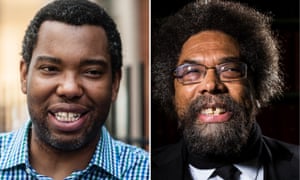
Ta-Nehisi Coates v Cornel West:

Black Academics and Activists Give their Verdict

Ta-Nehisi Coates and Cornel Wes Ta-Nehisi Coates and Cornel West


Folks I read about this recently, and at the end of my musings is a link to an article I hope you'll read along with Comments.

Don't know what got into me this morning, but after reading other readers' Comments, I looked back up at the faces in the photos above, with the thoughts and questions of the relevance of the Coates/West debate running through my head. And sadly, the only thing that came to my silly mind was, "Damn, both these n__as look like they should be shuckin' sugar."

Now that's how Spirit works in me. "Spirit?!?!" you may be wondering. And yes, let me explain why I say that and how the ONE LIFE lives as me.

First premise, The One Mind in me, loves to laugh.

Second, IT is INFINITE. Things come to me, that I really have no personal experience (laughing right now) with. But I have this gift, of sometimes pulling a word out of the air, that just perfectly expresses the phenomenon I'm thinking of. I mean I receive a perfect and accurate description, definition or explanation. I've likened it in the past as perhaps a word or something I've come across in the many books I've read in my lifetime shoots up from deep memory...? But here, what arose was the phrase, "shuckin' sugar". 

Now my generation and before know what 'shucking and jiving' mean, but shucking sugar? I'm still shaking my head wondering where did that come from??

So being the sincere student that I am, I googled the definition, and the first thing I noticed were some images, all from Asian nations of people, shucking sugar:

Woman Shucking Sugar in Shanghai

 Image result for shucking sugar

Image result for shucking sugar 

 Hong Kong street vendor shucking sugar

 And last this great scene~Shucking sugar cane in Cambodia


So now I had an image, and I confirmed my understanding with a dictionary visit which said that the verb 'to shuck' means to remove the outer shell, or outer part of something.

Then I hit pay dirt, as they say. youtube had a song by an artist named Blind Lemon Jefferson, entitled Shuckin' Sugar! I played it and loved it. It seemed that some of his lyrics even fit the issues in the debate that started this adventure. But even more fascinating, is this brother's life story. I include the song here, for your enjoyment, and the Wikipedia link for Blind Lemon Jefferson. 


And again....the goodness I enjoy from my Inner Life's connection with Cosmic Wholeness wasn't done with me. It just happens that, Blind Lemon died 88 years ago, three days ago, at the age of 36, on Dec. 19, 1929.  https://en.wikipedia.org/wiki/Blind_Lemon_Jefferson

His career and influence were awesome. He was inducted into the Blues Hall of Fame in 1980. Known as the Father of Texas Blues, his songs crossed genres and were covered /recorded by numerous Rock and Roll greats, inspiring many musicians. His life has been recreated in films, and stage plays. In fact, it was a lyric from one of his biggest hits, "Black Snake Moan", that became the title of the song, "It's All Right" that launched Elvis Presley's career.

http://www.bad-seed.org/~cave/misc/blind.jpeg

 And finally to set the record straight. I was just ticklin' myself, in saying that Coates and West, looked like field hands. I appreciate both of their contributions and their work, indisputably demonstrating that the fountain feeding the continuum of Africa's children that Receive Insight, See and Feel Truth in our Hearts, develop wisdom, think deeply, act decisively and share and teach all that are interested, can not be turned off.

I bow down to all the great Black Men, rich in melanin, understanding, physical strength and agility, intelligence, joy and creative genius, and HUMILITY. All gushing from an Inner Love that is expressed through their compassion and generosity that allows my Pharoahs to Be and expect nothing but XCELLENCE.

lovu~ 

Kendke

Expect 2018 to be wonderful for you and all you love~

https://www.theguardian.com/commentisfree/2017/dec/22/-ta-nehisi-coates-cornel-west-black-academic-activists-debate-equality 


Tuesday, December 12, 2017

THIS is Soooo Beautiful

Anonymous Donor Pays Off Layaway Items for 200 Families


December 12, 2017 Updated: December 12, 2017 11:05am
 
 
EVERETT, Pa. (AP) —

An anonymous donor has paid off all the items on layaway at a Pennsylvania Walmart, giving 200 families a holiday gift.

WJAC-TV reports that staff members at the Everett store say this is the second year in a row that the anonymous donor has made such a gift.


Store veteran Barbara Kearns says she's never seen generosity and humility on this scale before.
The Walmart staff has been making calls to families with the news, letting them know their Christmas gifts on layaway are paid off.


Nobody knows who the secret donor is, not even the Walmart staff. They just call him "Santa B."


In total, the staff says the donor paid a total of $40,000.

Friday, September 15, 2017

The stunning underwater picture this photographer wishes ‘didn’t exist’

A small sea horse grabs onto garbage in Indonesia. 
Justin Hofman, Wildlife Photographer of the Year
 
 
The powerful and poignant image shows a tiny sea horse holding tightly onto a pink, plastic cotton swab in blue-green waters around Indonesia.


California nature photographer Justin Hofman snapped the picture late last year off the coast of Sumbawa, an Indonesian island in the Lesser Sunda Islands chain. The 33-year-old, from Monterey, Calif., said a colleague pointed out the pocket-size sea creature, which he estimated to be about 1.5 inches tall — so small, in fact, that Hofman said he almost didn't reach for his camera.

“The wind started to pick up and the sea horse started to drift. It first grabbed onto a piece of sea grass,” Hofman said Thursday in a phone interview.

Hofman started shooting.

“Eventually more and more trash and debris started to move through,” he said, adding that the critter lost its grip, then latched onto a white, wispy piece of a plastic bag. “The next thing it grabbed was a Q-Tip.”

Hofman said he wishes the picture “didn’t exist” — but it does; and now, he said, he feels responsible “to make sure it gets to as many eyes as possible.” He entered the photo and was a finalist in the Wildlife Photographer of the Year competition from the Natural History Museum in London.

“I want everybody to see it,” he added. “I want everybody to have a reaction to it.”

Hofman, an expedition leader with EYOS Expeditions, said he was wrapping up an expedition in December 2016 when he photographed the sea horse.

As he watched the creature through its journey, he said, his “blood was boiling.”
Hofman said the garbage had washed in, polluting their spot in the sea with sewage that he said he could smell and taste, and that the sea horse was searching for a raft on which to ride it out.

“I had this beautiful, little tiny creature that was so cute, and it was almost like we were brought back to reality — that this is something that happens to the sea horse day in and day out,” he said.

Justin Hofman (Justin Hofman)
 
After the Wildlife Photographer of the Year finalists were named this week, Hofman posted the picture on Instagram, prompting emotional responses from people across social media who called it an “eye opening” and “mind-blowing shot” that illustrates a “disgusting” reality.

“It’s a photo that I wish didn’t exist but now that it does I want everyone to see it,” Hofman wrote beneath the image. “What started as an opportunity to photograph a cute little sea horse turned into one of frustration and sadness as the incoming tide brought with it countless pieces of trash and sewage. This sea horse drifts long with the trash day in and day out as it rides the currents that flow along the Indonesian archipelago. 

“This photo serves as an allegory for the current and future state of our oceans. What sort of future are we creating? How can your actions shape our planet?
” he said.

Hofman said that he has since received messages from people all over the world.

“Some of them feel heartbroken, some of them feel frustrated,” he said, adding some in Indonesia acknowledged they have a problem with plastic pollution.

Indonesia is the world's second-largest producer of marine pollution, dumping 3.22 million metric tons of plastic debris per year, according to data published in 2015 by Environmental Health Perspectives. The country has vowed to reduce such waste by 70 percent by the end of 2025, according to the United Nations.

Maybe, Hofman said, the photo, and others like it, can be catalysts to create change.

“We are really affecting our oceans with our negligence and our ignorance,” he said.


Friday, July 21, 2017

The Un-Pretty History Of Georgia's Iconic Peach


During peach season, Georgia's roads are dotted with farm stands selling fresh peaches. Year-round, tourist traps sell mugs, hats, shirts and even snow globes with peaches on them. At the beginning of the Georgia peach boom, one of Atlanta's major roads was renamed Peachtree Street. But despite its associations with perfectly pink-orange peaches, "The Peach State" of Georgia is neither the biggest peach producing state (that honor goes to California) nor are peaches its biggest crop.

So why is it that Georgia peaches are so iconic? The answer, like so much of Southern history, has a lot to do with slavery — specifically, its end and a need for the South to rebrand itself. Yet, as historian William Thomas Okie writes in his book The Georgia Peach, the fruit may be sweet but the industry in the South was formed on the same culture of white supremacy as cotton and other slave-tended crops.

Peaches, which are native to Asia, have been growing haphazardly in the United States since they were brought over by Europeans in the 17th century. But it wasn't until the latter half of the 1800s that aspiring horticulturists began to try and grow the peach as an orchard crop. In 1856, a Belgian father-and-son pair, Louis and Prosper Berckmans, purchased a plot of orchard land in Augusta, Ga., that would come to be known as Fruitland. Their intention was to demonstrate that fruit and ornamental plants could become just as important an industry in the South as cotton, which was ruining the soil with its intensive planting.


The Georgia Peach Culture, Agriculture, and Environment in the American South
by William Thomas Okie, Hardcover, 303 pages 


Horticulture slowly became accepted as a gentleman's pursuit. But it wasn't until the end of the Civil War and the abolishment of slavery that the sudden availability of labor gave peaches the perfect opening. After the war, "fruit growing, which to the cotton planter was a secondary matter, [became] one of great solicitude to the farmer," Prosper Berckmans wrote in 1876. By the 1880s, Fruitland had grown so large and essential that it mailed 25,000 catalogs every year to horticulturists in the United States and abroad.

Freedmen now needed year-round employment, and the labor requirements of the peach season — tree trimming and harvest — fit perfectly with the time of year when cotton was slow. Though the story of the post-bellum South is often one of industrialization and urbanization, it was also a time of redefining what agriculture would mean without the enslaved labor plantation owners had relied on.
"Cotton had all these associations with poverty and slavery," says Okie, an assistant professor of history at Kennesaw State University in Georgia.

The peach had none of that baggage.
While King Cotton was still an important part of the Southern economy, town councils began sponsoring peach festivals and spreading marketing materials that sung the praises of Georgia-bred peaches like the famous Elberta Peaches.

"Tellingly," Okie writes, "the only role mentioned for Black southerners in the great Georgia Peach Carnival was as members of the opening procession's 'Watermelon Brigade' " — about 100 African-Americans who marched with the racially laden fruit balanced on their heads.


Gentleman farmers saw fruit cultivation as something particularly refined and European, and a craze for all things "oriental" gave peaches an even greater allure. This cultured crop fit in with the narrative white Southerners were eager to tell about themselves after the Civil War. "Growing peaches for market required expertise that seemed unnecessary with corn and cotton, which any dirt farmer could grow," Okie writes. To succeed, peach farmers had to be able to access horticultural literature and the latest scientific findings. Both required literacy, as well as a certain level of education that was still out of reach for many newly freed men and women.


An undated photo shows peach pickers being driven to the orchards in Muscella, Ga. Black labor was essential for the success of the peach crop, even if African-Americans were rarely credited for the importance of their work.
Dorothea Lange/Library of Congress 


Before peaches became an important crop, they hung low on branches throughout the South and landowners who saw them as without value were happy to give them freely to slaves. But once peaches were part of the agricultural economy, they became off limits to all but those who could afford them. By the end of the 1800s, Okie writes, a landowner who caught three black children pilfering little more than a handful of peaches charged the father of one $21 for three peaches, threatening the children with a chain gang if he caught them in his orchard again. A laborer working in a city at that time made less than $1.50 per day on average, making it likely that, for a black family in the South, those three peaches amounted to roughly a full month's wages. What was once freely available to African-American became "a white fruit," Okie says.

In addition to the cost of the trees and horticultural education, it took three or four years of expenses without income before trees would reliably produce fruit. Peaches required so much capital to grow that few African-Americans could afford to start their own orchard. When women were referred to admiringly as "Georgia peaches," it was a reflection of their light, rosy skin more than the state where they were from. (In an act of reclamation, a black gospel singer born in 1899 as Clara Hudman would go on to use the stage name "Georgia Peach.")

Of course, black labor was essential for the success of the peach crop, even if African-Americans were rarely credited for the importance of their work. Fort Valley State University, a historically black school in the epicenter of Georgia's peach region, would not have existed without the peach industry. It was created with the promise of educating African-Americans to be better workers in the orchards. But decades after its founding, it became a "Tuskegee-like institute" that was important for the Civil Rights movement in that region, Okie says. The college was involved in marches and demonstrations; Jo Ann Gibson, an organizer of the Montgomery Bus Boycott, was a 1936 graduate.

Many states remain associated with a particular food or agricultural product well after the product's importance has waned. Florida now grows far fewer oranges for consumption than many states, though the Sunshine state still produces a lot of juicing oranges. But these agricultural connections remain important for more than just marketing slogans or choosing a design for the state license plate.


"In a world of ephemerality and digital presence, there's something fundamental about the wind and the weather and the soil and microorganisms that make the environment we live in," Okie says.
For better or worse, Okie's book explains, peaches have become the story of the New South and its environment as much as cotton represents the Old. He adds, "To have a cultural icon with its roots deep in the physical landscape of the South is important."

Labels

2008 (1) Absence of citizen online privacy protection by U S government (1) achievements of women (1) Africa human rights (1) africa political violence (1) African Muslims want peace (1) African politics (1) African refugee assisting homeland (1) African violence and corruption (1) African-American art (1) agriculture biotechnology industry (1) alQaida in Africa (1) American economic system (1) American education (1) American labor movement (2) American prison system (1) American racism (1) animals (1) Animals and humans (3) anti-American Middle Eastern cyber hijackers (1) apartheid 20 years gone (1) Arnold (1) Art by artists of African descent both continental (1) Atlanta (1) Avatar (1) Barack Obama (2) BeeSweet Lemonade (1) beneficial presence in the world (1) Bill Clinton (1) biogenetics (1) birthday (1) Black male role models (1) Black men unjustly incarcerated (1) Black people worldwide (1) busting American myths (1) buyer beware (1) Caribbean Literature Book Club 2010 reading list (1) champions (1) change for america world (1) charity (1) charter schools (2) China (1) classy artists (1) Congo (1) Consumer Rights (1) consumerism (1) Cornel West (1) Cosmos (1) coups in Africa (1) creativity built from our culture (1) credit game (1) Crenshaw community (1) cyberspace brought into wars (1) Dark Matter (1) David Bowie (1) Dedan Gills (1) delusions of the American masse (1) democracy in the world (1) destroying myths that no longer serve the good (1) Dialogue in America (1) diaspora (1) Disgust; Being our true selves (1) distribution of wealth (1) donating (1) earthworms (1) ecologically smart cars; green lifestyle (1) ecology (1) economic meltdown (1) economics (1) Edge intellectuals (1) Education in America (1) Egypt (1) elevating consciousness of American people (1) endangered Mountain Gorillas (1) European internet privacy (1) Excellent athletes (1) expanding consciousness (1) fear and greed of white people (1) female corporate/ multinational CEOs (1) first blog of the year (1) freedom of the press (1) French and Mali troops roust al-Qaida Islamist invaders (1) G-20 (1) gardeners (1) giving (1) global immigration issues; Israel (1) golf (1) Good works in Africa by her children in the diaspora (1) gospel music (1) Gratitude (1) Groups doing great work (1) Haitian Earthquake relief effort (2) helping others globally (1) History of issue of race in America (1) Homophobia (1) Human omniaction (1) ignorance (1) imperialism (1) indigenious people (1) influencing purchasing trends with priming (1) Iraqi drones compromised (1) Islam (1) Islamic extremests in African; Timbuktu (2) jokes (1) Kenya bloggers (1) latest scientific discoveries (1) law (1) Los Angeles life; architecture; African-Americans in Los Angeles (2) lost world cultures (1) Love (1) Malcolm X Civil Rights Leader (1) Mali (3) Mali 2013 (1) manipulating the food of the world (1) manuscripts of Africa's past (1) men of integrity (1) men standing strong (1) Mikhail Khodorkovsky (1) military power in Afrcia (1) military power in Africa (1) Monsanto (1) MTV (1) Mugabe (2) my travels (1) Natalie Cole (1) National Parks (1) Native Americans (1) Nature at It's Best File (3) Nelson Mandela (1) Neuromelanin (1) New Yorker Magazine (1) Nigerian terrorist (1) Nobel Peace Prize winners (1) Obama as a balm (1) Obama diplomacy (1) Obama foreign diplomacy (1) Obama in Europe (1) Obama nobel prize winner (1) Obama policies regarding average citizens (1) Obama's ability to control and steer his administration (1) Octavvia E. Butler (1) order (1) organic (1) outstanding Black authors (1) Pan-African authors (1) personal fulfillment (1) Pharonic sacred science (1) photography - wildlife (1) Plant sentience (1) policies that endanger animal welfare (2) politics (1) positive life lessons (1) post-neocolonialism in Africa (1) poverty field studies in India (1) prejudice (1) priming (1) professionals (1) public protest of economic policies (1) race (1) race and housing (2) race in America (1) Racism in Hollywood (1) religious bigotry (1) right wing christians (1) right-wing fundamentalism (1) Russia (1) Russian politics (1) Sarah Palin's politics (1) Science - intelligent creative bacteria (1) scientific ignorance perpetuated in 2012 (1) sibling rivalry (1) Snoop Dogg (2) soil science (1) Somalia (1) South Africa labor problems (1) South side Chicago (1) Spring poetry (1) Stanford University (1) successful women (1) Sudan (2) technology (1) tennis (2) Thanksgiving Day (1) The Bigs/multinational corporations (1) the failure of No Child Left Behind (1) the wealthy (1) things that make you go 'hhmmm' (1) Tiger Woods (1) Timbuktu libraries (1) time (1) Toni Morrison (1) true meaning of dogsledding. (1) Tuskegee Airmen (1) Twitter hijacked (1) U S History (1) vegan (1) vegetarianism (1) Virunga Park (1) ways to help Africa (1) weak results re: campaign promises (1) wealth in America (1) wholesome food sources (2) wildlife and their habitats (1) Williams sisters (2) Wimbledon (1) wolves (1) women leaders (1) world economy (1) writing (1) Written & published March 21 (1) Xmas 2009 (1) yahoo (1) young Black entrepreneurs (1) Zimbabwe election (1)