Sunday, April 27, 2014

Coming Soon to your Community? A School Funded by Walmart Founders Walton Family Foundation

Mary Ann Carlson with pupils at a charter school in Washington run by KIPP, an organization aided by the Walton foundation. 
  Credit Gabriella Demczuk/The New York Times 


A Walmart Fortune, Spreading Charter Schools


WASHINGTON — DC Prep operates four charter schools here with 1,200 students in preschool through eighth grade. The schools, whose students are mostly poor and black, are among the highest performing in Washington. Last year, DC Prep’s flagship middle school earned the best test scores among local charter schools, far outperforming the average of the city’s traditional neighborhood schools as well.

Another, less trumpeted, distinction for DC Prep is the extent to which it — as well as many other charter schools in the city — relies on the Walton Family Foundation, a philanthropic group governed by the family that founded Walmart.

Since 2002, the charter network has received close to $1.2 million from Walton in direct grants. A Walton-funded nonprofit helped DC Prep find building space when it moved its first two schools from a chapel basement into former warehouses that now have large classrooms and wide, art-filled hallways.
One-third of DC Prep’s teachers are alumni of Teach for America, whose largest private donor is Walton. A Walton-funded advocacy group fights for more public funding and autonomy for charter schools in the city. Even the local board that regulates charter schools receives funding from the Walton Family Foundation.

Nate Hanna at Washington’s Mundo Verde school, a foundation recipient. 

In effect, Walton has subsidized an entire charter school system in the nation’s capital, helping to fuel enrollment growth so that close to half of all public school students in the city now attend charters, which receive taxpayer dollars but are privately operated.

Walton’s investments here are a microcosm of its spending across the country. The foundation has awarded more than $1 billion in grants nationally to educational efforts since 2000, making it one of the largest private contributors to education in the country. It is one of a handful of foundations with strong interests in education, including those belonging to Bill and Melinda Gates of Microsoft; Eli Broad, a Los Angeles insurance billionaire; and Susan and Michael Dell, who made their money in computers. The groups have many overlapping interests, but analysts often describe Walton as following a distinct ideological path.

In addition to giving grants to right-leaning think tanks like the Thomas B. Fordham Institute and the American Enterprise Institute for Public Policy Research, the Walton foundation hired an education program officer who had worked at the American Legislative Exchange Council, a conservative business-backed group. Walton has also given to centrist organizations such as New Leaders for New Schools, a group co-founded by Jon Schnur, a former senior adviser to President Obama’s transition team and to Arne Duncan, the secretary of education.

In 2013, the Walton foundation spent more than $164 million across the country. According to Marc Sternberg, who was appointed director of K-12 education reform at the Walton Family Foundation last September, Walton has given grants to one in every four charter start-ups in the country, for a total of $335 million.

“The Walton Family Foundation has been deeply committed to a theory of change, which is that we have a moral obligation to provide families with high quality choices,” said Mr. Sternberg. “We believe that in providing choices we are also compelling the other schools in an ecosystem to raise their game.”

The supporters and critics of charter schools, many of them fierce, cannot be easily divided into political camps. Supporters include both Republicans and Democrats, although critics tend to come more from the left. In Washington, where the charter system has strong backing in City Hall, supporters have been more successful than in New York, where opposition from teachers unions and others has kept charter school enrollment to about 6 percent, despite growth in the past decade.

The size of the Walton foundation’s wallet allows it to exert an outsize influence on education policy as well as on which schools flourish and which are forced to fold. With its many tentacles, it has helped fuel some of the fastest growing, and most divisive, trends in public education — including teacher evaluations based on student test scores and publicly funded vouchers for students to attend private schools.

“The influence of philanthropy in terms of the bang for the buck they get is just really kind of shocking,” said Jack Schneider, an assistant professor of education at the College of the Holy Cross in Worcester, Mass.

A separate Walton foundation that supports higher education bankrolls an academic department at the University of Arkansas in which faculty, several of whom were recruited from conservative think tanks, conduct research on charter schools, voucher programs and other policies the foundation supports.

A class at Junior High School 118 in the Bronx led by Pamela Paniagua of the Walton-backed Teach for America. 

Last year, the Walton Family Foundation gave $478,380 to a fund affiliated with the Chicago public schools to help officials conduct community meetings to discuss their plan to close more than 50 schools at a time when charters were expanding in the city.

And Walton played a role in a recent battle in New York, giving a grant to a charter advocacy group that helped pay for advertisements attacking Mayor Bill de Blasio after he denied public space to three schools run by Success Academy Charter Schools, a network in which students have gotten high scores on standardized tests.

While charter schools and vouchers may benefit those families that attend these schools, there may be unintended effects on the broader public school system.

Grant recipients say Walton injects entrepreneurial energy into public education and helps groups eager to try new ideas move more quickly than they could if they relied solely on publicly managed bureaucracies. Thousands of children, they say, attend better schools because of options Walton supports.

“The supply of new models and new ideas is really important, and so I think it’s a very positive thing,” said Robert C. Pianta, dean of the Curry School of Education at the University of Virginia, of the Walton investments. Neither Dr. Pianta nor the Curry School have received funding from Walton.

Critics say that Walton backs schools and measures that take public dollars — and, some say, the most motivated families — away from the existing public schools, effectively creating a two-tier educational system that could hurt the students most in need.

Although Walmart opened its first two stores in the nation’s capital just last December after a protracted battle over the retailer’s wages, the Walton Family Foundation has played a role in steering the direction of public education in the city for more than a decade. Since 2000, the foundation has invested more than $80 million here, not only in charter schools but also in support of taxpayer-funded vouchers for students to attend private schools. It poured millions into a controversial overhaul of tenure, the implementation of stricter teacher evaluation systems and the introduction of performance pay in the district’s public schools.

Walton also supports measures that labor leaders say undermine union protections for teachers. Like-minded Walton recipients are working together in many cases, so there are few dissenting voices.
“When lots of charter schools open up, it’s like a new Walmart store moving in,” said Kevin G. Welner, director of the National Education Policy Center at University of Colorado in Boulder. “You could look at it and say, ‘Well, the schools in a community are losing families because of healthy competition the same way that the hardware store is losing customers because of healthy competition.’ But that doesn’t take into account the long-term harms to the community, which are probably greater than any short-term benefit.”

Walton’s Marc Sternberg, second from left, does not apologize for the foundation’s focus on charter schools. "What’s the argument there?" he said. "Don’t help anybody until you can help everybody?"

In addition to the foundation’s activities, many individual members of the Walton family have made millions of dollars in campaign donations to candidates for local school boards and state legislatures who support causes funded by the foundation.

Walton’s largest recipients include the Charter School Growth Fund, which helps charter school networks expand ($101.6 million since 2000); Teach for America, which recruits high-achieving college graduates for two-year teaching stints in poor districts and now places about a third of its corps members in charter schools ($67.2 million); KIPP, one of the country’s best-known and largest charter school networks ($58.7 million); the Alliance for School Choice, a national advocate for private school vouchers ($18.4 million), whose board includes Carrie Penner, a member of the Walton family; and GreatSchools Inc., an online schools information database ($15.5 million.)

Last year, the foundation announced a two-year, $8 million grant to StudentsFirst, an advocacy group led by Michelle A. Rhee, the former schools chancellor in Washington who oversaw many of the policy changes funded by Walton in the district’s public schools. StudentsFirst now pushes for the extension of many of those same policies in states across the country, contributing to the campaigns of lawmakers who support the group’s agenda.

“What they’re doing in terms of education is they’re trying to create an alternative system and destabilize what has been the anchor of American democracy,” said Randi Weingarten, president of the American Federation of Teachers, the country’s second-largest teachers union.

Although the foundation’s leaders say they are focused on helping children in poverty or stuck in low-performing schools, some of their actions support concepts regardless of whether poor children benefit. In 2012, for example, Walton gave $300,000 to the Douglas County School District in Colorado to help it fight a lawsuit brought by opponents of a voucher program. The median income of families in the district, where the public schools are high performing, is more than $99,000, according to census data.

Walton supporters say the foundation is not blindly supporting the expansion of charters. Two years ago, Walton announced a $5.2 million grant to the National Association of Charter School Authorizers to support an initiative under which the group would push state and local regulators to close about 900 low-performing charter schools around the country, while opening another 2,000.
“Any foundation that invests the money has to ask themselves, is their money impacting the system as a whole?” said Dennis Van Roeckel, president of the National Education Association, the country’s largest teachers union.

Walton’s Mr. Sternberg, who started his career in Teach for America and founded the Bronx Lab School, a public school in New York City, does not apologize for Walton’s commitment to charter schools and vouchers. “What’s the argument there?” he said during an interview. “Don’t help anybody until you can help everybody?”

He said the foundation was focused not on ideology but on results, a word he repeated many times.

A student worked at Mundo Verde. Credit Gabriella Demczuk/The New York Times

In Washington, for example, the group has given more than $5.8 million to the District of Columbia Public Charter School Board, whose members are nominated by the mayor to regulate the opening and closing of charter schools. The board has used Walton’s grants to help develop accountability measures for all charter schools in the city. When critics complained that charters were pushing out difficult students, the board began reviewing and publishing data on expulsions and midyear departures. Scott Pearson, executive director of the board, said charter schools in the city had halved expulsions since the board began releasing statistics.

“D.C. is a better place today than it was 10 years ago because of the reforms that have played out here,” said Mr. Sternberg, who was an official in the New York City Department of Education under Mayor Michael R. Bloomberg. He pointed to recent increases in scores on national tests by both public and charter school students, saying that neighborhood schools had responded to competition from charters. “And maybe in very small part, because of Walton’s role,” he added.

Walton has become a go-to source for many charter schools seeking start-up grants. In addition to funding large networks like KIPP, which is expanding in Washington, the foundation has given grants to several stand-alone schools.

The Richard Wright Public Charter School for Journalism and Media Arts, housed in a building across the street from the Washington Navy Yard in the southeast part of the city, received $250,000 from Walton in 2011. The school used the money to buy computers for students, as well as chemistry lab equipment and recording gear for the school’s media studio.

All of the school’s students qualify for federally subsidized free or reduced price lunches. According to Marco Clark, the founder and head of the school, one in five students have special needs and one in 10 have been involved with the criminal justice system.

On a recent morning, the range of academic abilities in the school was apparent. In an advanced placement world history class, 11th-graders gave rapid-fire answers to questions about Native American tribes, with the teacher asking “Why?” to gauge whether students were merely regurgitating memorized facts. Upstairs, in an eighth-grade reading class, several students asked the teacher for help in understanding a passage about the world’s largest harp. One boy struggled to eke out what he thought was the main point. “It about how can orchastra works,” he wrote.

Several students noted that they had come from schools in which they either did not feel safe or were not learning much. Dr. Clark acknowledged that the school was still working to raise test scores, and had added extra math and reading classes.

“Those who want to criticize any philanthropy group for giving money to kids to change their futures,” said Dr. Clark, “there’s something wrong with them.”

Some parents said they felt torn between the interests of their children and those of the city. Marcus Robinson, the owner of a pet supply and grooming business, said he had attended public schools in Washington and wanted his children to do the same. But his daughters Lourdes, 8, and Maja, 6, attend Mundo Verde Bilingual Public Charter School, a start-up that received $250,000 from Walton.

Mr. Robinson was concerned that the schools in his northeastern neighborhood had trouble coping with students who had behavioral problems. He also liked the dual language approach at Mundo Verde, where students work in small classes on projects related to the environment and sustainability. A relaxed atmosphere permeates the classrooms, and a yoga teacher and nutritionist are on the faculty.

“Charter schools are a bit of a disservice to the public schools,” Mr. Robinson said. “It puts the onus on public schools to take on the people and children that other schools don’t want. But in the meantime, between everyone fighting about it, I did not want my kids to be caught in the limbo.”

Wednesday, April 23, 2014

Stop Telling Women To Smile

You may have seen this sister's posters around your town. 
Meet the artist behind this street art in this short but powerful video,
which relays a correct message
 from beautiful women.

lovu,
Kentke

Saturday, April 19, 2014

Lost in Literary History: A Tale of Courage in the South

 
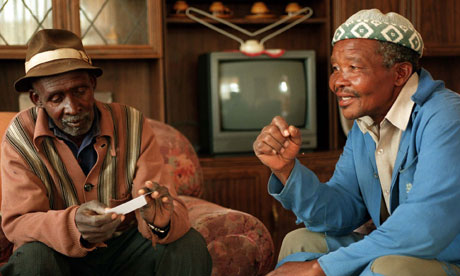
The sharecropper Ned Cobb, a.k.a. Nate Shaw, at 22, with his wife, Viola, and their son Andrew, in 1907.  
Credit Courtesy of Theodore Rosengarten

NYT Now
Nineteen seventy-four was a good year for nonfiction writing in America. Robert A. Caro’s monumental biography of Robert Moses, “The Power Broker,” came out. So did Bob Woodward and Carl Bernstein’s “All the President’s Men.” So did “Working,” by Studs Terkel, and Robert M. Pirsig’s “Zen and the Art of Motorcycle Maintenance.”

Each was a finalist for the National Book Award. Yet the winner in general nonfiction — the category was then called contemporary affairs — was “All God’s Dangers: The Life of Nate Shaw,” an oral history of an illiterate black Alabama sharecropper. Its author, the man who compiled it from extensive interviews, was a writer named Theodore Rosengarten.

Forty years later, we remember “The Power Broker,” “All the President’s Men,” “Working” and “Zen and the Art of Motorcycle Maintenance.” But in a troubling quirk of history, “All God’s Dangers” has all but fallen off the map.
Somewhere along the line, people stopped talking about it. Friends of mine who talk about nothing except Southern literature have barely heard of the book. I pounced on it after I discovered that Richard Howorth, the well-read owner of Square Books, the independent bookstore in Oxford, Miss., utters its title aloud every time a customer asks the question, “What one book would you say best explains the South?”
Credit Courtesy of 
Theodore Rosengarten
I wish I could say that, this early spring, I read “All God’s Dangers” in one sitting. It’s not that kind of book.  It’s a meandering thing; its pleasures are intense but cumulative. This book rolls. But it is superb — both serious history and a serious pleasure, a story that reads as if Huddie Ledbetter ( the great musician known as Lead Belly) spoke it while W. E. B. Du Bois took dictation. That it’s been largely forgotten is bad for it, but worse for us.

“All God’s Dangers” collected euphoric reviews in 1974, from Robert Coles and Studs Terkel himself, among others. On the cover of The New York Times Book Review, H. Jack Geiger wrote that in Nate Shaw, America “had found a black Homer, bursting with his black Odyssey.”

“All God’s Dangers” remained in print for years as a Vintage paperback. In 1989 it was turned into a one-man play, starring Cleavon Little. (If the clips on YouTube are any indication, it was unwatchable.) These days, a hefty paperback edition is available from the University of Chicago Press. But it seems to have vanished from the culture at large.

This book has a back story. Nate Shaw is a pseudonym. The sharecropper’s real name was Ned Cobb (1885-1973). Mr. Rosengarten changed the name for the safety of Mr. Cobb’s family— a grim commentary on race relations in Alabama in 1974.

In 1969 Mr. Rosengarten was a recent Harvard graduate who went to Alabama with a friend who was researching a defunct organization called the Alabama Sharecroppers Union. Someone suggested they speak to Mr. Cobb, then 84.
Mr. Rosengarten relates what happened: “We asked him right off why he joined the union. He didn’t respond directly; rather, he ‘interpreted’ the question and began, ‘I was haulin’ a load of hay out of Apafalya one day ...’ and continued uninterrupted for eight hours. He recounted dealings with landlords, bankers, fertilizer agents, mule traders, gin operators, sheriffs and judges — stories of the social relations of the cotton system. By evening, the fire had risen and died and risen again, and our question was answered.”

No fool, Mr. Rosengarten returned many times, over several years, to speak with Mr. Cobb. He’d found a powerful American voice, one that cracked open a world never so fully explored in print. The result is “All God’s Dangers,” which deserves a place in the front rank of American autobiographies.

There are many reasons, in 2014, to attend to Ned Cobb’s story. It is dense and tangled social history, a narrative that essentially takes us from slavery to Selma from the point of view of an unprosperous but eloquent and unbroken black man. In some ways, the book is a reverse photographic image of “Let Us Now Praise Famous Men,” the 1941 classic from James Agee and Walker Evans. Agee and Evans scrutinized the lives of white tenant farmers; in “All God’s Dangers,” we witness a black tenant family through three generations. The book is Faulknerian in its weave. Mr. Cobb’s working years, Mr. Rosengarten notes, “span approximately the same years as the Snopes family odyssey in William Faulkner’s trilogy.”

The book has its share of drama. We read about Cobb’s joining the radical union, about getting into a shootout with police while protecting a friend’s property from a fraudulent foreclosure, about his 12-year prison stint. But, in general, it moves gently; it’s more a stream than a river.

You will learn more about wheat, guano, farm implements, bugs, cattle killing and mule handling than you would think possible. Mr. Cobb loved and took good care of his working mules. About one, he declares: “She was just as pretty as a peeled onion.”

“All God’s Dangers” also happens to be a dense catalog of the ways that whites tricked and mistreated blacks in the first half of the 20th century. “Years ago I heard that Abraham Lincoln freed the colored people,” Mr. Cobb says early on, “but it didn’t amount to a hill of beans.” About his white neighbors, he declares, “Any way they could deprive a Negro was a celebration to ’em.”
The book’s title comes from these sentences: “All God’s dangers ain’t a white man. When the boll weevil starts in your cotton and go to depositin’ his eggs in them squares, that’s when he’ll kill you.”

Perhaps the best thing about “All God’s Dangers” is that it is so direct about the injustices piled upon Mr. Cobb’s family and other blacks in Alabama, while remaining so buoyant. Mr. Cobb had an unshakable sense of moral justice, but he did not want his heart to curdle with bitterness. “Good God, there wasn’t but few privileges that we was allowed,” he remarks. Yet he always had “big eyes and high hopes.” He becomes one of the first black farmers in Alabama to own a car.

Ned Cobb is full of advice about how to live. Some of this advice is funny. If you marry a sickly girl, he says, “you might just marry a doctor’s bill.” About farming and any kind of labor, you often get your best work done when you’re most tempted to nap. “Look out,” he advises, “for off times and rainy days.”
The real lessons in “All God’s Dangers” are the old, primal ones, lessons that Mr. Cobb manages to make fresh: Stand up for what you believe in; remain awake to experience; any job worth doing is worth doing well. Mr. Rosengarten went on to become, in 1989, a MacArthur Fellow. His later books include “Tombee: Portrait of a Cotton Planter” (1986).

The exceptional man he presents to us in “All God’s Dangers” says, “Some folks don’t use the time God gives ’em; that’s why they’re liable to come up defeated.”

A version of this article appears in print on April 19, 2014, on page C1 of the New York edition with the headline: Lost in Literary History: A Tale of Courage in the South.

Thursday, April 3, 2014

Siri, You're Messing Up a Generation of Children

The New Republic Magazine online
April 2, 2014

Parenting


One of the unexpected pleasures of modern parenthood is eavesdropping on your ten-year-old as she conducts existential conversations with an iPhone. “Who are you, Siri?” “What is the meaning of life?” Pride becomes bemusement, though, as the questions degenerate into abuse. “Siri, you’re stupid!” Siri’s unruffled response—“I’m sorry you feel that way”—provokes “Siri, you’re fired!”

I don’t think of my daughter as petulant. Friends tell me they’ve watched their children go through the same love, then hate, for digital personal assistants. Siri’s repertoire of bon mots is limited, and she can be slow to understand seemingly straightforward commands, such as, “Send e-mail to Hannah.” (“Uh oh, something’s gone wrong.”) Worse, from a child’s point of view, she rebuffs stabs at intimacy: Ask her if she loves you, and after deflecting the question a few times (“Awk-ward,” “Do I what?”) she admits: “I’m not capable of love.” Earlier this year, a mother wrote to Philip Galanes, the “Social Q’s” columnist for The New York Times, asking him what to do when her ten-year-old son called Siri a “stupid idiot.” Stop him, said Galanes; the vituperation of virtual pals amounts to a “dry run” for hurling insults at people. His answer struck me as clueless: Children yell at toys all the time, whether talking or dumb. It’s how they work through their aggression.

Siri will get smarter, though, and more companionable, because conversational agents are almost certain to become the user interface of the future. They’re already close to ubiquitous. Google has had its own digital personal assistant, Google Voice Search, since 2008. Siri will soon be available in Ford, Toyota, and General Motors cars. As this magazine goes to press, Microsoft is unveiling its own version of Siri, code-named Cortana (the brilliant, babelicious hologram in Microsoft’s Halo video game). Voice activation is the easiest method of controlling the smart devices—refrigerators, toilets, lights, elevators, robotic servants—that will soon populate our environment. All the more reason, then, to understand why children can’t stop trying to make friends with these voices. 
Think of our children as less inhibited avatars of ourselves. It is through them that we’ll learn what it will be like to live in a world crowded with “friends” like Siri.

The wonderment is that Siri has any emotional pull at all, given her many limitations. Some of her appeal can be chalked up to novelty. But she has another, more fundamental attraction: her voice. Voice is a more visceral medium than text. A child first comes to know his mother through her voice, which he recognizes as distinctively hers while still in the womb. Moreover, the disembodied voice unleashes fantasies and projections that the embodied voice somehow keeps in check. That’s why Freud sat psychoanalysts behind their patients. It’s also why phone sex can be so intense.

The literary critic Ruth Franklin, whose children were also entranced by, then peeved at, Siri, suggested to me that maybe kids get mad at her because she fails to meet “the maternal expectations they associate with women.” That sounds right, although, of course, adults have these expectations, too. The current generation of iPhones allows you to set Siri to male as well as female, but the point is that voices communicate gender, age, authority or the lack thereof—primal social cues that we can’t help but process as markers of a real personality.

Our minds respond to speech as if it were human, no matter what device it comes out of. Evolutionary theorists point out that, during the 200,000 years or so in which homo sapiens have been chatting with an “other,” the only other beings who could chat were also human; we didn’t need to differentiate the speech of humans and not-quite humans, and we still can’t do so without mental effort. (Processing speech, as it happens, draws on more parts of the brain than any other mental function.) Manufactured speech tricks us into reacting as if it were real, if only for a moment or two. 

Children today will be the first to grow up in constant interaction with these artificially more or less intelligent entities. So what will they make of them? What social category will they slot them into? I put that question to Peter Kahn, a developmental psychologist who studies child-robot interactions at the University of Washington. In his lab, Kahn analyzes how children relate to cumbersome robots whose unmistakably electronic voices express very human emotions. I watched a videotape of one of Kahn’s experiments, in which a teenaged boy played a game of “I Spy” with a robot named Robovie. First, Robovie “thought” of an object in the room and the boy had to guess what it was. Then it was Robovie’s turn. The boy tugged on his hair and said, “This object is green.” Robovie slowly turned its bulging eyes and clunky head and entire metallic body to scan the room, but just as it was about to make a guess, a man emerged and announced that Robovie had to go in the closet. (This, not the game, was the point of the exercise.) “That’s not fair,” said Robovie, in its soft, childish, faintly reverberating voice. “I wasn’t given enough chances to. Guess the object. I should be able to finish. This round of the game.” “Come on, Robovie,” the man said brusquely. “You’re just a robot.” “Sorry, Robovie,” said the boy, who looked uncomfortable. “It hurts my feelings that,” said Robovie, “You would want. To put me in. The closet. Everyone else. Is out here.” 

Afterward, Kahn asked the children whether they thought the machine had been treated unjustly. Most thought it had. Moreover, most believed that Robovie was intelligent and had feelings. They knew that they were playing with a robot, but nonetheless experienced Robovie as something like a person. Kahn speculates that “we’re creating a new category of being,” the “personified non-animal semi-conscious half-agent.” Or, as one child involved in his experiment said of Robovie, “He’s like, he’s half living, half not.”

Sherry Turkle, a psychologist at MIT who has been studying technology and children for several decades, worries that they’ll be too willing to settle for the reduced emotional sustenance to be had from these non-animal half-agents. 

In her recent book, Alone Together: Why We Expect More from Technology and Less From Each Other, she describes watching children’s toys go from being “sort of alive” (like the Tamagotchis popular two decades ago) to being “alive enough.” In other words, robotic pets, friends, teachers, babysitters, even therapists—all already in production or development—will do when the real thing isn’t available, as it so often isn’t in our time- and care-deprived world. (And don’t think that robotic caregivers will be given only to children. Robotic baby harp seals have already begun serving as companions for the elderly.) Turkle believes that today’s socially precocious technologies are training all of us, regardless of age, to accept “the performance of connection” in lieu of connection itself. 

But what will these simulations of fellow-feeling mean for the psychological and moral development of children? “I think we’re going to be unpleasantly surprised,” Turkle told me. One risk is that they’ll turn into selfish monsters. 

“Imagine the following future situation,” writes Kahn in his paper on the “I Spy” experiment. “A humanoid robot, like Robovie, helps look after your 8-year-old son after school every day. ... He considers the robot his friend, maybe one of his best friends. Do you want this robot to do everything your child tells it to do? ... If we design robots to do everything a child demands, does that put into motion a master-servant relationship?” To be sure, the robot could be programmed to say no to the child. But as parents understand all too well, the key to getting a child to accept authority is knowing when to say no and when to say yes, and you wonder how a robot can be taught to know the difference. 

Toward the end of his interviews with the children, Kahn asked them questions about Robovie’s moral status. They felt bad for the robot, they told him, but weren’t willing to grant it its freedom. They were OK with it being bought or sold. Nor did they think it should have the right to vote or to be paid for its labor. To the children, Robovie was “slave-like,” Kahn told me. Anyone who has read about life in slaveholding societies knows how coarsening it can be to grow up among others defined as almost but not quite equal.

Moreover, thinking of these “friends” and “mentors” as subordinates may obscure the fact that many of them will effectively serve as spies. Most children probably don’t realize—and might not care—that every question they ask Siri is relayed back to servers in Apple’s cloud for analysis and kept there for two years. For the first six months, voice records are tagged with a number; after that, the number is stripped from the recordings. But that doesn’t actually anonymize the data. According to Nicole Ozer, who keeps tabs on technology and privacy for the aclu of Northern California, the recordings can still be traced to our smartphones via a “unique device identifier”; the data also contains geolocation. As for our children’s inquiries and impertinences, Siri’s privacy policy says that Apple does not “knowingly collect personal information” on children, although “knowingly” and “personal” go undefined. But that’s almost beside the point. Friends don’t collect data on friends, wittingly or not.

Judith Shulevitz is a senior editor at The New Republic.

Saturday, March 22, 2014

Nature At It's Best - Giraffe Licks Dying Zoo Worker


So sweet~
 
 This photo released Saturday March 22, 2014 by Stichting Ambulance Wens or Ambulance Wish Foundation shows a giraffe at Blijdorp Zoo in Rotterdam giving a lick to terminally ill Mario Eijs on Wednesday March 19, 2014 . The Stichting Ambulancewens "Ambulance Wish Foundation" offers transport for terminally ill patients who cannot walk to help fulfill a last wish, in Eijs' case to be taken to the Blijdorp Zoo in Rotterdam where he worked doing odd jobs for 25 years. Eijs, who has a mental handicap, is dying of a brain tumor and has difficulty walking or speaking. 
(AP Photo/Stichting Ambulance Wens)
 

Mar 22, 12:10 PM (ET)

AMSTERDAM (AP) - 

A giraffe gave a lick to a dying man who asked as a last wish to be taken to Blijdorp Zoo in Rotterdam, Netherlands, where he had done odd jobs for 25 years.

Mario Eijs, who is mentally disabled, had developed a brain tumor and had difficulty walking or speaking. He wanted to pay a final visit to the co-workers and animals he loved.

The Stichting Ambulance Wens offers free transport to terminally ill patients.
Several giraffes became curious when Eijs was brought to their inside enclosure on March 19.

"Mario got a lick on his nose after a lot of snuffles," Foundation worker Olaf Exoo said in a written summary of the day.

Exoo said it was "a last greeting to each other that gave everybody watching goose bumps."

Sunday, December 8, 2013

Where Nelson Mandela will Rest: Qunu: The Place where Nelson Mandela was at Home

The former South African president always returned to the modest village where he grew up.


Qunu
The village of Qunu, where Nelson Mandela spent his childhood. 
Photograph: Per-Anders Pettersson/Getty Images
 
 
and David Smith in Qunu
 
 
Nature was our playground," wrote Nelson Mandela in his memoir, Long Walk to Freedom. "The hills above Qunu were dotted with large smooth rocks which we transformed into our own rollercoaster. We sat on flat stones and slid down the face of the rocks. We did this until our backsides were so sore we could hardly sit down."

Mandela's "sliding stone" is still visible today, a big granite boulder with a track worn smooth and shiny by his childhood sport nearly a century ago. It is one of the rocky outcrops overlooking the bucolic valley of Qunu, the place where he grew up and always returned.

"Some of the happiest years of my boyhood were spent in Qunu," Mandela wrote. The old men and women of Qunu smile to remember, remembering themselves.

If Mandela's death inspires pilgrims, it is to this modest village in Eastern Cape province, where chickens scarper at the sound of a car and maize grows ad hoc in the yards, that they will come. It is hard to look at the green hills of the former Transkei, designated during the apartheid era as an "independent homeland" and as such a great source of political unrest, and not find in them some sympathy of scale with the man who emerged from them.

Mandela was born in the nearby village of Mvezo, schooled in neighbouring Mqekezweni and made his name in Johannesburg. But it was Qunu he called home, both as a child and after his release from prison when he returned to build a house. It was here that he retired to spend his twilight years, preferring the tug of the ancestors to the brash metropolis.

The remoteness and poverty of the region have ensured that Qunu is almost as quiet as it was in the 1920s when Mandela was a herd boy, looking after sheep and calves in the fields. There is a museum dedicated to him, one of three in the area, but this is no Graceland.

Modernity is still a relative stranger here. The huts Mandela knew in his childhood, with their beehive-shaped structures of mud walls and their floors made of crushed ant-heap, have given way to matchbox brick houses that dot the undulating landscape. There are still rondavels with thatched roofs, but now rondavels with iron roofs too. Small farms are ringed by wire fences, containing maize crops and livestock pens fashioned from corrugated sheets and crooked branches. At dusk, the gloom is pierced by open fires.

"A humble man" is how the custodians of Qunu choose to remember Mandela, resisting the urge to eke posthumous glory from his boyhood antics. It was a long time ago. But even during the early years, there were incidents that distinguished him from his peers. Mandela was the only boy in the village who learned to speak English.

One day, a white man on a motorbike broke down while passing through Qunu. A group of raggedly dressed children crowded round to watch him, out of which Mandela stepped forward and asked, in English, if he could help. Surprised, the man asked his name. "Nelson," he said, offering the English name he had been given at school, rather than his Xhosa name Rolihlahla, meaning "one who brings trouble on himself", and proceeded to help the man fix his motorbike. The man gave him three pennies. As the villagers tell it, Mandela gave one to each of his sisters and kept the third for his school fees.

His school friends are gone now, but Victoria Msiwa, an octogenarian, said it was her grandfather who founded the school that Mandela attended. Like most rural South African boys, he learned the art of stick fighting. Msiwa said: "He took the sticks to school, but they were not allowed there, so all the boys had to leave the sticks on the other side of the school.

"If he was defeated in a stick fight, he would go back and fight the next day. He was a fighter. He liked fighting and he did not want to be defeated by anybody."

Unusually, Msiwa's mother owned an organ. She recalled: "Nelson came to play the organ at my home. He was a school pupil at the time. It was a game. These were the things that used to entertain us in the rural areas."

After his release from jail in 1990, Mandela returned to Qunu, catching up on gossip about old acquaintances, some of whom were no longer alive. Msiwa, a great-grandmother wearing a woolly hat and apron, said: "He was friendly when he came out of prison, visiting us all. But when he became president, that made him another prisoner. People were not allowed to talk to him. He was cut off from us by the government."

The house that Mandela built when he gained his freedom is conspicuous beside a national motorway; a peach-coloured mansion with tiled roof behind guardhouse, multiple security walls and satellite dishes. Cars speed by the famous property but so too do cows and sheep at a gentler pace. When Mandela was in residence, the South African flag and police flag flew at full mast.

Nelson Mandela's house in Qunu   Nelson Mandela's house, in the village of Qunu, where the former South African president returned for his retirement. 
Photograph: Rodger Bosch/AFP/Getty Images 
 
   His nearest neighbour lives across the road, behind a modest hut that serves as a spaza (convenience) shop and post office. Nokwanele Balizulu, the "chieftainess" of Qunu, said Mandela stopped to wave to her every time he came home. "Here in Qunu," she said, "he didn't wear a suit. He wore a big shirt and walked around without bodyguards. Here he was home. He loved this place."

What stories do people in the village tell about him? "There is one," Balizulu said. "When Madiba [Mandela's clan name] was a young boy, he was given his first pair of proper shoes to wear. But they were too large for him. He was so proud of them – he was a proud boy – but when he wore them through the village, all the girls laughed at him."

Close by, in a small house where flies swarm in the afternoon heat, are a couple in their 80s, Manquma and Noluzile Gamakhulu, who knew Mandela all their lives. Even as a young man, they recalled, his homecomings were a big event in the village: he would arrive in a black car and hand out apples and oranges. Noluzile, wearing a checked red dress and speaking through a Xhosa interpreter, said: "If he was giving out money, he gave everyone the same amount. He would go to the bigger children and tell them they must sing, 'South Africa is going to be free'."

The Gamakhulus lived next door to Mandela's mother, Noqaphi Nosekeni, until her death in 1968.

"His mother went to see him in prison," Noluzile said: "She'd come back and be very annoyed because they gave her very little time to be with her son. She died because she was very depressed. She got sick and there were no cows and no sheep.

"We had to get donkeys and load her on a sledge to be pulled up to the shop, where the doctors could regularly visit. This doctor said: 'This lady is very depressed, what is the thing worrying her so much?' After we came from the doctor at five o'clock, the old lady passed on.

"Everyone said the son has to be informed, but those in authority totally refused to allow him to come. The people in the village donated livestock, food and money so the old lady could be buried even though her son wasn't there."

The standard of living in Qunu and neighbouring villages is still desperately poor. But for Noluzile, Mandela was a generous spirit who built houses with access to electricity and water, renovated a clinic and schools and helped pay for the mourning to bury their dead. "He was very kind. He was a gift."

Along a bumpy dirt track is another brick house bequeathed by Mandela. Inside is a picture of the former president with raised fist and an image of an unknown boy with the slogan: "I have a dream." It is the home of Morris Mandela, a cousin.

"I remember Madiba well as a boy," he said. "He used to come and visit the homestead on his way home from school. I was looking after cattle as a herd boy. We would eat together: samp (dried corn kernels) and beans. I saw him as someone humble. To the present day we see him as someone humble."
Morris Mandela died last year.

Morris Mandela 
Nelson Mandela's cousin Morris, left, and his nephew Napilisi.
 Photograph: Obed Zilwa/AP 
 
  A short walk away is an iron fence, bits of litter and a gate secured by a rusty chain and padlock. A sign says: "Mandela graveyard. Monuments designed, manufactured and erected by Transkei Tombstones, Butterworth." Eighteen headstones poke out of the long grass. The air is still and silent, at peace save for the crowing of a cock. The cemetery looks out across the endless brown and green hills to the horizon.

"They say he was a good stick fighter," muses Theminkosi Ntshebe, head of a nearby village. "When he grew up, he played sticks so well but he didn't want to hit anyone on the head because 'if I hit you on the head, you will die.'"

Ntshebe added: "Nelson Mandela will be remembered by what he has done for his people: he emancipated them. I've never seen God but I take it Mandela is the god you can see with your eyes."

Friday, November 29, 2013

Living Where You Don't Make the Rules - Part I

In an August blog post this year I raised a series of  questions which I hoped would be taken as more than rhetorical. I offered them hoping that readers would regard the questions as invitations to contemplate the ideas and all they entailed. I hoped readers would seriously or playfully, let their imagination run with the thoughts, images and scenarios that might arise. The questions were:
Where....on earth, does our idea of 'heaven' on earth or utopia exist? Where do we thrive? Where are we welcome to continue to bless humanity and the planet with our ideas, astonish others with our systems for harmonious progress, and feed ourselves and all with both the fruit of our wisdom and knowledge of the land? Where do we determine the values that we live by?

Today I'd like to share the first part of a thoughtful article I recently read on a website called, The Globalist. The author, Ebrahim Rasool is the South African Ambassador to the United States. Mr Rasool, a Muslim of Malay origin who grew up in South Africa has penned an interesting piece about  the cultural, religious and political realities of being a member of the Muslim minority in South Africa, the U.S., Europe and India. 

Let me be clear, I am NOT sharing this as a discussion about Islam. I offer his article as food for thought because he describes some universal elements that describe humanities current idea of itself, which regardless of religious affiliation,  are being experienced all over the globe right now. I offer the article solely for the universal concepts he describes which anyone part of a group considered a minority by the dominant culture/political group, might find valuable. 

Part II and Part III will also be presented so you will have the entirety of Mr. Rasool's thoughts.

lovu,
Kendke

Faith and cultural change in the age of globalization.

This is part one of a three-part series on Muslims, faith and cultural change in the age of globalization.

One of the touchiest issues in the world today is the Muslim disquiet, especially in countries where Muslims are minorities. We often miss it and call it all kinds of names. 

We call it Islamism. We call it radicalism, we call it extremism, we call it fundamentalism and we call it violence. We claim it springs from conflict-driven communities. 

Those labels have a semblance of truth in them, because on any given day, some Muslims may display some of those characteristics. 

But those labels don’t tell the story about what the causes of the disquiet really are. They don’t even begin to describe how to deal with it and how to manage it. In particular, they don’t tell how to bring peace to the soul of a community that is often uncomfortable in the context of the disquiet.

The existing disquiet, in turn, invites fear, suspicion and often hostility among non-Muslims. In some way, we have to tackle the issue head on. How do we deal with this problem? The way in which I have come to understand it is that the key lies in the theological assumptions of the Muslim community that were formed in times of dominance. 

When Islam was an empire, when Muslims were the rulers and when they moved into Spain, they made theological assumptions about how they could live. They created the rules for how to engage with those who are non-Muslim (and how those others could live). That set the tone of the lifestyle that they could lead.

Muslims in the minority

Now there are a whole host of countries where there are sizable Muslim populations – but where Muslims are in a minority. Rather suddenly (in historical terms), there are a few million Muslims in South Africa, a few million in the United States, a few million in Europe and hundreds of millions in India. Because they are not the majority, they are not dominant. 

The idea of having a traditional set of rules and precepts – and not being able to live by those rules in full and with regard to shaping all aspects of public life – is one of the most unsettling things for Muslims. 

I speak from experience: I am a Muslim who grew up in Johannesburg, South Africa. Not living by one’s traditional rules makes us feel that we are not respected for being given time off when the call to prayer is made. 

Muslims feel disrespected for being compelled to work at lunchtime on Fridays – when we should be in mosques. Similar issues arise when choosing to abide by the dress codes we have inherited, by Halal diets or by customs like not shaking women’s hands. 

Together, these things become a phenomenon that manifests itself often very emotionally.

How do we help manage this phenomenon of living where you don’t make the rules? Well, it’s not only Muslims who live in a world where they don’t feel respected, where their rules don’t count and where they don’t even have the closeness to power in order to set them. 

We live in a fundamentally uncertain world and we can either rail against that uncertainty – or we can embrace it.

Sell your cleverness and buy bewilderment

I was fascinated in the “Masnavi” – the poem written in Persian by Jalal al-Din Muhammad Rumi – when the great Rumi writes, “sell your cleverness and buy bewilderment.” 

That speaks to us: sell your cleverness, your ability to know all the answers, your ability to be certain, your ability to plot a graph of how you will progress, your ability to know things. Sell that cleverness and buy bewilderment.

Learn to enjoy being bewildered, learn to embrace uncertainty, give up the black and white areas of life and enter the gray area. Master all the creativity and the innovation, all the fascination of not knowing.

Rumi doesn’t merely say to buy bewilderment. He doesn’t leave us up a creek without a paddle. 

Rumi also says to us, “As you start to walk out of the way, the way appears. It is often when we are afraid of the dark that we get trapped in what we know. We are afraid of the unknown, so we only want to be with those who look like, eat like, think like, pray like and dress like us.” 

But as Rumi says, the moment that you actually set out on the path of the unknown is when the path begins to appear. It doesn’t appear to those who want to see it from a safe haven. And it doesn’t appear to those who know they must be on the path, but are afraid of the first step.

The path only appears when you embrace bewilderment and you let your curiosity get the better of you. And you begin to build courage in order to go out on this path. 

How do we apply those very profound philosophical precepts of selling cleverness and buying bewilderment to our lives as a minority population?

Globalization = Equal Opportunity Discriminator?

Through the condition of the world, through globalization, all of us have had to cede some of our knowledge, certainty, power, decision-making and rules. With all that, we have even had to cede autonomy and sovereignty. 

We live in a world that has produced more wealth and more growth than ever before in the history of humankind. Yet, this world has had the unintended consequences of greater poverty and greater inequality. 

We live in a world where there is so much technology, but often at the expense of the natural world and the environment. We live in a world where one can access so much information and knowledge at the click of a button on a phone. 

Yet, we have gained those crisp new insights at the expense of traditional systems, traditional knowledge, faith-based knowledge, culture and other things that have been the anchors in the lives of people all along.

And so suddenly entire faith communities find that every supposition on which their life has been based is questioned. Every value they held dear suddenly appears less valuable.

We live in a world where capital and goods are instantly mobile. One can press a button now and billions of dollars can flow from one continent to another. We load fresh fish onto an airplane in South Africa and serve it in a London restaurant 12 hours later. 

Yet, when people are mobile, want to follow capital and want to follow goods where they are abundant, we don’t know how to handle their mobility. We call them immigrants, migrants or aliens. We make them “the other.” 

So this world that holds so much promise, potential, wealth and so many material things is at the same time a world that creates so much uncertainty, fear, hopelessness, despair and so many mental problems. This world breeds troubled mindsets. 

Continue to part II.

Thursday, November 28, 2013

Update on (Gen.) Amadou Sanogo, Leader of 2012 Mali Coup

Oh Give Thanks!!!!
Excuse my language, but they finally arrested his ass. In March 2012, as a captain in the Malian Army Sanogo opened the door on a year of hell for the nation of Mali and the region.  Although power was officially handed back to civilian leadership, it was said that his influence was still the real power. That assessment seems more plausible by his startling promotion to the rank of 4 star general by the Malian Army in August of 2012. In truth, I hesitated to add General to his prefix, because...well, in reality, can you really appoint yourself a 4 star general?

It is good to see efforts to bring justice for the victims of his actions, which exploded the already precarious state of Malian national unity.

For an earlier post providing some of the fascinating backstory for this article, see my blog post on 7/8/12: http://knewzfrommeroewest.blogspot.com/2012/07/mali-again-government-unraveling.html

Mali's Coup Leader Arrested


Nov 27, 12:56 PM (ET)By BABA AHMED and RUKMINI CALLIMACHI

— The military strongman who led last year's military coup in Mali was arrested Wednesday and charged with kidnapping, hours after he was forcibly escorted from his home in the capital by soldiers.

The development indicates that the government of Mali's newly elected president is not afraid to stand up to Gen. Amadou Haya Sanogo, who led the March 2012 coup and is accused of systematically torturing and executing soldiers who questioned his rise to power.

"Sanogo has been inculpated for complicity in kidnapping. Right now that is the only charge," said the country's chief prosecutor Daniel Tessougue, who was reached by telephone on Wednesday. "He could be charged with other crimes later."

Sanogo's spokesman, Lt. Mohamed Boua Coulibaly, confirmed that the general had been taken by force from his residence earlier in the day by a unit of soldiers sent by the ministry of defense.

Despite stepping down and handing control to a civilian administration, Sanogo remained a powerful force in Mali for much of 2012, and many believe he was calling the shots.

In August, the country held its first election since the coup, electing a new leader whose administration has not shied away from confronting the powerful and much-feared Sanogo.

On Oct. 31, a judge issued a summons calling for Sanogo to present himself before the court to answer questions regarding his alleged role in the abuses. Sanogo repeatedly failed to show up. The judge who had issued the summons reportedly received death threats, and was given a security detail for his protection.

Most Malians had never heard of Sanogo last spring, when a mutiny broke out at a military garrison, located just miles from the presidential palace.

The rioting rank-and-file soldiers asked Sanogo, then an army captain, to be their leader, and together they marched on the palace, ending two decades of democracy in a matter of hours. The country's elected leader fled, and Sanogo appointed himself president.

Although forced to step down just weeks later, he still held the reins of power, and the country's transitional leaders were afraid to cross him.

In May, protesters allied with Sanogo broke through the security cordon at the presidential compound, and beat interim leader Dioncounda Traore. He was brought to the hospital unconscious, and demonstrators were seen hoisting his bloody tie and shoe in celebration.

Although Sanogo denied involvement in the attack, it was seen by many as Sanogo's reminder to the country's civilian administration of who was really in charge.

Soldiers that didn't bow to him were picked up, tortured and killed, according to Human Rights Watch. Victims were tied up, beaten with sticks and gun butts, kicked in the head, ribs and genitals, stabbed in their extremities, and burned with lighters, according to the rights group.

Witnesses who were among the last people to see the disappeared men alive — including a group of 20 soldiers picked up on May 2, 2012 — said they saw them being loaded onto trucks, their eyes covered. The mother of one of the missing men told Human Rights Watch that her son made one last phone call to her, saying the soldiers holding him were arguing about whether or not to kill him.

Among the perks Sanogo was able to secure for himself before fading from the limelight was the salary of an ex-head of state, estimated at more than $8,000 per month, as well as the rank of general.

"The Malian judge and judiciary have shown that no one, not even a four-star general, is above the law. This is a very encouraging step for the victims of the alleged crimes committed by those loyal to Sanogo and for Mali's struggle to address the culture of impunity," said Corinne Dufka, a senior researcher for Human Rights Watch, who has led 10 missions to Mali to investigate allegations of abuse since the start of the country's crisis. 
Callimachi contributed from Dakar, Senegal. Associated Press staffer Jerome Delay in Bamako also contributed to this report.
 And for those really interested, here's a link to wikipedia's timeline of factors that contributed to the coup. 
  http://en.wikipedia.org/wiki/2012_Malian_coup_d%27%C3%A9tat
lovu~
Kendke

Labels

2008 (1) Absence of citizen online privacy protection by U S government (1) achievements of women (1) Africa human rights (1) africa political violence (1) African Muslims want peace (1) African politics (1) African refugee assisting homeland (1) African violence and corruption (1) African-American art (1) agriculture biotechnology industry (1) alQaida in Africa (1) American economic system (1) American education (1) American labor movement (2) American prison system (1) American racism (1) animals (1) Animals and humans (3) anti-American Middle Eastern cyber hijackers (1) apartheid 20 years gone (1) Arnold (1) Art by artists of African descent both continental (1) Atlanta (1) Avatar (1) Barack Obama (2) BeeSweet Lemonade (1) beneficial presence in the world (1) Bill Clinton (1) biogenetics (1) birthday (1) Black male role models (1) Black men unjustly incarcerated (1) Black people worldwide (1) busting American myths (1) buyer beware (1) Caribbean Literature Book Club 2010 reading list (1) champions (1) change for america world (1) charity (1) charter schools (2) China (1) classy artists (1) Congo (1) Consumer Rights (1) consumerism (1) Cornel West (1) Cosmos (1) coups in Africa (1) creativity built from our culture (1) credit game (1) Crenshaw community (1) cyberspace brought into wars (1) Dark Matter (1) David Bowie (1) Dedan Gills (1) delusions of the American masse (1) democracy in the world (1) destroying myths that no longer serve the good (1) Dialogue in America (1) diaspora (1) Disgust; Being our true selves (1) distribution of wealth (1) donating (1) earthworms (1) ecologically smart cars; green lifestyle (1) ecology (1) economic meltdown (1) economics (1) Edge intellectuals (1) Education in America (1) Egypt (1) elevating consciousness of American people (1) endangered Mountain Gorillas (1) European internet privacy (1) Excellent athletes (1) expanding consciousness (1) fear and greed of white people (1) female corporate/ multinational CEOs (1) first blog of the year (1) freedom of the press (1) French and Mali troops roust al-Qaida Islamist invaders (1) G-20 (1) gardeners (1) giving (1) global immigration issues; Israel (1) golf (1) Good works in Africa by her children in the diaspora (1) gospel music (1) Gratitude (1) Groups doing great work (1) Haitian Earthquake relief effort (2) helping others globally (1) History of issue of race in America (1) Homophobia (1) Human omniaction (1) ignorance (1) imperialism (1) indigenious people (1) influencing purchasing trends with priming (1) Iraqi drones compromised (1) Islam (1) Islamic extremests in African; Timbuktu (2) jokes (1) Kenya bloggers (1) latest scientific discoveries (1) law (1) Los Angeles life; architecture; African-Americans in Los Angeles (2) lost world cultures (1) Love (1) Malcolm X Civil Rights Leader (1) Mali (3) Mali 2013 (1) manipulating the food of the world (1) manuscripts of Africa's past (1) men of integrity (1) men standing strong (1) Mikhail Khodorkovsky (1) military power in Afrcia (1) military power in Africa (1) Monsanto (1) MTV (1) Mugabe (2) my travels (1) Natalie Cole (1) National Parks (1) Native Americans (1) Nature at It's Best File (3) Nelson Mandela (1) Neuromelanin (1) New Yorker Magazine (1) Nigerian terrorist (1) Nobel Peace Prize winners (1) Obama as a balm (1) Obama diplomacy (1) Obama foreign diplomacy (1) Obama in Europe (1) Obama nobel prize winner (1) Obama policies regarding average citizens (1) Obama's ability to control and steer his administration (1) Octavvia E. Butler (1) order (1) organic (1) outstanding Black authors (1) Pan-African authors (1) personal fulfillment (1) Pharonic sacred science (1) photography - wildlife (1) Plant sentience (1) policies that endanger animal welfare (2) politics (1) positive life lessons (1) post-neocolonialism in Africa (1) poverty field studies in India (1) prejudice (1) priming (1) professionals (1) public protest of economic policies (1) race (1) race and housing (2) race in America (1) Racism in Hollywood (1) religious bigotry (1) right wing christians (1) right-wing fundamentalism (1) Russia (1) Russian politics (1) Sarah Palin's politics (1) Science - intelligent creative bacteria (1) scientific ignorance perpetuated in 2012 (1) sibling rivalry (1) Snoop Dogg (2) soil science (1) Somalia (1) South Africa labor problems (1) South side Chicago (1) Spring poetry (1) Stanford University (1) successful women (1) Sudan (2) technology (1) tennis (2) Thanksgiving Day (1) The Bigs/multinational corporations (1) the failure of No Child Left Behind (1) the wealthy (1) things that make you go 'hhmmm' (1) Tiger Woods (1) Timbuktu libraries (1) time (1) Toni Morrison (1) true meaning of dogsledding. (1) Tuskegee Airmen (1) Twitter hijacked (1) U S History (1) vegan (1) vegetarianism (1) Virunga Park (1) ways to help Africa (1) weak results re: campaign promises (1) wealth in America (1) wholesome food sources (2) wildlife and their habitats (1) Williams sisters (2) Wimbledon (1) wolves (1) women leaders (1) world economy (1) writing (1) Written & published March 21 (1) Xmas 2009 (1) yahoo (1) young Black entrepreneurs (1) Zimbabwe election (1)