Saturday, June 23, 2012

The First Family: A New Glimpse of Michelle Obama’s White Ancestors

Henry Wells Shields is the man with the white beard. His wife, Christian Patterson Shields, sits to his right. Charles Marion Shields is the third man standing from the right.
Courtesy of Jarrod Shields, in honor of Melvin Shields


New York Times
Friday, June 22, 2012


We knew that the Sunday article (noted below) about Mrs. Obama’s white ancestors would stir considerable interest so we decided to invite readers to pose questions and make comments. We never imagined that one of those readers would provide us with the first glimpse of two key figures in the first lady’s family tree: The white man who owned Mrs. Obama’s great-great-great grandmother, Melvinia Shields, and his son, who most likely fathered Melvinia’s child.

The photograph of those two men and their relatives, which is believed to have been taken in Georgia sometime around 1884, is being published here for the first time.


The slaveowner was Henry Wells Shields, who inherited Melvinia when his father-in-law died in 1852. DNA testing and research indicate that he and his wife, Christian Patterson Shields, are the first lady’s great-great-great-great grandparents.


Their son, Charles Marion Shields, worked as a farmer and a teacher. DNA testing and research point to him as the father of Melvinia’s son, Dolphus Shields. That would make Charles Mrs. Obama’s great-great-great grandfather.


The photo came from Jarrod Shields, a science teacher at a community college in Alabama who also happens to be the great-great-great grandson of Henry Wells Shields. He was getting ready to mow the lawn when his wife, Tonya, got a call about the article and called him to come inside. Jarrod had grown up knowing that his family had once owned slaves and always wondered what happened to their descendants. His wife sent me an e-mail this week, outlining her husband’s connection to the Shields family, along with the photograph.


When I spoke to Jarrod by phone, he told me that he hoped that he might be able to meet his extended black family, he said of the descendants of the slaves his ancestors had owned. “I always really wanted to say I was sorry. I also wanted to let them know that we’re glad that you’re part of our family, however it came about.’’ — Rachel L. Swarns


Sunday’s article is adapted from “American Tapestry: The Story of the Black, White and Multiracial Ancestors of Michelle Obama” by Rachel L. Swarns, published by Amistad, an imprint of HarperCollins Publishers.


Readers wrote the author and asked many questions after the article was published. She was kind enough to answer many of their queries, and they add deeper insight into the issues raised by this history. I present them for you here and you can also click this link should provide direct access to the article.


Mrs. Obama’s Participation
Did Mrs. Obama concede to this research?

"I suspect that there will be many more books to come about Mrs. Obama, given her historic role. ”
Mrs. Obama has a policy of not participating in book projects so unfortunately I didn’t get a chance to interview her. I did interview members of her family – an aunt, an uncle, a great-aunt, a great-uncle, some cousins and some more distant relatives. I also briefed the first lady’s staff periodically on my research and gave Mrs. Obama and her aides copies of the book prior to publication. Americans are fascinated by their first ladies and there have been books written about Laura Bush, Hillary Rodham Clinton and Eleanor Roosevelt, just to name a few. I suspect that there will be many more books to come about Mrs. Obama, given her historic role as the first African American first lady.


Family Tree
It would be helpful if a family tree diagram were provided.

Yes, there is a detailed family tree in my book, “American Tapestry: The Story of the Black, White and Multiracial Ancestors of Michelle Obama.” The family tree in the enhanced ebook is interactive and includes photos and historical documents along with the names of the first lady’s ancestors.


Making the Connection
Who decided to pursue the DNA and connection between this lady in Georgia and Mrs. Obama?

"Many Americans are doing this now, using DNA testing to find out more about their origins. ”
I suspected that the white father of Dolphus Shields, Mrs. Obama’s great-great grandfather, was probably a member of the Georgia family who owned him. So I tracked down as many descendants of that family – the white Shields family -- as I could. In the end, three agreed to be tested. Many Americans are doing this now, using DNA testing to find out more about their origins and their families. It allows people to take their research a step further than your grandfather could."


Other Cousins
I wonder if they're interested in meeting their not so famous black cousins?

Both Sherry George and Joan Tribble, who are the descendants of the man who owned Mrs. Obama’s ancestors, would like to meet Mrs. Obama as well as their black relatives who are not famous.


The Moten Side
Can you tell us more about the Moten side of the family?

"The spelling of their names changed at times in the census. ”
The Motens are on Mrs. Obama’s paternal line. Her great-grandmother was Phoebe Moten, who was born in Villa Ridge, Ill. in 1879. Her great-great-grandparents were Nelson and Mary Moten, who arrived in southern Illinois sometime during the 1860s. The spelling of their names changed at times in the census; sometimes they appeared as Morten; other times as Moulton. But Mrs. Obama’s relatives say that they spelled it Moten.


DNA Testing
If you don't have close male relatives, what can you find out from female DNA alone? How do you go about getting tested?

These days, you can find out a good deal about your family line without having close male relatives. Companies like FamilyTreeDNA and 23andMe, among others, do such testing.
Jewish Connection


I’d be interested in reading about Michelle Obama’s Jewish ancestors.

"The surname Cohen suggests a possible link to the white Cohen family, a very prominent Jewish family in Georgetown in the early 1800s. ”
Mrs. Obama’s paternal great-grandmother was Rosella Cohen of Georgetown, S.C., and her origins remain something of a mystery. We can’t say with certitude who Rosella’s parents were, but some historical documents suggest that they were Caeser and Tira Cohen, who were born into slavery in Georgetown. The surname Cohen suggests a possible link to the white Cohen family, a very prominent Jewish family in Georgetown in the early 1800s. Moises Cohen, who emigrated from London to South Carolina around 1750, was the first chief rabbi of Charleston’s Congregation of Beth Elohim, the birthplace of Reform Judaism in the United States. His two sons, Abraham and Solomon, moved to Georgetown and became deeply involved in its civic and political life. Abraham, who fought in the Revolutionary War and served as the town’s postmaster, met with George Washington when the American president visited Georgetown in 1791. Solomon was a director of the Bank of the State of South Carolina and his son, Solomon Jr., was elected to the South Carolina State Senate in 1831. Several Cohens were also slave owners. Most of the Cohens eventually left Georgetown for Charleston, but before they did, it is possible that a member of this prominent Jewish family owned Caeser or his parents.


African Ancestry
Were any DNA tests conducted on the white Shields family to determine whether any of them have African ancestry?

None of the white Shields descendants who were tested had African origins. You’re absolutely right that there’s a long history of “passing” in this country.

European Ancestors
Out of curiosity, what percentage of Mrs. Obama's ancestors are European?

"I do know that all four of her grandparents had multiracial roots. ”
Growing numbers of Americans are coming to terms with these issues as they learn more about their origins through genealogy and DNA testing. It’s not always easy for people to find out that their ancestors were slaveholders. These can be difficult things to confront. But it is our history. As for Mrs. Obama, I don’t know what percentage of her ancestors are European. But I do know that all four of her grandparents had multiracial roots: In addition to African ancestry, some had Irish American ancestry; some claimed Cherokee ancestry and others were simply described as mixed-race or mulatto without any specific reference to their European roots.

Issue of Consent
Why does this article give so much credence to the idea that a slave woman could have had a consensual relationship with her owner?

"We will never know whether there was any affection between the two of them. ”
Slave masters, their sons and overseers often preyed on their female slaves. Georgia instituted the death penalty for any man of color who raped a white woman. But white men who raped black women were not considered criminals; such assaults were not deemed crimes under Georgia’s criminal code. No one knows what happened to Melvinia, but given the frequency of sexual assaults against enslaved women at the time, it is quite likely that she was raped. However, the descendants of Melvinia’s slave owners – and some of her own descendants – hope that there was some affection between Melvinia and the white man who fathered her child.


Melvinia continued to have biracial children as a free woman, after slavery was over. She also continued to live close to the Shields family and to the man who fathered her son years after slavery ended. We will never know whether there was any affection between the two of them, or whether she stayed because she was brutalized and too terrified to leave or because she was dependent on his financial support.

Friday, June 15, 2012

Michelle Obama Family History - A Book Review

Dolphus Shields, seated, with relatives in Birmingham, Ala., was born into slavery on a Georgia farm. He was Michelle Obama's maternal great-great-grandfather.
Notice how the little girl next to Mr. Shields resembles the Obama girls.


The First Lady’s Family
By EDWARD BALL


AMERICAN TAPESTRY
The Story of the Black, White, and Multiracial Ancestors of Michelle Obama
By Rachel L. Swarns
Illustrated. 391 pp.
Amistad/HarperCollins Publishers.
$27.99.

I encourage you to order by phone from Esowan Books in Los Angeles, or Marcus Book Stores, San Francisco, or Oakland. For decades, these California bookstores have excelled at providing literature by Black authors and all genres of reading material related to Black life.They are businesses and cultural institutions that are truly worthy of your support.


Twelve American presidents were slaveholders, and perhaps another dozen (including the two named George Bush) came from families that once upon a time owned slaves. In common with many of our most venerable institutions, the presidency has ample connection to “slavery time”: the White House is like an Internet link that, if you click on it, bounces you to the lawn of a plantation.

For 42 million Americans — African-Americans — having slaves in the family tree is almost a given, but this fact wasn’t relevant at 1600 Pennsylvania Avenue until the current first family. Michelle Robinson Obama happens to descend from people once enslaved in South Carolina, Georgia, Virginia and Kentucky. She can peer at American history from that far side of the looking glass. Her husband, with no slaves in the family, may not see America in quite the same way.

After the president’s term began, one expected to hear more in the press and from the Obamas about blackness, whiteness and the nation’s never-ending debates about race and class. But Barack and Michelle Obama have not made theirs into a “black” White House. An exception jumped up for two nights last winter, when the commander in chief, on camera, sang the opening lines of a Robert Johnson blues standard, “Sweet Home Chicago,” and Al Green’s R&B ballad “Let’s Stay Together” — the kind of songs that used to be called “race music.”

“American Tapestry,” a fascinating account of the first lady’s family, corrects the omission of race from the Obama White House. No political memoir has ever looked or sounded like this one: the book spans several generations of Mrs. Obama’s people and reads like a panorama of black life.

Rachel L. Swarns, a reporter for The New York Times, has uncovered the story of an ordinary black American family, typical in so many details: generations of forced work on Southern farms; sexual exploitation; children born half white; attempts to flee slavery; emancipation at the end of a rifle barrel; terrorization by the Klan during Reconstruction; futility stirred in with pleasure and church in the 1900s; a stepladder into the working class — and finally, the opportunity that allowed for Michelle Obama’s superior education and unlocked 150 years of bolted doors.

The book is nonfiction, but with some 30 characters competing for space it’s like a saga or perhaps a mini-series, minus the dialogue. It starts wide, intercutting the stories of four families in four Southern states during the early 1900s. Each of them deposits Northern-bound migrants, refugees from the Jim Crow South, into the growing black neighborhood of South Chicago, where, after chance meetings, dates and marriage, they produce all of Mrs. Obama’s grandparents. The book then turns around and stitches together the back stories of the first lady’s family lines during the 1800s, in slavery and out of it.

Some of Mrs. Obama’s people lived as human property at Weymouth plantation, near Georgetown, S.C., owned by Ralph Izard, from an old family of rice planters. They became sharecroppers after the Civil War. A couple on her father’s side, Mary and Nelson Moten, with a young daughter named Cora, achieved that rarest of feats — they escaped slavery on the Underground Railroad. Living in Kentucky, not far from the town of Lexington, the Motens managed to make their way about 300 miles west during the Civil War and sneak across the Ohio River to Illinois. They settled in Pulaski County, north of the town of Cairo, and waited for the general emancipation.

But the hero of the book is Melvinia, Mrs. Obama’s great-great-great-grandmother, who in 1852 was an enslaved 8-year-old girl living on a farm in Spartanburg, S.C., along with 20 other slaves. When her owner, David Patterson, died, Melvinia was appraised at $475, taken from her parents and shipped to another Patterson family property, south of Atlanta. And there, seven or eight years later, the child who had been snatched from her family was raped by, or consented to sex with, her owner or one of his relatives, and gave birth to a boy named Dolphus. Swarns digs out from Mrs. Obama’s background this cruel vignette, along with many others like it, and pushes them front and center. “ ‘Mulatto’ forebears pop up all across Mrs. Obama’s family tree,” she writes. Melvinia’s life goes a long way toward explaining what Mrs. Obama means when she says, regarding her family’s tendency to speak softly about the past, “A lot of times these stories get buried, because sometimes the pain of them makes it hard to want to remember.”

Swarns persuaded a number of Mrs. Obama’s relatives to sit for interviews, but the first lady herself did not, and she seems to have given only passive consent to the herculean investigations made on her behalf. Some of the stories here will be news, one suspects, even to members of Michelle Obama’s family. There can be little doubt that she, and the president, will savor this book, but political necessity requires that she not publicly “own” her family’s slave history, which conceivably could cost her husband votes in the coming election.

The book is not about the living family in the White House. It’s about the dead: the field hands, housekeepers, single mothers, sharecroppers, brick workers, postmen, shoe repairmen, Pullman porters and maids — Mrs. Obama’s relatives all, plain people who owned no property and left no writings. Theirs was mostly a bitter tale, full of abandonments, early death, poverty, orphans and illiteracy. Yet it is also an occasionally sweet story of church, home-buying, business-founding and weddings.

Swarns struggles to answer the question of how many of the first lady’s female ancestors were compelled to have sex with white men, a common occurrence in the Old South (the most famous instance being Thomas Jefferson and Sally Hemings), though one that black families still find it hard to talk about — and that’s to say nothing of the descendants of slave owners. Swarns is at her best when airing such painful matters and the contradictory emotions they release — pity, shame, curiosity, revulsion. She gives less attention to other signal moments of Mrs. Obama’s family history, like how Melvinia was freed, at age 21, after Gen. William T. Sherman’s 60,000 troops swept toward Atlanta and burned her master’s town in August 1864.

The first lady has said that growing up, she talked about “almost everything” with her parents, and spent summer vacations in South Carolina within shouting distance of the plantations where some in her family may once have worked as slaves, but as for slavery, “we didn’t talk about that.” Swarns wrestles with this phenomenon, which might be compared to the Holocaust effect, “an almost willful, collective forgetting, an intentional loss of memory,” and finally accepts it as the necessary censorship of trauma.

A drawback of the book is that Mrs. Obama’s ancestors are presented as having an obsession with uplift. They seem always to be seeking and striving. One “stepped eagerly into her new future,” another is “poised to seize the widening opportunities,” a third was “nurtured by a family that strived for success.” Personal journeying is not what ordinary folks, swamped with work and kids and grief and laughter — and weighed down by the additional burden of racism — have tended to do. Striving is a sentiment we like to project back onto the dead.

Another problem is the heavy use of plot points that “probably” happened. In the absence of letters and written remembrance, Swarns relies too much on the conditional mood. Characters “would have,” “could have” and “may have” done things, until speculation becomes a stylistic tic.
But the narrative line of “American Tapestry” is extraordinary because, at least some of the time, we see the first lady as indisputably “black.” No decorous White House hostess — from Mamie Eisenhower to Jackie Kennedy to Barbara or Laura Bush — has anything to compare with Mrs. Obama’s sturdy timber of a family story. Few important women come from such raw places. The book makes you remember why the Obamas, four years ago, seemed so new, so implausible.

Edward Ball is the author of “Slaves in the Family” and other books. “The Inventor and the Tycoon” — his account of the partnership between Eadweard Muybridge, the motion picture pioneer and admitted killer, and Leland Stanford, the Western railroad baron — is forthcoming.

Thursday, June 14, 2012

The Original Original Gangsta

Ice-T and Chuck D in Something From Nothing: The Art of Rap


Ice-T talks about his Star-Studded Directorial Debut, his Famous Affiliates and Life with Coco in New York


By Ben Westhoff
published: June 14, 2012
L A Weekly

Like fellow local hip-hop legend Snoop Dogg, Ice-T has made a career out of cashing in on his former street credibility. It's understandably lucrative, as audiences never seem to grow tired of seeing the former heist specialist and pimp in fish-out-of-water scenarios, be it as detective "Fin" Tutuola on Law & Order: SVU or as a married, domestic guy on E! reality show Ice Loves Coco.

One could almost forget that he was (arguably) the first gangsta rapper, but hip-hop remains close to Ice-T's heart. His documentary, Something From Nothing: The Art of Rap — which he directed, partly funded and hosts — explores the nuances of his original craft. For the film, which opens at about 150 theaters nationwide on June 15, he went deep into his Rolodex and traversed the country to secure interviews with the genre's biggest names — Eminem, Kanye West, Dr. Dre — many of whom perform on-the-spot freestyles.

Speaking out against "pop rap," he commiserates with the genre's originators; scenes with such practically forgotten trailblazers as Grandmaster Caz and Doug E. Fresh are particularly memorable.

We caught up with Ice-T at the Beverly Hills Montage hotel, where he was promoting the film. Looking fit and sporting a diamond bracelet and red Adidas, he discoursed on everything from Dr. Dre's luxurious new house and the LAPD to his curvaceous wife, Coco, at times standing up to act out the scenes he was describing and even rapping old verses. Below are highlights from our conversation.

L.A. WEEKLY: You got practically everyone notable in rap for this documentary. How long did it take to film?

ICE-T: Two years. We shot [the trailer] and got the film funded, got a few hundred thousand dollars, and now we can get helicopters, we can step it up. Then, we had to triangulate, which means get the film crew guys from London, the artists and myself — who's doing Law & Order full-time — in the same place on a particular day at a particular time. You have no idea how hard it is to get a rapper to stop moving.

Who was the hardest person to get, logistically?

We had to go to Detroit to get Eminem, but then when he's ready, I'm not because I'm working, or the guys in London are doing their thing. So we had to fly out there, and we actually had to get the aerial footage another time. We really wanted to shoot Eminem in Detroit because we wanted to use that movement across the country. But he gave me unparalleled access.

[We used] no stock footage. We don't want rappers to say anything they've said before. Basically you're making a movie of talking heads. How do you make a movie of people talking for two hours without making it boring? So you shoot them, you get the shoes, you get the feet, get the hands. Some of the best shots are when you see that we both have the same sneakers on. The aerial shots are to let the movie breathe, so you don't feel so claustrophobic.

The aerial shots of Dr. Dre's house are especially cool.

We wanted to show something from nothing. The [shot] starts off grimy, and then it ends up in Beverly Hills. I thought Dre's house said it all. It's his new house, the $13 million house, with a view of downtown to the beach, unobstructed. It's the craziest view ever. I was, like, "OK, you make N.W.A, you make Tupac, you make Eminem, you make The Game, you make 50 Cent, you get a $13 million house."

Beyond the freestyles, the film featured tons of classic, and I'd imagine very expensive, hip-hop songs. How'd you get the rights to all of them?

We did a "favored nations" scenario. It's something they do on compilations, where they say that everyone gets paid the same. So with the soundtrack, we told everybody, "We have this much for each song, and we're paying everyone the same — do you want to be on the soundtrack?" The only people who had a problem were the sample licensees who aren't hip-hop.

The film goes out of its way to emphasize the craft of hip-hop, rather than pop-oriented rap.
Pop was always the enemy. You heard Mos Def say in the film, "Rap is not pop. If you think it is, you need to stop." Quincy Jones taught me that pop is doing what everyone else wants you to do. Art is doing what you want to fuckin' do. If you're just saying what everyone wants, you're being pop. If you say, "I don't give a fuck," then you're rocking. ...

Here's my comment. If you have more words in your hook than in your rap, you're not rappin', you're hookin'. [Laughs.]

What was Coco's role in the documentary?

She was rollin' right behind me every day, on the phone. While I'm on the camera, somebody needs to be wrangling artists. Today, actually, she would be here, but she's doing RuPaul's Drag Race. Coco's been there for years, like my executive secretary. She helps me handle everything. I have to give her credit because she sat through every interview.

Do you two have a place in L.A. anymore?

I sold my house in L.A. It was up on Sunset Plaza. So now we have the house in Arizona, New York and a spot in Miami. Even after I [moved to New York] I used to have a house in L.A., and I let my buddy live there. I would call him and be, like, "How's my house?" I'd hear people in the background laughing, jumping into the pool, and he's like, "Hold on." I'm going, "Motherfucker, it's my house!" It was cool. It was documented on MTV Cribs, but there's no sense in my holding that property. ...

We figured out we want to plant our roots in New York. I operate out of New York a little bit better than L.A. L.A.'s cool, but people move slow here compared to New York. I like the grind of New York. Now I live in Edgewater, N.J., which is facing Manhattan over the Hudson. When I first got to New York I was staying there, but then I was like, "They got the good view of Manhattan." We're actually building a house over there now; we live in a condo now.

You've talked about how L.A.'s changed since the riots. Do you think the aftermath ultimately compelled the cops to be more respectful to inner-city residents?

People have to police the government just like the government polices us. When we break the law, there's a consequence. When they break the law, there should be a consequence, or else they'll keep doing it. Like with the Occupy Wall Street thing, they have to know that people aren't going to take it. Like, if I take your pad and I take [your recorder], I'm going to keep taking things until you stand up [for yourself].

LAPD only checked themselves when the people demanded it. Now, when a cop pulls you over, other people might pull over and watch, too. We need to police the police. That's how we gotta be, because they're not all good.

That's the way that the world should operate. We need to watch everyone else, like even with a Neighborhood Watch. You're just supposed to make the phone call; it's not "neighborhood hunt." Everybody has to be accountable for everybody else.

Again Individuals in Israel Demonstrate a Change of Heart

In this June 11, 2012 photo, Andre Pshenichnikov, a 23-year-old immigrant from Tajikistan who was recently detained by Israeli police for residing illegally in the Dheishe Refugee Camp near Bethlehem, poses for a picture in Bat Yam near Tel Aviv, Israel. In what has to be considered one of the oddest twists to the never-ending Israeli-Palestinian saga, Pshenichnikov has embarked on a new fight: renouncing his Israeli citizenship and moving to a Palestinian refugee camp in the West Bank. It's incredibly rare for Israelis to seek living under Palestinian rule, only a few precedents of Israelis who have done so are known. (AP Photo/Ariel Schalit)
Copyright 2011 Associated Press. All right reserved. This material may not be published, broadcast, rewritten, or redistributed.


Ex-Israeli soldier seeks Palestinian citizenship


Jun 14, 3:40 AM (ET)

By DALIA NAMMARI


RAMALLAH, West Bank (AP) - In an odd twist to the decades-old Israeli-Palestinian saga, a former Israeli soldier has embarked on a new fight: He wants to renounce his Israeli citizenship and move to a Palestinian refugee camp in the West Bank.

Andre Pshenichnikov, a 23-year-old Jewish immigrant from Tajikistan, was recently detained by Israeli police for residing illegally in the Deheishe Refugee Camp near Bethlehem. There he told police that he wants to break all ties with Israel, give up his Israeli citizenship and obtain a Palestinian one instead.

Pshenichnikov is currently traveling in Europe for two months. When he returns, he hopes to move to the West Bank.

It's incredibly rare for Israelis to seek to live under Palestinian rule. There are only a few known cases of Jewish Israelis who have done so, mostly ones who have married Palestinians, as well as a journalist for the Israeli daily Haaretz who moved to Ramallah and reports from there. None are known to have renounced Israeli citizenship - though some Israelis living abroad have. Nor are any known to have sought Palestinian residency instead. People are not allowed to be dual citizens.

Reached at his Israeli home, Pshenichnikov's mother Svetlana said she was troubled by her son's plans.

"I'm his mother and I am trying to support him like a mother should," she said. "But I don't support his war."

The family immigrated to Israel when Pshenichnikov was 13. Israel grants automatic citizenship to anyone who is Jewish. He later completed his three years of mandatory military service, enlisting as a computer programmer in the army's signals corps, and even served an additional year and a half as a career soldier.

But sometime during his military service, he began to question Israel's relationship with the Palestinians. Since then, he has completely rejected his adopted country. After his service ended, he moved to the refugee camp in April and worked as a waiter in a Bethlehem hotel and as a construction worker in Deheishe.

"I hate Zionism ... I want to be part of the Palestinian resistance," Pshenichnikov told The Associated Press. "I call for other Israelis who support the existence of a state of Palestine to do the same, to come live in the West Bank or Gaza as Palestinians."

The Palestinians want to make the West Bank part of an independent state. For the time being, in accordance with past agreements with Israel, they technically don't have a Palestinian citizenship but the self-rule authority issues I.D. residency cards and Palestinian passports.
Pshenichnikov said he chose to live near Bethlehem in hopes of taking advantage of his fluency in Russian to guide Russian tourists in Jesus' traditional hometown.

Residents say he was initially treated with suspicion. Many Palestinians suspected him of being an Israeli spy and Palestinian officials eventually handed him over to Israeli authorities. But Pshenichnikov remained undeterred, returning to Deheishe where was apprehended by Palestinian forces and handed over to Israel again.

Israeli police released him under restrictive conditions and banned him from entering the Palestinian-controlled areas pending the end of legal proceedings against him.
Tareq Abu Sheikha, who rented Pshenichnikov a room for a month, said he was "suspicious and not honest."

Abu Sheikha said Pshenichnikov presented himself as a Russian foreign activist and was even seen throwing stones at Israeli soldiers during demonstrations. But he was also heard speaking in Hebrew on his phone and carried his old military I.D. card with him.

"We don't have a problem with any Israeli coming to be one of us. We'll be honored and give them an I.D. card, but this young man was suspicious and he lied and that's why we handed him to the Israelis," he said.

Officially renouncing Israeli citizenship is a lengthy, complicated process. Interior Ministry spokeswoman Sabine Hadad said that one has to file a request at an Israeli representative office overseas, prove that one has another citizenship and then await a ruling, which is not always granted. She said she wasn't familiar with Pshenichnikov's case, but that only few hundred people have their citizenship revoked each year.

The Israeli military declined to comment on Pshenichnikov.
Abdel-Fatah Hamayel, the governor of Bethlehem, said that in principle there should be no problem granting Pshenichnikov Palestinian citizenship, but that it would have to go through the proper legal channels.

"He wasn't supposed to come illegally. If people knew his true identity, there's no guarantee for his safety. He should have informed the Palestinian side with an official request and his request would be considered," he said.

Saturday, April 28, 2012

Finally.....a glimmer of sanity coming out of Israel

Ex-Security Chief in Israel Questions Current Leadership


By JODI RUDOREN
Published: April 28, 2012
New York Times

JERUSALEM — The recently retired chief of Israel’s internal security agency said on Friday night that he had “no faith” in the ability of the current leadership to handle the Iranian nuclear threat, ratcheting up the criticism of Prime Minister Benjamin Netanyahu and Defense Minister Ehud Barak from the defense and intelligence communities.

"I don’t believe in a leadership that makes decisions based on messianic feelings,” said Yuval Diskin, who stepped down last May after six years running the Shin Bet, Israel’s version of the F.B.I. “I have observed them from up close,” Mr. Diskin said. “I fear very much that these are not the people I’d want at the wheel.”

Echoing Meir Dagan, the former head of the Mossad, Israel’s spy agency, Mr. Diskin also said that the government was “misleading the public” about the likely effectiveness of an aerial strike on Iran’s nuclear facilities.

“A lot of experts have long been saying that one of the results of an Israeli attack on Iran could be a dramatic acceleration of the Iranian nuclear program,” Mr. Diskin said at a community forum in Kfar Saba, a central Israeli city. “What the Iranians prefer to do today slowly and quietly, they would have the legitimacy to do quickly and in a much shorter time.”

The comments followed interviews published last week in which the current chief of the Israeli Defense Force, Lt. Gen. Benny Gantz, appeared to be taking a more moderate approach on Iran than Mr. Netanyahu and Mr. Barak, although aides to all three men later insisted that they were on the same page.

Mr. Diskin has been widely thought to share the views of Mr. Dagan — who has been harshly attacking the government’s approach in speeches and interviews for nearly a year — but this is the first time he has spoken about it publicly. Shin Bet does not deal with foreign affairs, and Mr. Diskin was careful to say that he was not saying that attacking Iran “is not a legitimate decision,” but was instead questioning the leaders’ abilities and their motives for their hawkish policies. Still, his biting statements, coming so soon after Mr. Gantz’s remarks, suggest that Mr. Netanyahu might be facing more of a challenge of his policy on Iran than before.

Mr. Netanyahu and Mr. Barak have made clear for months that they believe urgent action is needed to stop Iran from building a bomb, and that they consider themselves the main decision makers on whether to stage a pre-emptive strike on Iran.

Ronen Bergman, an Israeli analyst and author of the 2008 book “The Secret War With Iran,” said in an interview that Mr. Diskin’s comments were significant because he left the government in good standing with Mr. Netanyahu — unlike Mr. Dagan, who was forced out — and because he was widely respected “for being professional and honest and completely disconnected from politics.”

Still, Mr. Bergman noted the growing chorus of criticisms: “They have an impact, but I wouldn’t say that this is a crucial factor in the decision-making process. The opinion of the current chief of Shin Bet and the chief of Mossad and the current chief of the military are much more critical when it comes to whether to strike Iran or not.”

Meir Javedanfar, an Iranian-Israeli who runs the blog Middle East Analyst, said Mr. Diskin, in his comments, offered an insider’s view of the motivations and decision-making processes of the nation’s leadership. “Israel’s citizens would be forgiven for thinking that when it comes to addressing the Iranian nuclear threat, Netanyahu and Barak rely more on their own self-created image as the messiahs,” Mr. Javedanfar wrote in an e-mail, “than mounting evidence and warnings that such an attack could be counterproductive.”

“The public nature of such warnings by former intelligence officials puts pressure on Netanyahu and Barak,” he added, “because if they attack Iran and it backfires, such warnings could be used against both of them in postwar commissions.”

The prime minister’s office was expected to respond to the comments on Saturday night. A vice prime minister, Silvan Shalom, hinted in an interview with Israel Radio that Mr. Diskin might have political motives, and promised that any decision on attacking Iran would not be made by Mr. Netanyahu and Mr. Barak alone, but in a wider forum.

Indeed, Mr. Diskin did not limit his critique to the policy on Iran. He said Israel had in recent years become “more and more racist,” and, invoking the 1995 assassination of Yitzhak Rabin, said there were many extremist Jews today who “would be willing to take up arms against their Jewish brothers.”


Isabel Kershner contributed reporting.


Friday, April 20, 2012

Sho Nuf'! Sho Nuf'!

Good Food for your thoughts~

N Y Times Book Review:

Race, the Remix ‘The Grey Album,’
 by Kevin Young


By DAVID SHIELDS

Published: April 20, 2012


From the first slave ship arriving in harbor, America stole and judged blacks. Black life that didn’t fit into white logic was commercially exploited or lynched. Slave bodies lied to their masters. Denied dancing and musical instruments, slaves expressed a hidden tradition of musicality and poetics by tongue and signal. The trickster was born. In his new work of literary and cultural criticism, “The Grey Album: On the Blackness of Blackness,” the accomplished poet Kevin Young unearths, orchestrates, improvises and imagines lies and more lies — in short, American history.


Kevin Young


THE GREY ALBUM
On the Blackness of Blackness
By Kevin Young
483 pp. Graywolf Press. Paper, $25.

Young places the trickster near the axis of black American culture. “A tradition of counterfeit and fiction, of storying,” he writes, “has just as much place in African-­American letters as our rituals of church or prayer or music.” Separated from their families, blacks created a communal story from fragments. Condescended to, suppressed, effaced, ripped off and covered, black artists have resorted throughout American history to subversive styles of artistic expression largely revolving around the “trickster” as mask and music. How much of Young the Author is in the trickster tradition? He’s escaping even as he’s explaining. “The desire to escape America is as American as you can get,” a friend warns him.

One rides Young’s groove from slavery to hip-hop, a line that looks like this: the slave poet Phillis Wheatley, whose authorship had to be proved by white “experts” before her book could be published; another slave poet, George ­Moses Horton, who sold his poetry in thwarted attempts to buy his own freedom; the poet Paul Laurence Dunbar, in whom Young sees “modernism’s not-so-modest beginnings”; Zora Neale Hurston, who “collected ‘lies’ as a folklorist but lied just to get by”; Robert Johnson, evoked via W. E. B. Du Bois’s description of “two warring ideals in one dark body, whose dogged strength alone keeps it from being torn asunder”; Louis Armstrong (“entertainer is no less a mask than cool is for those who came later”); bebop, which Young sees as the early flowering of a “postmodern black aesthetic”; the obscured Beat poet Bob Kaufman (“anonymity is not indeterminacy, but rather, namelessness as a state of grace, an acceptance of being part of the unnameable universe”); Otis Redding, who reverse-engineered the Rolling Stones’ “Satisfaction,” laying bare its black influences; Jimi Hendrix, who commandeered the national anthem, turning it into a “benediction”; Afrika Bambaataa, sampler of Kraftwerk, who “renamed himself in order to craft something interplanetary, his earlier identity erased so effectively few if any know it”; Lauryn Hill, whose “Mis­education” album represents “the possibilities of a post-soul aesthetic”; Jay-Z (“the maker as mogul, translating the street game to the corporate one — and making this somehow the stuff of realness”); N.W.A., following in the Jamaican and African-American tradition of “bragging and hyperbole as a form of critique”; Danger Mouse, the D.J. who merged the vocals from Jay-Z’s “Black Album” with the unlicensed beats from the Beatles’ “White Album” to create his own illicit “Grey Album,” which gives Young’s book its name.

What does the trickster-curator want? For one thing, to overthrow the literary executor of black writing. To Young, white critics who read slave narratives “simply in terms of authenticity do two quite damaging things: first, they read (white) skepticism back into the slave’s writing and thus limit the ‘freedom’ of black authorship; second, they ignore or downplay the African-American trickster tradition, itself related to black rhetorical strategies like lying.” It is not just creation per se but specifically creation of the counterfeit that “provides a means of black acquisition of authority (even as so-called authenticity is called into question).”

The figure in the carpet is “the notion of lying — the artful dodge, faking it till you make it — the forging of black lives and selves in all their forms.” This lying can manifest in the “storying” of Hurston, “the ‘lies’ black folks tell to amuse themselves and to explain their origins,” or in “counterfeiting,” a term Young uses to “discuss ways in which black writers create their own authority in order to craft their own, alternative system of literary currency and value, so to speak, functioning both within and without the dominant, supposed gold-standard system of American culture. . . . For the black author, and even the ex-slave narrator, creativity has often lain with the lie — forging an identity, ‘making’ one, but ‘lying’ about one too.” Young is “interested in the ways in which black folks use fiction in its various forms to free themselves from the bounds of fact.”

The problem is, one reads the scholarship and misses the party. A potentially incendiary throw-down gets lost in a redundancy of too-long, too-close readings. Black life has taught America how revolutionary pleasure is against the capitalism of the Pilgrim, the plantation and plagiarism. “Pleasure is a revolutionary act in the face of pain,” Young argues. “Hip-hop at its zenith insists on thinking and dancing simultaneously. In fact, it sees them as synonymous.” The historical remix is in session. Do you hear the thrumming bass line?

A core conviction of the book is “the centrality of black people to the American experience, to the dream of America.” Young understands that language is a weapon and that black self-defense necessitates a radical reimagining of the English language. “We are, after all, not immigrants but imports to this experiment America, lending not just everyday artifice to our experience in English but true violence” — dismembering and reassembling the master narrative.

To complete the remix, Young needs to remake modernism and postmodernism. He nominates the blues as a fount of modernist artistic impulses, and he promotes James Weldon Johnson’s “Book of American Negro Poetry” as a gathering that “should be thought of as one of the heights of modernism.” Young wonders if the “it” in Ezra Pound’s dictum “Make it new” might refer not to “tradition but the Negro.” “White folks projected back onto blacks the kind of pastiche or ‘blank copy’ that Fredric Jameson saw as one of the fundamental qualities of postmodernism — a full century before the idea took hold. In this, those of us in the postmodern era may glimpse a fascinating, racialized aspect of the postmodern — its possible black origins.” Young wants what everybody else wants. He wants the zeitgeist (the stealth-made man’s moment is now). He wants it all.

The party is on, but it’s deadly serious. The curatorial trickster claims American language as black music. “At our peril we ignore the fact that black vernacular, like the blues, both has a form and performs. . . . For just as there would be no American music without black folks, there would be very little of our American language.” The mask drops; Young exercises power. “It is black culture that is the dominant culture. English broken here.” This Young is a musician with muscle.

The story could be called “How Blacks Invented America.” In the end, the trickster’s desire isn’t to replace white America (which, after all, the trickster’s black America helped construct), but instead to remix the destroyed dream of integration as panacea and say, as Dr. King said, “I must confess that I am not afraid of the word ‘tension.’ ” Did I dream this book or did it just kill me and the dream? America is built on the tension between black and white. “The Grey Album” is angular scholarship for whites, a storying songbook for blacks. Who is the liar, who the thief, who is telling whose history, and who is keeping score? Young forces us to contemplate who controls the music.


Photo: By Todd Martens


lovu,
Kentke


Tuesday, April 10, 2012

Nature at It's Best

Need a lift for your Heart?

Hit the link, start the video and feel good about being a human being.


lovu,

Kentke

This happened on a beach in Brazil~

Thursday, February 23, 2012

Yea!!! It's Winter - Get Out and Play!!!

I know many of you have been skiing for years, but for others looking for new ways to experience the winter months, let yourself be inspired by the article below. I hope you're enjoying each season and all climates, no matter where you find yourself on our awesome planet!

Have fun,

Kentke


New York Ski Club Adds Black Faces to the Slopes


By LIZ LEYDEN
Published: February 20, 2012


QUEENSBURY, N.Y. — It was nearly time for lessons to begin, but Marcel and Kwesi could not be found. The West Mountain ski school director hurried into the rental shop looking for the missing students. Other members of the Nubian Empire Ski Club filled the benches, snapping stiff buckles into place.

Omoye Cooper, the club’s president, stood among the bent bodies, sorting tickets and fielding questions, including this latest: Where were Marcel and Kwesi?

Ms. Cooper pointed out the window toward the base lodge.

“You’ll see them,” she said, laughing. “They’re probably the only brown boys in there.”
At the small mountain about an hour north of Albany, the faces buried beneath helmets and neck gaiters were mostly white. But scattered among them were the Nubians, whose mission is to coax more African-Americans onto skis.

When Phil Littlejohn moved to the Albany area around 2001, he immediately saw what was missing. Mr. Littlejohn, 74, who first skied in the Poconos when he was 28, had joined black ski clubs wherever he lived.

“In Albany, there was no black ski club, and this is the gateway to ski country,” he said. The problem, he said, was “lack of exposure.”

“So many African-Americans don’t know what a great, great addition to their life skiing becomes,” he said.

In 2001, he and a skiing novice, Peggie Allen, persuaded a dozen people who had never skied to try. They named the group in honor of the black people of southern Egypt, and so began what Mr. Littlejohn described as a “labor of love.”

The Nubian Empire Ski Club, which is based in Albany, has since grown to more than 40 members: experts and beginners, first graders and retirees, professors and accountants. They have skied most mountains in New York and as far away as Chamonix-Mont-Blanc in the French Alps.

This season, despite a lack of snow, the club’s youth program has drawn nine participants. On a recent Sunday they gathered on the bunny trail at West Mountain for their second lesson of the season. Brown grass edged the trails, but no one seemed to mind, soon caught up in the silly language of learning: Pizza stop. Duck walk. Sit low to slow.

Do you remember when we couldn’t even turn?” one little girl shouted to the boy beside her. “When we used to fall and fall?”

Nisha Thomas, a 31-year-old employee in the state comptroller’s office, was one of three adults in the group of beginners. That Ms. Thomas ignored an oncoming cold to do so was as surprising to her as was the fact that she let Ms. Cooper, her mother-in-law, talk her into skiing at all.

“I’m from the Caribbean,” said Ms. Thomas, who lives in Albany. “I didn’t grow up dreaming about snow. I think this club helps because it’s a sort of mentorship.”

The Nubian Web site brims with instructions that people accustomed to winter sports take for granted, like layering on synthetic clothes and sunscreen, as well as the reason for buying water-resistant snow pants: “Your first day will acquaint your butt with the snow. Keep it warm and dry!”

Off-season, club members appear wherever they might find new recruits, visiting Kwanzaa and Juneteenth celebrations and setting up information booths in Walmarts.

When skeptics tell them “black people don’t ski,” Ms. Cooper notes that the National Brotherhood of Skiers, a black organization that formed in 1973, has 3,000 members. It has 59 member clubs, including three in New York City.

Kimberly Barksdale, executive secretary of the group, said that for people who did not grow up with snow sports, the clubs provided critical support.

“Our people in the clubs love to ski, and they also love to help others learn to,” Ms. Barksdale said. “They walk them through everything and really make sure they have a good time. And that sense of camaraderie makes it so much more likely that people stay with the sport.”

Of 67,000 skiers who responded to a question in a survey conducted by the National Ski Areas Association at the end of the 2010-11 season, 2 percent identified themselves as African-American.

Audrey Bennett, a communications professor at Rensselaer Polytechnic Institute in Troy, said she heard about the Nubians through word of mouth two years ago. Though her son Marcel was sure he would hate skiing, Ms. Bennett, 40, pushed him to try it. Now, Marcel, 14, races giant slalom and is applying to ski academies.

“I loved it after the first run,” he said. “I felt like I was free, like I was flying down the mountain. All my stresses disappeared.”

By noon, most everyone on the beginner slope at West Mountain had turned toward the lodge for lunch — everyone but three small children who scooted back for one more run.

“Look, they snuck back up,” Ms. Cooper said, smiling. She watched the three, remembering her own beginnings on skis.

“I wanted to conquer that hill, not let it conquer me,” she said. “And then I was going to quit.”
But it was too late. “It was too addictive,” she said.

The children snaked down the hill. Wide smiles filled their faces as they reached the bottom without falling. Before they could jump back in line, Ms. Cooper glided toward them.

“Do not go back up,” she said. “We are going in for lunch. Exit stage left. Don’t worry. We’ll be back out.”

Click this link to view the 10 photo slide show:


Websites:

Nubian Empire Ski Club - http://www.nubianempireski.org/
National Brotherhood of Skiers - http://www.nbs.org/

Thursday, February 16, 2012

Oakland Museum of California's Question Bridge Panel Delves Deep into Black Manhood (Review/Reflection)

Arnold Perkins and Joshua Merchant ruminate during the Question Bridge panel discussion.


Published on Tuesday, February 14, 2012


Oakland Local Online


By Eric K. Arnold


One of the deeper discussions on black male identity in recent memory took place this past Saturday at the Oakland Museum of California. The event - a roundtable panel discussion between several generations of black me, age 17-70 – was part of OMCA’s programming around Question Bridge: Black Males, an exhibit currently showing simultaneously at the Brooklyn Museum, Salt Lake City Arts Center and Atlanta’s Castain Arts gallery (earlier this year, it also was shown at the Sundance Film Festival).


Question Bridge is somewhat of an onomatopoeia of a video installation: It’s exactly what it sounds like – a Q&A exchange, which bridges the generation gap among African-American men from the hip-hop and Civil Rights generations. The installation, which runs through July 8 at OMCA, consists of 1,500 video exchanges between 150 black men recruited from 11 cities, including Oakland and San Francisco, along with Chicago, New York, New Orleans, Birmingham, Atlanta and Philadelphia, and collected by Chris Johnson, Hank Willis Thomas, Kamal Sinclair and Oakland’s own Bayete Ross-Smith.


Why is this a big deal? Well, for one, it shatters many commonly-held stereotypes about black men - that they are angry, unemotional, non-communicative, inarticulate and blame racism for everything that has happened to them. Watching the exhibit, one is forced to reexamine one’s perceptions about African-American males. It’s a big rethink.


The afternoon began with a performance by Motif Performance Project with choreographer Rashad Pridgen, developed especially for Question Bridge, followed by a roundtable forum, which recreated much of the format of the exhibit, but in 3-D (rather than the two-dimensional back and forth of the video screens) with real, live, actual black men.


The panel included moderator Chris Chatmon, the Oakland Unified School District's executive officer of African-American Male Achievement, and a stellar group of panelists, including actor Delroy Lindo; spoken word artists Ise Lyfe and Joshua “Adonis” Merchant; photographer Pendarvis Harshaw; educators Greg Hodge; youth worker Abbas Khalid; social justice activist Abel Habtegeorgis; retired public health official Arnold Perkins; and student Sean Johnson.


If anything, the panel discussion - whose starting point was the question, "Why didn’t you leave us with the blueprint,” posed by a hip-hop generationer to a Civil Rights-era veteran - went even deeper into the African-American male psyche than the exhibit. Instead of a singular or small group learning experience, as might be expected of a museum viewing, the presence of an audience made for a more public experience and a stronger connection to community. Additionally, follow-up questions were asked and answered in real time.


Before the panel began, Question Bridge co-director Chris Johnson explained how speaking about the topic “really articulated truths” about the generational divide between black men, while addressing the lack of a “direct connection” between the hip-hop and Civil Rights eras.
If the purpose of Question Bridge was to address that disconnect and repair the hurt caused by it, it succeeded. First, the younger generation asked questions of the elders; then the elders asked questions from younger people. But who qualified as what wasn’t immediately apparent. Habtegeorgis noted that he was included in the group of community elders, yet was only 27.


Hodge cleared that up, however, by noting that “everybody here is somebody’s elder.”


During the panel, several revealing exchanges between the participants occurred, such as when Harshaw queried, “When do you learn how to tie a tie?”


“That is so profound,” Lindo replied, before recounting an anecdote about being on the way to rapper Heavy D’s funeral and being asked by a young black man he was riding with to tie his tie. Lyfe followed with his own anecdote, about being 22 years old, being invited to a black-tie event to accept an award and realizing he didn’t know how to tie a tie.


“I was so embarrassed,” he recalled. Later, he went to the library and checked out an etiquette book.


Johnson, the youngest panelist, discussed when he considered dropping out of high school. When asked why, he mentioned poor math grades and noted that Skyline has almost 500 juniors and just one counselor for them. Other panelists chimed in with supportive words.


“Frederick Douglass cajoled his education out of white people. Get the help,” Hodge said.


The difference, Lyfe said, between being 17 and 27 was having perspective on life.
“You can’t condemn yourself to a moment,” he added.


The panel resulted in many other quotable soundbites. Here are a few of the most notable and profound quips:

“Who are we considering young [people]?” (Lindo)
“If I’m 20 and a brother’s 80, asking me what to do … You had a 60-year-head start. That’s terrifying.” (Lyfe)
“Do my skinny jeans and non-prescription glasses make me safer walking around my neighborhood?” (Merchant)
“When will sagging go out of style?” (Hodge)
[As black men,] “We’re all going to be judged, all the time.” (Lindo)
“Why is it so hard for us to call ourselves African?” (Perkins)
“I am of African descent, but I am from Oakland” (Harshaw)
“It’s so normalized, not having your father in your life.” (Lyfe)
“Seventy-five percent of people I know, their father hasn’t been in their lives.” (Khalid)
“Since I was in the sixth grade, my dad has been in and out of jail.” (Khalid)
“We have to break the cycle.” (Khalid)
“Even [white people’s] resistance … is full of valor and vigor and privilege: ‘We occupying this.’” (Lyfe)
“Why are so many black people dying in Chicago when Barack Obama’s in office?” (Harshaw)
“For me, the blueprint is education because it created tremendous power in daily life.” (Perkins)
“Our charge is to be that continuum.” (Harshaw)
“What I need from elders and community leaders is the play.” (Lyfe)
“The fact of the matter is the goal posts shift all the time.” (Lindo)


An audience member asks a question as Chris Chatmon and Delroy Lindo look on.


Overall, the panel discussion offered two solid hours of deep reflection, brutal honesty, brave vulnerability – and a glimpse behind the cool pose and beyond the mean mug. It transcended both the saggy-pants conundrum and the Cosby-syndrome of misunderstanding. It created, as intended, the blueprint for discourse, giving hope that the elder generation and the youth will one day be able to see eye to eye.


Perhaps the most remarkable aspect of this landmark intergenerational dialogue? Not once was the word “racism” mentioned.

Click here to visit the article, for a slideshow of images from the video installation.
Kentke
http://oaklandlocal.com/article/omca’s-question-bridge-panel-delves-deep-black-manhood-reviewreflection


About Eric K Arnold
Eric K. Arnold has been writing about urban music culture since the mid-1990s, when he was the Managing Editor of now-defunct 4080 Magazine. Since then, he’s been a columnist for such publications as The Source, XXL, Murder Dog, Africana.com, and the East Bay Express; his work has also appeared in the San Francisco Chronicle, Vibe, Wax Poetics, SF Weekly, XLR8R, the Village Voice and Jamrock, as well as the academic anthologies Total Chaos and The Vinyl Ain’t Final. Eric began his journalistic career while DJing on college radio station KZSC, and remembers well the early days of hip-hop radio, before consolidation, and commercialization set in. He currently lives in Oakland, California.

Thursday, February 2, 2012

I am the first to declare South Africa has found it's own Condeleezza Rice


Lindiwe Mazibuko


Delusions ... and Illusions...


or ...When a Tool Doesn't Know that it's Being Mis-Used...


Uhmm......What to name this post!?!??!!!!


Since Nelson Mandela left the office of President of South Africa, I don't believe that the voices, needs and dreams of the masses of the nation, --- those Africans whose potential was most denied and retarded by the system of apartheid and the white supremist thinking of the regime --- have yet to be handed their proper place in the nation's priororities.


I visited South Africa in 1967. At the time in order for me (and 14 other young Black women) to walk the streets of Capetown and Durban without being arrested for having none of the documents that would allow Blacks to freely walk the streets of these cities, the Parliament had to pass a special law for our two week visit. Eversince my law-changing visit, I've followed the history and politics of the nation.The article below is therefore quite interesting to me. But it should also be of interest to all that stood up to free that nation from apartheid.


As my opening paragraph mentioned, I don't think the work is finished there. So I hope we'll all pay attention, and watch the "new" tactics afoot....or maybe not so knew.

The article will introduce you to a young woman that being the prescient mystic that I am, I can see assuming a role in South African politics similar to the one played by Condeleezza Rice for the Republican party on the American political stage. We had "Condi", and they are about to get their dose of "Lindi" who now leads the Democratic Alliance, the party in opposition to the African National Congress in South Africa's Parliament.


There are similarities in the backgrounds of the two women. Both come from middle class households, with traditional values. It also seems that their alliegence to their political parties began because they were impressed by a kindness which either they or their family experienced at the hands of the party they now support. Both women also share a strong love of music, and began their college studies pursuing music degrees.


Also each enjoyed the opportunity of close and personal involvment with the theoreticians of their parties. This fostering later resulted in their quick rise to positions of importance and leadership. For as both parties carry the banner of the white the political establishment in their countries, they understand that they must at least attempt to reach out to Blacks and people of color, and also demonstrate that women are important in their vision. With women such as Condi and Lindi, on their teams, they get a real bargain. Especially with their apparent preference for the status quo. There are many articles on Lindiwe Mazibuko, so google her and get your own feel for this new face on the scene.


Oh, and both women, have nice smiles.


Kentke


A South African Party’s New Face, and Lightning Rod


January 27, 2012
CAPE TOWN


SHE has unmistakably African roots, from her birthplace (the kingdom of Swaziland) to one of her native tongues (isiZulu) to her mocha skin.


But for many people, Lindiwe Mazibuko is just not black enough.


During a parliamentary session this year, a government minister here called her a coconut (white on the inside, brown on the outside). One political opponent described Ms. Mazibuko as the tea girl, or servant, for the leader of the country’s chief opposition party. Twitter users have flung racial slurs at her, called her a token and said she was naïve.


Even a member of her own party was quoted as saying that when you closed your eyes and listened to Ms. Mazibuko, “you would say a white person is talking to you.”


There is a profound ambivalence surrounding Ms. Mazibuko, 31 — and it represents the stiff challenge facing her party, the Democratic Alliance, in its effort to wrestle power from the dominant governing party, the African National Congress.


Ms. Mazibuko became the first black leader of the alliance’s parliamentary caucus after an internal party vote in October. She is now the face of an effort to diversify the party’s leadership, shed its stereotype as the party of South Africa's white elite and give it any hope of catching up to the A.N.C., which captured more than 65 percent of the vote to the alliance’s 16 percent during the last national election in 2009.


Yet Ms. Mazibuko remains dogged by critics who say her private school education and refined British accent are signs that she is out of touch with most black South Africans. Critics have said that her party pushed Ms. Mazibuko into the second most powerful position, despite her inexperience, simply because she was black and might help broaden the alliance’s appeal.


“She can only attract a particular type of black, young person, not the whole spectrum of black, young people,” said Baleka Mbete, the chairwoman of the A.N.C. “I don’t think the people she would attract are the majority.”

BUT what opponents view as Ms. Mazibuko’s weakness, her party, supported by about 5 percent of black South Africans, sees as potential.


There is an untapped population of young black voters raised in middle-class environments like Ms. Mazibuko’s, voters who talk like her, were born after apartheid and will be able to vote for president for the first time in 2014. The Democratic Alliance’s hope is that those voters do not feel the same emotional attachment as their elders to the A.N.C., which liberated blacks from apartheid. Instead, the alliance hopes that young blacks will look to leaders like Ms. Mazibuko as someone who represents their interests.


The D.A. has to grapple with the perception that it is a white party and it is interested in preserving white privilege,” said Sejamothopo Motau, a member of Parliament for the alliance. “Its leadership has to reflect that the party has gone beyond that — that the party is a party of all South Africans. So having Lindiwe as one of the two leaders of the party at the national level is quite significant.”


Yet one of Ms. Mazibuko’s loudest critics was a member of her own party, Masizole Mnqasela, a member of Parliament, who wrote a letter months ago to the party’s leader, Helen Zille, saying that Ms. Mazibuko “does not have a strong resonance with the black constituencies, and it will defeat our objective of trying to attract black votes.”


Mr. Mnqasela, facing disciplinary charges from his party because of those and other comments, was more supportive in an interview, saying, “It is an opportunity to have a black leader, and especially a black woman — it is an opportunity in itself for the organization.”


Ms. Zille, one of Ms. Mazibuko’s biggest supporters, said it was ridiculous to suggest that Ms. Mazibuko was elected only because she was black.


“Can’t people be judged for who they are?” Ms. Zille asked. “She’s highly intelligent, she’s very capable, she’s extremely articulate, she’s a very good politician and she’s black.”

Ms. Mazibuko has maintained a tough exterior amid the questions about her blackness, saying she has heard them since her childhood. Suggesting that all black people must be a certain way was an apartheid way of thinking, she said. During some of her radio appearances, she said, people called in demanding to hear her speak isiZulu.


“I refuse to do that,” she said. “I don’t believe being black is a prize people can award to you.”
Ms. Mazibuko was born in the tiny kingdom of Swaziland, tucked between South Africa and Mozambique. Her father was a banker and small-business owner, and her mother was a nurse.
When she was 6, her parents moved the family to apartheid-torn South Africa, believing that, despite the racism, the country would provide them with new opportunities.


For six years, Ms. Mazibuko lived in Umlazi, a black township, but her family maintained her middle-class lifestyle. She attended a Jewish school because her parents could not get her into the Catholic school. Every June 16, on the anniversary of the Soweto uprising, a protest in 1976 against the education system under apartheid, her parents sneaked her past street demonstrations to get her to school, even going so far as hiding her in the trunk of their car, she said.


After her father died, her mother moved the family to an affluent neighborhood in north Durban in 1992. Ms. Mazibuko went off to an Anglican boarding school.


POLITICS were never big in her household.


She said she voted for the A.N.C. in her younger days because “that’s what I thought black people did.”


Her inner politician began surfacing after she moved to England to study classical singing.
The Sept. 11 terrorist attacks happened, and she was disturbed by the way Muslims were negatively portrayed. It smacked of the racism that had defined South African politics, she said, and had the feel of the crusades.


“It made me pause, and it made me think about things I could do in the future, I suppose, to shed a bit of light on that,” Ms. Mazibuko said.


At the same time, she was looking at South Africa from afar and began to change her view of the role government should play in people’s lives. Whereas township life had led her to believe that government needed to pull people up, she said, she began to adopt the view that government empowers people to help themselves.


She left her music studies to pursue political journalism. While working on a research paper on Ms. Zille for an honors degree, Ms. Mazibuko said, she found common ground with the party’s leader and its politics. Ms. Mazibuko parlayed the assignment into a job as a researcher for the Democratic Alliance. In 2009, she was appointed the party’s national spokeswoman and selected by it to serve in Parliament.


When she speaks about her value to the party, Ms. Mazibuko mentions her age before her race, saying it gives her the ability to communicate in a different way from that of party veterans.
When she ran for parliamentary leader, she hired a media strategist and ran a public campaign, the first time that had been done for one of the alliance’s internal elections.


“Because of that, a number of members of Parliament were pressurized by their own constituencies to support her,” said Ian Ollis, an alliance member in Parliament who supported Ms. Mazibuko. “For the first time, we saw constituencies telephoning their member of Parliament and saying, ‘I want you to vote for Lindiwe Mazibuko.’ ”


But in her Twitter messages, politics take a back seat to intimate life details, like what she is cooking for dinner or how she styles her hair.


When one user asked whether she should wear a hair weave or braids, Ms. Mazibuko responded, “Braids, so you can hit the beach this summer,” under the hash tag “blackgirlsolutions.”

Sunday, January 29, 2012

Lone Wolf's Trek Makes History ~ All in Search of A Mate

Officials say this image from a trail camera in south Oregon is probably of OR7


Hey! The month for celebrating Love, Unions and Harmonious Companionship is Just Around the Corner... and nothing is more precious to all mammals than to feel the presence of acceptance, warmth and affection~


A year or so ago, I showed you the winning photo in an international wildlife photo competition that depicted a wolf jumping a fence in darkness. As you can see here, it was a stunning image, but alas, it turned out to be staged, and the photographer was stripped of his prize.

Spanish Wolf


Well here's a story a lot closer to reality, and also, one that's being told in 'real time', as this grey wolves movements are being tracked by GPS systems.

You know that I'm part canine at heart thanks to my gift of time as Anubis' mother. And the wikipedia says that the origin of the domestic dog~ Canis lupus familiaris ~began with the domestication of the gray wolf~ Canis lupus ~ several tens of thousands of years ago. I love the Canidae Family. Wonderful animals, lifemates and wonderful teachers.....

Montana Wolf


lovu,

Kentke


SAN FRANCISCO — On the Chinese calendar, this week ushers in the year of the dragon. But here, it feels a lot more like the year of the wolf.

On Dec. 28, a 2 1/2 -year-old gray wolf crossed the state line from Oregon, becoming the first of his species to run wild here in 88 years.


His arrival has prompted news articles, attracted feverish fans and sent wildlife officials scrambling to prepare for a new and unfamiliar predator.


“California has more people with more opinions than other states,” said Mark Stopher, senior policy adviser for the California Department of Fish and Game. “We have people calling, saying we should find him a girlfriend as soon as possible and let them settle down. Some people say we should clear humans out of parts of the state and make a wolf sanctuary.”


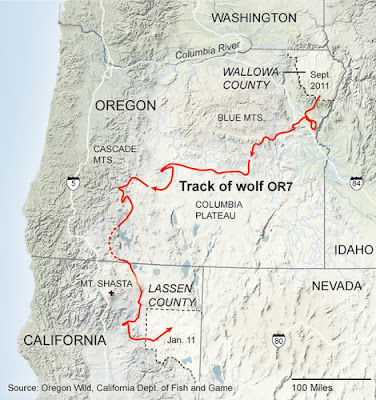
The wolf, known to biologists as OR7, owes his fame to the GPS collar around his neck, which has allowed scientists and fans alike to use maps to follow his 1,000-mile, lovelorn trek south from his birthplace in northeastern Oregon.


Along the way, OR7 has accrued an almost cultlike status.


“People are going to get wolf tattoos, wolf sweaters, wolf key chains, wolf hats,” said Patrick Valentino, a board member with the California Wolf Center, a nonprofit advocacy and education organization.


In Oregon, students participated in art contests to draw OR7’s likeness and a competition to rename him (the winner: “Journey”). This month, people across the country attended full-moon, candlelight wolf vigils organized by groups with names like Howl Across America and Wolf Warriors.


John Stephenson, a biologist, measured the stride of the gray wolf known as OR7 in Crater Lake National Forest, Ore., in December.


As with seemingly all wayward and famous animals these days, the wolf has a lively virtual existence on social networking sites like Twitter, where at least two Twitter accounts have been posting from the wolf’s perspective.


“Left family to find wife & new home. eHarmony just wasn’t working for me,” read one Twitter profile. Another account, which describes the wolf’s hobbies as “wandering, ungulates,” recently had in a post: “Why is everyone so worried about my love life?”


The wolf’s presence has also set off more practical responses from state wildlife officials, who are hustling to prepare for what they now see as the inevitability of wild gray wolves here.


In mid-January, the California Department of Fish and Game put up a gray wolf Web site that includes a map of OR7’s trek and a 36-page explainer on the species. The department has already begun a series of public meetings with local governments in the state’s northern counties, where wolves are most likely to take up residence first.


Biologists say that OR7 is unlikely to survive long hunting alone without a pack and that it could be as many as 10 years before wild wolf packs roam northern California. Still, state and federal wildlife officials met Friday to discuss a strategy for wolves.


Next month, state biologists will get training by the Agriculture Department to identify livestock killed by wolves.


Once widespread across much of the country, gray wolves were nearly extinct in the contiguous United States by the early 20th century, killed by government trappers, ranchers and hunters. In 1974, the gray wolf was listed as endangered under the newly established Endangered Species Act. Then in 1995 and 1996 wildlife officials released 66 Canadian wolves into Yellowstone National Park and central Idaho, an area that is now home to nearly 1,700 wolves.


Wolves have been remarkably successful in reinhabiting their old terrain. In recent years regulators removed wolves from the endangered list for much of the northern Rocky Mountains and Great Lakes regions. In Idaho and Montana, they can be legally hunted.


In California, gray wolves remain protected under federal law, and the recent appearance of one has flared up large predator agita among ranchers.


“I’m afraid somebody will step up and take this wolf’s life in their own hands,” said Darrell Wood, a cattle rancher. “There are huge state and federal penalties for killing a wolf.”


Mr. Wood’s family has been raising cattle in Lassen County — where OR7 is now and where the state’s last wolf was shot in 1924 — for six generations. “I just hope it wasn’t a relative of mine who shot him,” said Mr. Wood, 56.


Other area residents seemed more interested in the wolf’s place in the mythological pantheon. “What’s next, sparkly vampires?” asked a commenter on a Lassen County Times article about the wolf, an apparent reference to “Twilight,” the vampire and werewolf series.


Ardent wolf fandom and ire do not surprise Ed Bangs, the federal Fish and Wildlife Service’s recently retired wolf recovery coordinator. “When wolves come back, one side says it’s the end of civilization, our children will be dragged down at the bus stop,” he said. “The other side thinks nature is finally back in balance and can we all have a group hug now.”


California will see the same divisions, said Mr. Bangs, who in his 30 years in gray wolf management attended hundreds of contentious meetings with residents, ranchers and environmentalists.


“I like to say wolves are boring,” he said, “but people are fascinating.”


Photographes:

Richard Cockle/The Oregonian, via Associated Press
Allen Daniels/The Medford Mail Tribune

Labels

2008 (1) Absence of citizen online privacy protection by U S government (1) achievements of women (1) Africa human rights (1) africa political violence (1) African Muslims want peace (1) African politics (1) African refugee assisting homeland (1) African violence and corruption (1) African-American art (1) agriculture biotechnology industry (1) alQaida in Africa (1) American economic system (1) American education (1) American labor movement (2) American prison system (1) American racism (1) animals (1) Animals and humans (3) anti-American Middle Eastern cyber hijackers (1) apartheid 20 years gone (1) Arnold (1) Art by artists of African descent both continental (1) Atlanta (1) Avatar (1) Barack Obama (2) BeeSweet Lemonade (1) beneficial presence in the world (1) Bill Clinton (1) biogenetics (1) birthday (1) Black male role models (1) Black men unjustly incarcerated (1) Black people worldwide (1) busting American myths (1) buyer beware (1) Caribbean Literature Book Club 2010 reading list (1) champions (1) change for america world (1) charity (1) charter schools (2) China (1) classy artists (1) Congo (1) Consumer Rights (1) consumerism (1) Cornel West (1) Cosmos (1) coups in Africa (1) creativity built from our culture (1) credit game (1) Crenshaw community (1) cyberspace brought into wars (1) Dark Matter (1) David Bowie (1) Dedan Gills (1) delusions of the American masse (1) democracy in the world (1) destroying myths that no longer serve the good (1) Dialogue in America (1) diaspora (1) Disgust; Being our true selves (1) distribution of wealth (1) donating (1) earthworms (1) ecologically smart cars; green lifestyle (1) ecology (1) economic meltdown (1) economics (1) Edge intellectuals (1) Education in America (1) Egypt (1) elevating consciousness of American people (1) endangered Mountain Gorillas (1) European internet privacy (1) Excellent athletes (1) expanding consciousness (1) fear and greed of white people (1) female corporate/ multinational CEOs (1) first blog of the year (1) freedom of the press (1) French and Mali troops roust al-Qaida Islamist invaders (1) G-20 (1) gardeners (1) giving (1) global immigration issues; Israel (1) golf (1) Good works in Africa by her children in the diaspora (1) gospel music (1) Gratitude (1) Groups doing great work (1) Haitian Earthquake relief effort (2) helping others globally (1) History of issue of race in America (1) Homophobia (1) Human omniaction (1) ignorance (1) imperialism (1) indigenious people (1) influencing purchasing trends with priming (1) Iraqi drones compromised (1) Islam (1) Islamic extremests in African; Timbuktu (2) jokes (1) Kenya bloggers (1) latest scientific discoveries (1) law (1) Los Angeles life; architecture; African-Americans in Los Angeles (2) lost world cultures (1) Love (1) Malcolm X Civil Rights Leader (1) Mali (3) Mali 2013 (1) manipulating the food of the world (1) manuscripts of Africa's past (1) men of integrity (1) men standing strong (1) Mikhail Khodorkovsky (1) military power in Afrcia (1) military power in Africa (1) Monsanto (1) MTV (1) Mugabe (2) my travels (1) Natalie Cole (1) National Parks (1) Native Americans (1) Nature at It's Best File (3) Nelson Mandela (1) Neuromelanin (1) New Yorker Magazine (1) Nigerian terrorist (1) Nobel Peace Prize winners (1) Obama as a balm (1) Obama diplomacy (1) Obama foreign diplomacy (1) Obama in Europe (1) Obama nobel prize winner (1) Obama policies regarding average citizens (1) Obama's ability to control and steer his administration (1) Octavvia E. Butler (1) order (1) organic (1) outstanding Black authors (1) Pan-African authors (1) personal fulfillment (1) Pharonic sacred science (1) photography - wildlife (1) Plant sentience (1) policies that endanger animal welfare (2) politics (1) positive life lessons (1) post-neocolonialism in Africa (1) poverty field studies in India (1) prejudice (1) priming (1) professionals (1) public protest of economic policies (1) race (1) race and housing (2) race in America (1) Racism in Hollywood (1) religious bigotry (1) right wing christians (1) right-wing fundamentalism (1) Russia (1) Russian politics (1) Sarah Palin's politics (1) Science - intelligent creative bacteria (1) scientific ignorance perpetuated in 2012 (1) sibling rivalry (1) Snoop Dogg (2) soil science (1) Somalia (1) South Africa labor problems (1) South side Chicago (1) Spring poetry (1) Stanford University (1) successful women (1) Sudan (2) technology (1) tennis (2) Thanksgiving Day (1) The Bigs/multinational corporations (1) the failure of No Child Left Behind (1) the wealthy (1) things that make you go 'hhmmm' (1) Tiger Woods (1) Timbuktu libraries (1) time (1) Toni Morrison (1) true meaning of dogsledding. (1) Tuskegee Airmen (1) Twitter hijacked (1) U S History (1) vegan (1) vegetarianism (1) Virunga Park (1) ways to help Africa (1) weak results re: campaign promises (1) wealth in America (1) wholesome food sources (2) wildlife and their habitats (1) Williams sisters (2) Wimbledon (1) wolves (1) women leaders (1) world economy (1) writing (1) Written & published March 21 (1) Xmas 2009 (1) yahoo (1) young Black entrepreneurs (1) Zimbabwe election (1)